Key Points
- Instant Liquidity Deployment: Transitioning to programmable revenue rails utilizing RTP and FedNow eliminates the traditional liquidity lag, providing creators with sub-second capital access.
- AI-Driven Revenue Operations: Leveraging artificial intelligence as core business infrastructure enables autonomous ad rate negotiation, dynamic subscription pricing, and seamless multi-party smart contract payouts.
- Cross-Platform Interoperability: Architecting decentralized subscription ecosystems allows creators to bypass restrictive platform taxes, own first-party data, and prepare for autonomous agentic commerce.
Table of Contents
The Financial Tech Friction
Data from Goldman Sachs Research reveals that U.S. ad spend on independent content creators is set to surge to $43.9 billion in 2026. This marks a massive 26% year-over-year increase as brands aggressively bypass traditional media to prioritize direct-to-consumer engagement. The creator economy is no longer a fringe market, but rather a macroeconomic powerhouse demanding institutional-grade financial rails.
However, the legacy systems powering these digital entrepreneurs remain fundamentally broken. Traditional advertising revenue models force creators into a frustrating 30 to 60-day waiting period for their payouts. This systemic friction chokes cash flow and severely stifles rapid reinvestment into high-quality content production.
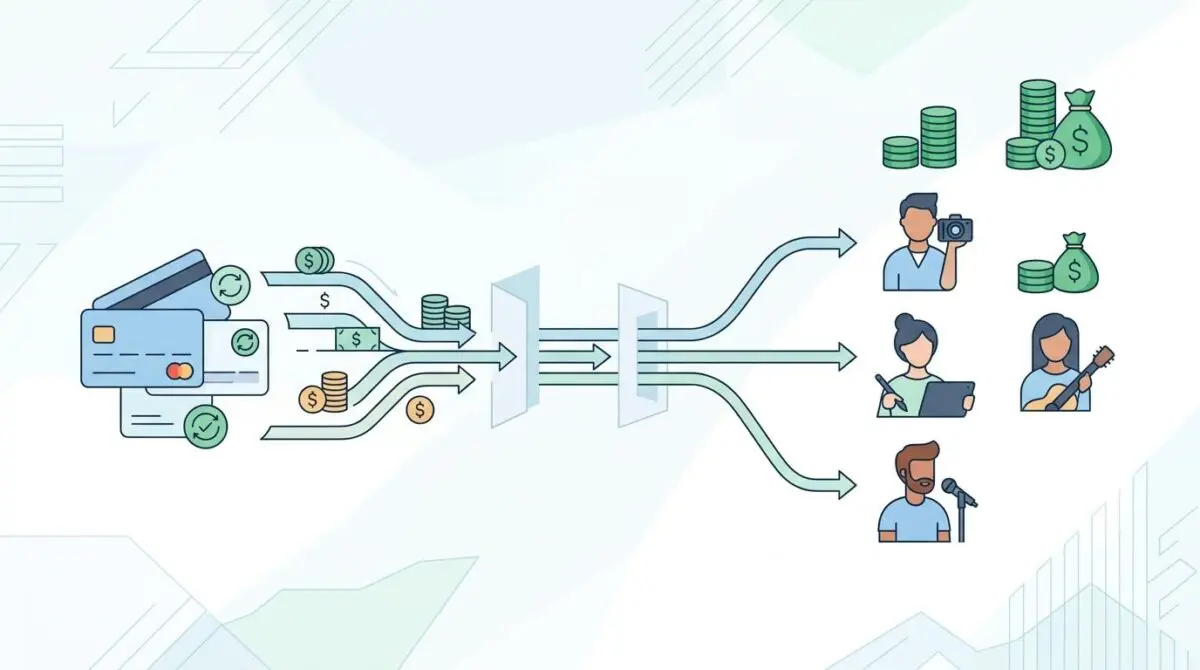
The definitive solution is the deployment of creator-centric programmable monetization infrastructure. This technology transforms passive payment gateways into autonomous, intelligent financial engines. By leveraging Real-Time Payments (RTP) and FedNow, this infrastructure guarantees instant liquidity and fundamentally rewrites the rules of digital wealth generation.
Overcoming Liquidity Lag
The primary hurdle in the modern digital economy is widely recognized as liquidity lag. Creators consistently generate massive engagement metrics but are starved of the immediate capital needed to scale their operations. Legacy banking infrastructure simply cannot keep pace with the sheer velocity of viral content.
Programmable revenue rails eliminate this bottleneck entirely by offering sub-second settlement for global transactions. This technological shift allows creators to bypass platform dependency and the notorious app store tax. Consequently, digital entrepreneurs can now launch private banking ecosystems and credit lines fueled by verified social engagement data.
Market Intelligence and Capital Flow
The financial metrics surrounding digital entrepreneurship are shifting at an unprecedented velocity. Institutional capital is aggressively hunting for scalable infrastructure plays within the broader creator ecosystem. We are currently witnessing a historic wealth transfer from legacy media conglomerates to agile, tech-enabled individuals.
Market Intelligence & Data
Current Market Valuation
Behind the Scenes reports the global creator economy valuation has reached $234.65 billion in 2026, fueled by user-generated content finally surpassing traditional media in total advertising revenue.
Real-Time Payout Volume
The Clearing House recorded a 405% increase in transaction value on the RTP network through early 2026, as creators shift toward instant liquidity over traditional delayed payout cycles.
Subscription Dominance
According to 2026 survey data from Circle, 88% of professional creators now prioritize paid memberships as their primary revenue foundation to mitigate the volatility of platform-dependent ad shares.
Disruptor Peak Value
New Market Pitch reports that live-commerce platform Whatnot reached a valuation of $11.5 billion in late 2025, underscoring the massive capital flow into transactional creator infrastructure.
This data clearly illustrates exactly where the smart money is flowing. Institutional venture firms are pivoting toward human equity platforms, deliberately treating individual creators as high-growth startups. Forward-thinking firms are pioneering advanced models that provide upfront capital in exchange for future programmable earnings.
We are seeing massive valuations for platforms that successfully execute these new transactional models at scale. For example, Whatnot reached a valuation of $11.5 billion in late 2025, dominating the highly lucrative live-commerce sector. This underscores the immense market appetite for robust infrastructure that facilitates instant, frictionless creator-to-fan transactions.
The FinTech Deep Dive
The technological backbone of the modern creator economy relies heavily on artificial intelligence and decentralized networks. We are moving far beyond simple content generation algorithms into the sophisticated realm of revenue operations AI. These dynamic systems autonomously negotiate ad rates and optimize subscription tiers based on real-time churn telemetry.
Recent industry surveys indicate that a vast majority of creators have transitioned from using AI as a creative novelty to utilizing it as core business infrastructure. This includes tasks such as automated revenue forecasting and multi-platform IP repurposing. This rapid adoption proves that artificial intelligence is now the foundational layer of digital monetization, rather than just an experimental tool.
Smart Contracts and AI Co-Pilots
Multi-party revenue splits have historically been an absolute accounting nightmare for digital collaborations. Today, smart contracts deployed on Layer-2 blockchain networks seamlessly handle these complex distributions autonomously. When a digital asset generates revenue, the underlying code instantly routes the exact predefined percentages to every collaborator’s wallet.
This unprecedented level of automation transforms FinTech platforms into intelligent financial co-pilots. Creators are no longer burdened by manual invoicing, payment reconciliation, or delayed royalty statements. The infrastructure actively works in the background to maximize yield and ensure immediate, frictionless access to earned capital.
Decentralized Subscription Rails
The traditional subscription model is highly fragmented, forcing fans to manage separate payments across dozens of isolated applications. The smart money from top-tier venture capital is actively funding verticalized AI infrastructure to solve this massive fragmentation problem. These advanced tools enable creators to own their first-party data and completely bypass restrictive, platform-specific algorithms.
Unified marketplaces for digital products are capturing massive market share by offering these decentralized rails directly to users. A prime example of this explosive growth is Whop’s recent $1.6 billion valuation, which highlights the intense demand for consolidated creator storefronts. By centralizing the transaction layer, creators can offer seamless, highly portable digital credentials to their global audiences.
From a regulatory standpoint, these decentralized rails must carefully navigate complex global KYC and AML frameworks. However, modern embedded finance tools utilize automated compliance APIs to ensure frictionless user onboarding without ever sacrificing transaction speed or security.
The Strategic Action Plan
For FinTech founders and institutional investors, the mandate for the next decade is incredibly clear. Building the next generation of digital finance requires a relentless focus on cross-platform interoperability and instant liquidity. The platforms that ultimately win will be those that seamlessly integrate AI-driven micro-transactions into the everyday consumer experience.
Strategic Trajectory
- Architect infrastructure for ‘Cross-Platform Subscription Interoperability’ to unify creator footprints.
- Leverage single, portable digital credentials to enable seamless fan access across diverse app ecosystems.
- Deploy AI-curated bundles that consolidate multi-platform content into unified consumer subscriptions.
- Prepare for the transition to ‘Agentic Commerce’ where AI agents manage fan transactions autonomously.
- Implement micro-payout frameworks for granular pay-per-view sessions and digital asset interactions.
- Transform every second of engagement into a potential transaction point via automated financial rails.
The next 24 months will be entirely defined by cross-platform subscription interoperability. AI-curated bundles will soon allow fans to subscribe to a creator’s entire digital footprint with a single, unified payment. This consolidated approach drastically reduces subscriber churn and maximizes lifetime customer value.
Furthermore, the industry is rapidly accelerating toward the reality of agentic commerce. In this near-future state, AI agents acting on behalf of fans will autonomously manage micro-payouts for exclusive pay-per-view sessions. Every second of content consumption will effectively become an invisible, frictionless transaction point powered by smart contracts.
Conclusion
The financial architecture of the digital economy is undergoing a profound and entirely irreversible transformation. Creator-centric programmable monetization infrastructure is not just a technological upgrade; it is a fundamental paradigm shift in how human capital is valued and compensated. By eliminating liquidity lag and deploying autonomous revenue rails, we are unlocking unprecedented global economic potential.
As artificial intelligence merges seamlessly with real-time payment networks, the traditional barriers between content creation and financial settlement will completely dissolve. The future undoubtedly belongs to those who build the intelligent, decentralized systems that empower this new class of digital entrepreneurs.
Navigating the intersection of financial technology, institutional capital, and market psychology requires a sharp strategy. To future-proof your FinTech architecture and scale with precision, connect with Andres at Andres SEO Expert.
Frequently Asked Questions
What is creator-centric programmable monetization infrastructure?
Creator-centric programmable monetization infrastructure refers to advanced financial technology that converts passive payment gateways into autonomous, intelligent engines. By utilizing Real-Time Payments (RTP) and FedNow, this system ensures instant liquidity and eliminates the 30 to 60-day payout delays typical of legacy advertising revenue models.
How does liquidity lag impact the creator economy?
Liquidity lag is a systemic friction where digital entrepreneurs generate massive engagement but must wait weeks or months for revenue settlement. This delay chokes cash flow and prevents creators from rapidly reinvesting in their production. Programmable revenue rails solve this by offering sub-second settlement for global transactions.
How do smart contracts automate revenue splits for creators?
Smart contracts on Layer-2 blockchain networks handle multi-party revenue splits autonomously. When a digital asset generates income, the underlying code instantly routes predefined percentages to every collaborator’s digital wallet, removing the need for manual invoicing or payment reconciliation.
What is the projected market valuation of the creator economy by 2026?
The global creator economy is projected to reach a valuation of approximately $234.7 billion by 2026. Additionally, U.S. ad spend on independent creators is set to surge to $43.9 billion as brands shift budgets from traditional media toward direct-to-consumer digital engagement.
How are creators using AI for financial business infrastructure?
Beyond creative content, 86% of creators use AI for core Revenue Operations, such as automated forecasting, real-time churn telemetry, and negotiating ad rates. This transition moves AI from a creative novelty to a foundational layer for managing complex digital monetization ecosystems.
What are decentralized subscription rails and interoperability?
Decentralized subscription rails allow creators to own first-party data and offer portable digital credentials. Cross-platform interoperability enables fans to subscribe to a creator’s entire multi-platform digital footprint with a single, unified payment, which reduces churn and increases long-term customer value.