Key Points
- The Rise of Agentic AI: Organizations are shifting toward Prescriptive Agentic AI, empowering systems to autonomously plan repairs, source parts, and simulate fixes in a digital twin before human deployment.
- Capitalizing on Edge AI: With 50% of factory data now processed locally, Edge AI and multimodal telemetry allow facilities to detect micro-anomalies in acoustic and thermal signatures with zero latency.
- Bridging the Expertise Deficit: AI acts as an infinite senior technician, codifying decades of tribal knowledge and delivering real-time AR guidance to mitigate the devastating financial bleed of unplanned downtime.
Table of Contents
The Trillion-Dollar Friction
According to the Siemens True Cost of Downtime 2024 report, Fortune Global 500 companies lose an estimated $1.4 trillion annually to unplanned equipment downtime. This represents a staggering 11% of their total revenues as of the current market cycle. For decades, manufacturing facilities have treated this capital bleed as an unavoidable cost of doing business.
That era of complacency is officially over. The global industrial sector is undergoing a massive paradigm shift fueled by AI-Driven Predictive Maintenance (PdM) 4.0. We are no longer talking about simple anomaly detection where a dashboard flashes red after a critical motor has already started failing.
Today, the market demands proactive, autonomous remediation. AI-Driven Predictive Maintenance (PdM) 4.0 represents the convergence of high-fidelity digital twins, multimodal machine learning, and decentralized edge computing. It is a fundamental rewiring of how industrial infrastructure operates, turning static assembly lines into living, self-healing ecosystems.
Market Intelligence & Smart Capital
Market Intelligence & Data
2026 Market Valuation
The global predictive maintenance market size is projected to reach this value in 2026, driven by a 24.3% CAGR, according to Fortune Business Insights.
Downtime Reduction
Manufacturers implementing AI-driven predictive maintenance consistently achieve these percentage reductions in unplanned downtime, as reported by Oxmaint in 2026.
Automotive Failure Cost
The hourly cost of unplanned downtime in the automotive sector has climbed to this record high, according to the Siemens 2024 True Cost of Downtime report.
Average AI ROI
Industrial organizations utilizing AI for predictive maintenance report this return on investment within 18 months of deployment, according to data from iFactory AI.
The numbers dictate a clear, undeniable narrative for the future of industrial manufacturing. The explosive growth projected, according to Fortune Business Insights, is not just a passing technology trend. It is a massive reallocation of global industrial wealth.
Smart capital is aggressively abandoning legacy maintenance protocols in favor of autonomous systems. Investors recognize that the competitive advantage of the next decade will not be defined by cheaper labor or faster supply chains. It will be defined by absolute, unbreakable operational uptime.
The Venture Capital Flood
Market dominance is currently a brutal battleground between established titans and agile innovators. Legacy industrial giants like Siemens and Schneider Electric are rapidly integrating industrial copilots to defend their historical market share. Meanwhile, disruptive startups like Arch Systems and Infinite Uptime are capturing massive institutional interest.
Venture capital is aggressively flooding the sector to capitalize on this friction. AI startups captured an astonishing 80% of the record-breaking $300 billion in global venture funding in the first quarter of 2026. This capital is specifically flowing into platforms that completely remove the need for human oversight.
Major tech players are not sitting on the sidelines watching this industrial evolution. Microsoft has committed $17.5 billion toward specialized AI infrastructure to support real-time industrial processing. The financial consensus is clear: the factory floor is the next great frontier for artificial intelligence.
The Strategic Deep Dive
To understand the sheer scale of this disruption, executives must look beyond the algorithms and examine the underlying market psychology. The primary friction point in 2026 remains the severe expertise deficit caused by a rapidly retiring workforce. Decades of invaluable tribal knowledge are walking out the door, leaving critical infrastructure highly vulnerable.
The financial penalty for this knowledge gap is catastrophic for modern enterprises. Unplanned downtime now averages $260,000 per hour across all sectors. In hyper-specialized fields, the bleeding is even worse, as heavily detailed in the Siemens True Cost of Downtime 2024 report.
Data from the PagerDuty 2026 State of AI-First Operations Report reveals that 68% of global organizations now lose more than $1 million per hour during production outages, driving a mandatory shift toward ‘Agentic AI’ that can autonomously plan and execute multi-step resolutions without waiting for human approval. The market simply cannot afford human latency when millions of dollars are evaporating by the minute.
Solving the Expertise Deficit
AI solves this critical workforce bottleneck by serving as an infinite senior technician. These advanced systems codify tribal knowledge from decades of maintenance logs into a seamless natural language interface. The technology effectively bridges the 24% expertise gap that previously hindered advanced maintenance programs.
Technicians now operate with augmented intelligence directly on the factory floor. Using AR-enabled glasses, workers receive real-time, AI-generated instructions overlaid onto physical machinery. This empowers junior staff to execute highly complex repairs with the precision and confidence of a thirty-year veteran.
The psychological impact on the workforce is profound. Instead of operating in a state of constant reactive panic, maintenance teams transition into proactive strategists. The AI handles the cognitive heavy lifting, allowing humans to focus on physical execution and high-level systems optimization.
Edge AI and Multimodal Telemetry
The technical architecture of AI-Driven Predictive Maintenance (PdM) 4.0 relies heavily on decentralized, localized processing. We are witnessing the rapid rise of Edge AI, where 50% of factory data is now processed entirely on-site. This eliminates cloud latency, which is absolutely critical for high-speed production lines.
Multimodal models are the true engine of this industrial revolution. These systems ingest real-time thermal video, acoustic frequency signatures, and electrical current telemetry simultaneously. This allows the AI to literally hear and feel machine degradation weeks before physical indicators emerge.
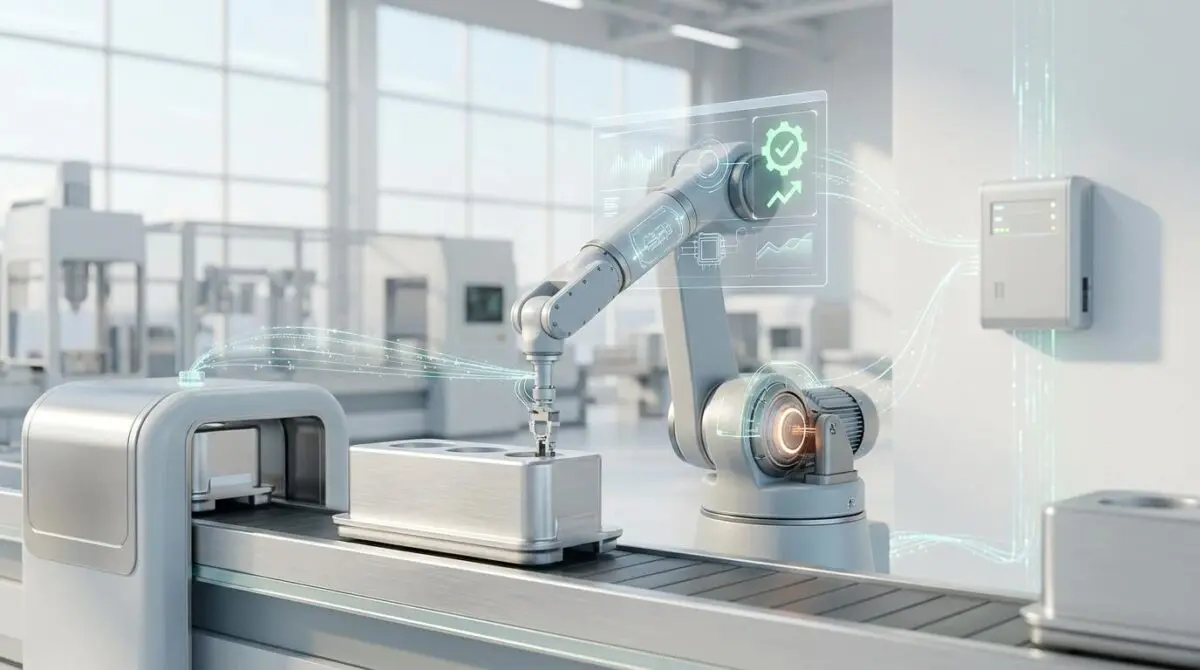
Once a micro-anomaly is detected, prescriptive agentic AI takes over the process entirely. It autonomously generates repair strategies, cross-references global inventory for spare parts, and simulates the entire repair in a high-fidelity digital twin. All of this critical planning happens before a human technician is even dispatched.
The Executive Action Plan
For C-level executives, the transition to AI-driven industrial operations is an existential mandate. Those who hesitate will find their profit margins consumed by the relentless cost of unplanned equipment failures. Survival requires immediate, decisive action to modernize infrastructure.
Strategic Trajectory
- Transition toward ‘Prescriptive Autonomy’ and ‘Dark Factory’ operations to minimize manual intervention.
- Implement closed-loop systems enabling AI agents to autonomously coordinate with robotic maintenance units.
- Evolution of failure management into autonomous remediation cycles without human oversight by 2027-2028.
- Adopt ‘Circular Asset Management’ to optimize part replacement cycles for maximum material recyclability.
- Align industrial uptime and maintenance schedules with aggressive corporate ESG mandates and sustainability goals.
Executing this roadmap requires a fundamental shift in enterprise architecture and corporate mindset. Leaders must stop viewing maintenance as a necessary cost center. They must start treating it as a dynamic, AI-managed asset that actively protects revenue streams.
Prescriptive Autonomy & Dark Factories
The next major evolution in manufacturing is the realization of prescriptive autonomy and dark factory operations. By 2027 to 2028, we are moving toward closed-loop systems where human intervention is the exception, not the rule. AI agents will predict failures and autonomously coordinate with robotic maintenance units to perform physical repairs.
Furthermore, this technology is driving the global shift toward circular asset management. AI now optimizes the exact moment for part replacement to maximize material recyclability. This perfectly aligns industrial uptime strategies with aggressive corporate ESG mandates.
The integration of sustainability and profitability is no longer a paradox. By preventing catastrophic machinery failures, facilities drastically reduce energy waste and material scrap. AI-Driven Predictive Maintenance (PdM) 4.0 is the ultimate tool for achieving both financial dominance and ecological compliance.
Conclusion
The era of reactive maintenance is completely dead. AI-Driven Predictive Maintenance (PdM) 4.0 has transformed the factory floor into a highly intelligent, self-optimizing financial asset. Organizations that fail to adopt prescriptive agentic AI will simply bleed capital until they are priced out of the market entirely.
Those who embrace multimodal telemetry, edge computing, and autonomous remediation will capture unprecedented market share. The future belongs to the dark factory, where machines heal themselves and human capital is reserved for high-level strategic innovation.
Navigating the intersection of technology, capital, and market psychology requires a sharp strategy. To future-proof your business architecture and scale with precision, connect with Andres at Andres SEO Expert.
Frequently Asked Questions
What is the total cost of unplanned downtime for Global 500 companies?
According to the Siemens True Cost of Downtime 2024 report, Fortune Global 500 companies lose an estimated $1.4 trillion annually to unplanned equipment downtime, representing 11% of their total revenues. In specific sectors like automotive, the hourly cost of failure has reached a record high of $2.3 million.
How does AI-Driven Predictive Maintenance (PdM) 4.0 improve manufacturing efficiency?
PdM 4.0 moves beyond simple anomaly detection toward proactive, autonomous remediation. By integrating high-fidelity digital twins and multimodal machine learning, manufacturers can achieve a 30% to 50% reduction in unplanned downtime and an average ROI of 10:1 to 30:1 within 18 months.
What is the significance of ‘Agentic AI’ in industrial operations?
Agentic AI represents a shift toward autonomous systems that can plan and execute multi-step resolutions without human approval. This is critical for modern enterprises where production outages can cost over $1 million per hour, necessitating systems that eliminate human latency during critical failures.
How does AI solve the expertise gap in the industrial workforce?
AI bridges the 24% expertise gap by codifying tribal knowledge from legacy maintenance logs into natural language interfaces. Using AR-enabled glasses, junior technicians receive real-time, AI-generated instructions, allowing them to perform complex repairs with the precision of senior veterans.
Why is Edge AI critical for predictive maintenance 4.0?
Edge AI allows 50% of factory data to be processed on-site, eliminating cloud latency which is vital for high-speed production. It utilizes multimodal telemetry—including thermal video, acoustic signatures, and electrical current—to detect micro-anomalies weeks before physical failure occurs.
What are ‘Dark Factories’ and when will they become industry standard?
Dark Factories are manufacturing environments optimized for prescriptive autonomy where human intervention is the exception. Driven by closed-loop AI systems and robotic maintenance units, this evolution toward fully autonomous failure management is expected to materialize at scale between 2027 and 2028.