Key Takeaways
- NVLink 6 binds 72 Rubin GPUs into one natively lossless scale-up domain using lightweight FEC, Physical Layer Retry, and UPHY recovery instead of heavy Ethernet FEC.
- Credit-based flow control and the NMX Controller’s ‘contain and drain’ state isolate degraded links in about 1.5 seconds, while Shadow Engine Recovery restores inference in 7.3 seconds versus 283 seconds for a cold restart.
- NVLink Fusion pushes that fault-tolerance stack into custom silicon, with MediaTek adopting the platform and AWS extending it to future Trainium chips.
Table of Contents
When a Lost Packet Becomes a Revenue Leak
Today, NVIDIA published an architecture deep-dive explaining how NVLink 6 connects 72 Rubin GPUs into a single natively lossless scale-up domain inside the Vera Rubin NVL72 platform.
For AI factory operators, that property is a direct revenue safeguard for training and inference workloads that cannot tolerate a single dropped packet.
The design combines lightweight FEC, Physical Layer Retry, UPHY recovery, credit-based flow control, NMX High Availability, Shadow Engine Recovery, CUDA checkpointing, and NVLink Fusion into one fault-tolerance stack.
The Escape Route from Cold Restarts and Ethernet PFC Storms
According to NVIDIA Technical Blog, the multi-layer architecture operates from silicon signal correction up to application-level process restitution.
- Physical layer: lightweight FEC, PLR, and UPHY recovery correct or replay errors at the silicon level.
- Link layer: credit-based flow control prevents packet drops, while link managers rebalance degraded paths.
- Software layer: Shadow Engine Recovery and CUDA checkpointing restore failed inference workers without cold restarts.
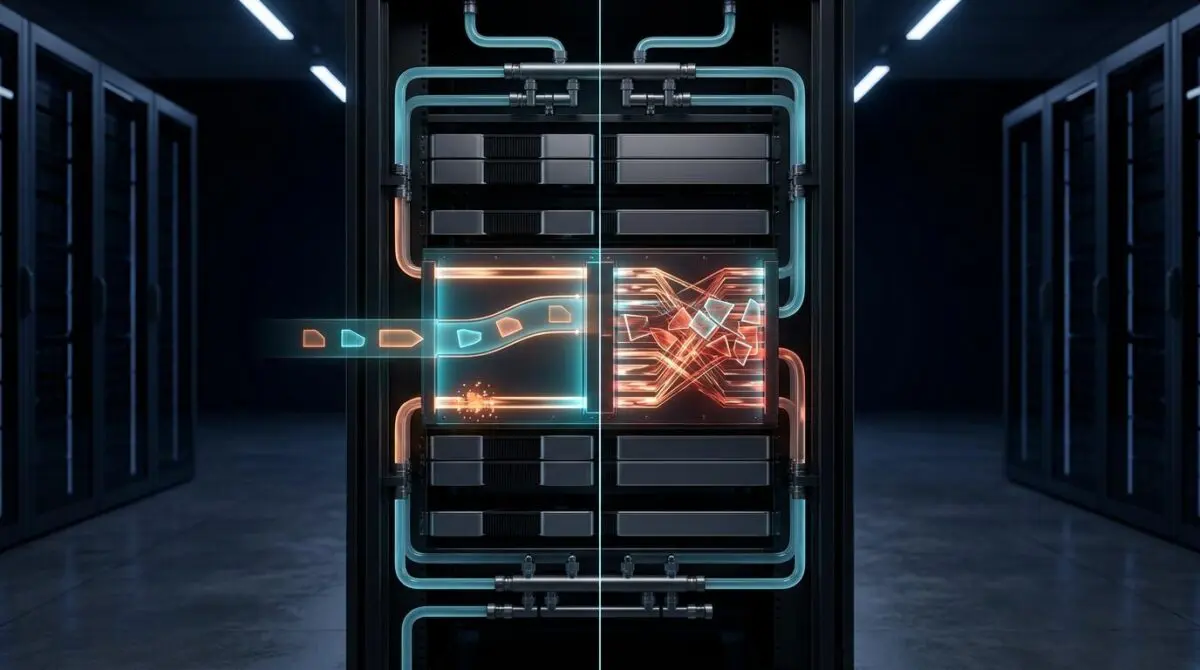
At the physical layer, NVLink 6 does not rely on the heavy FEC blocks common in general-purpose Ethernet networks.
It couples a lightweight FEC engine with Physical Layer Retry so single and multi-bit errors are corrected inline at a near-zero latency penalty, while larger bursts retransmit without involving higher software stacks.
If a link still fails, UPHY recovery recalibrates physical parameters while packets wait in a hardware replay buffer.
This physical-layer design is a core reason NVIDIA cites 3X lower end-to-end latency and 10X higher packet rates than generic Ethernet alternatives.
Above the wire, credit-based flow control removes loss by refusing to inject a packet unless the next hop has buffer credits available.
That stands in contrast to Ethernet PFC and ECN, which bolt losslessness onto a protocol that was never designed for it and can produce PFC storms and head-of-line blocking.
When physical links degrade, the Link Manager autonomously heals the fabric by rebalancing access and trunk links.
At the application layer, the NMX Controller uses a ‘contain and drain’ state to isolate degraded links in roughly 1.5 seconds.
NMX High Availability migrates the control function to another switch tray within seconds if the primary host fails, and the data plane continues forwarding even during a management CPU reset.
For inference engines that do suffer a severe NVLink interruption, Shadow Engine Recovery keeps a fully initialized idle replica process with healthy NCCL and NIXL communicators.
On B200 GPUs, that pre-warmed replica restores inference capacity in 7.3 seconds instead of 283 seconds for a cold restart.
CUDA checkpointing with CRIU adds process-level restore, and prototype NCCL support for cuda-checkpoint is expected to reach general availability by the end of the year.
At the system layer, Switch Admin State allows a single NVSwitch tray to be replaced without draining the entire NVLink domain.
The NMX Controller also discovers whatever compute or switch trays are physically present, which keeps partially populated racks operational during staged deployments.
NVLink Fusion Is Pulling the Resilience Stack into Custom Silicon
MediaTek Press Room confirmed on August 31, 2026 that MediaTek will adopt NVIDIA’s NVLink Fusion platform to give hyperscalers, cloud providers, and frontier model developers a prevalidated path for custom XPUs.
The collaboration includes a $3.5 billion NVIDIA investment in MediaTek convertible bonds and spans AI infrastructure, edge computing, and automotive compute.
Custom accelerators built through that path can inherit the same NVLink scale-up fabric and fault-tolerance mechanics through the NVLink Fusion Chiplet, NVLink-C2C for CPU connectivity, and NVHBM for custom memory.
NVIDIA Newsroom reported on August 26, 2026 that AWS and NVIDIA plan to deploy 2 million additional GPUs across AWS global infrastructure in 2027–2028.
The expansion includes Blackwell Ultra, Rubin, and Rubin Ultra products, and it extends NVLink Fusion with custom high-bandwidth memory so Annapurna Labs’ next-generation Trainium chips can access NVLink scale-up architecture.
A September 1 preprint on arXiv, which has not yet been peer-reviewed, evaluates existing NVL72 GB300-class hardware rather than NVLink 6 itself.
Across 2,400-GPU runs, those systems showed no meaningful slowdown under multi-tenant concurrency, while older DGX A100 deployments produced outliers up to 21x.
That gap reveals why deterministic lossless behavior has become a buying criterion for AI factories.
The architecture’s explicit contrast with Ethernet PFC and ECN is not a side note; it reframes resilience as a design-time property rather than a retrofit.
Operators comparing scale-up networks now face a clearer technical split between lossless-by-design and lossless-by-approximation.
AI Factory Uptime Is Now a Full-Stack Discipline
NVLink 6’s most consequential output is not a single recovery number; it is the removal of rare stall states that quietly throttle goodput across thousands of GPUs.
For AI factory owners, that shifts the evaluation lens from peak bandwidth to sustained availability under fault conditions.
For operators engineering AI factories that must survive hardware faults without stalling inference or training, programmatic SEO and AI automation is how Andres SEO Expert captures that same resilience-first authority in search — talk to the team.
Frequently Asked Questions
What is NVLink 6 and why does it matter for AI factories?
NVLink 6 is NVIDIA’s next-generation scale-up interconnect that links 72 Rubin GPUs into one natively lossless domain inside the Vera Rubin NVL72 platform. For AI factories, it matters because a single dropped packet can become a revenue leak by stalling training or inference.
How does NVLink 6 prevent packet loss across the physical and link layers?
At the physical layer, NVLink 6 uses lightweight FEC, Physical Layer Retry, and UPHY recovery to correct or replay errors at silicon speed. At the link layer, credit-based flow control refuses to inject a packet unless the next hop has buffer credits, eliminating drops without Ethernet PFC.
How is NVLink 6 different from Ethernet PFC and ECN for lossless networking?
Ethernet PFC and ECN add losslessness onto a protocol not originally designed for it, which can cause PFC storms and head-of-line blocking. NVLink 6 is lossless by design, with credit-based flow control and physical-layer retry, and NVIDIA cites 3X lower end-to-end latency and 10X higher packet rates than generic Ethernet alternatives.
What is Shadow Engine Recovery and how much downtime does it save?
Shadow Engine Recovery keeps a fully initialized idle replica process with healthy NCCL and NIXL communicators. On B200 GPUs, that pre-warmed replica restores inference capacity in 7.3 seconds instead of 283 seconds for a cold restart.
How does NMX High Availability and the Link Manager improve AI factory resilience?
The NMX Controller uses a contain and drain state to isolate degraded links in roughly 1.5 seconds. NMX High Availability migrates the control function to another switch tray within seconds if the primary host fails, while the data plane keeps forwarding during a management CPU reset.
What is NVLink Fusion and how does it extend resilience to custom XPUs?
NVLink Fusion is NVIDIA’s platform for custom accelerators to inherit the same NVLink scale-up fabric and fault-tolerance mechanics through the NVLink Fusion Chiplet, NVLink-C2C, and NVHBM. MediaTek and AWS are examples of partners adopting it for custom XPUs and Trainium chips.
Why is lossless-by-design scale-up networking a buying criterion for AI factories?
Rare stall states can quietly throttle goodput across thousands of GPUs, so operators now evaluate sustained availability under fault conditions rather than peak bandwidth alone. Research on NVL72 GB300-class systems showed no meaningful slowdown under multi-tenant concurrency, while older DGX A100 deployments produced outliers up to 21x.