Executive Summary
- Tray.io functions as a low-code iPaaS that facilitates complex API orchestration through a visual logic builder.
- The platform supports serverless scaling, allowing for high-concurrency data processing across disparate SaaS ecosystems.
- It enables advanced AI content operations by automating the ingestion, transformation, and distribution of large-scale JSON payloads.
What is Tray.io?
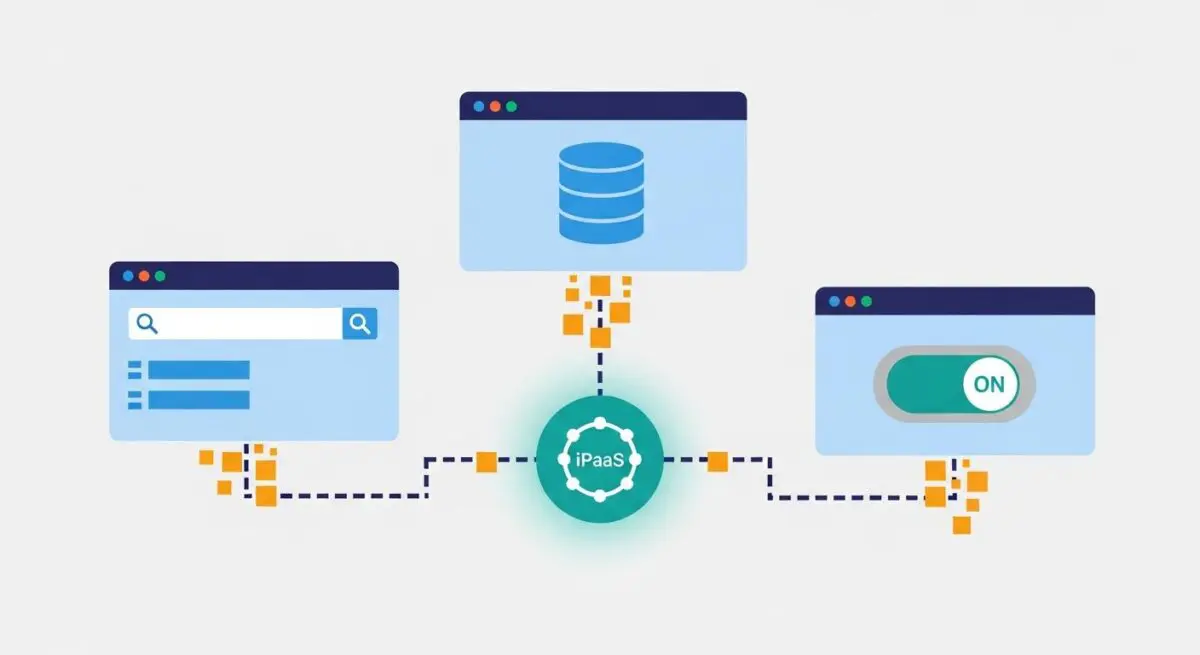
Tray.io is a sophisticated Integration Platform as a Service (iPaaS) designed to facilitate complex API orchestration and automated data movement between disparate software applications. Unlike basic automation tools, Tray.io provides a low-code environment that allows engineers and automation architects to build intricate logic, including loops, conditional branching, and data mapping, without the overhead of maintaining custom scripts on dedicated servers.
In the context of AI automations, Tray.io serves as the connective tissue that links data sources, large language models (LLMs), and distribution endpoints. It leverages a serverless architecture to handle high-concurrency workloads, making it an ideal solution for enterprise-grade programmatic SEO and autonomous content operations where data integrity and processing speed are paramount.
The Real-World Analogy
Imagine a massive international airport’s air traffic control system. The individual airplanes represent different SaaS applications (like Salesforce, Google Sheets, or OpenAI), each with its own schedule and destination. Tray.io is the control tower. It doesn’t fly the planes, but it ensures that every plane knows exactly when to land, which gate to go to, and what cargo to transfer to the next flight. Without the tower, the planes would operate in isolation; with Tray.io, they function as a synchronized, global transport network.
Why is Tray.io Critical for Autonomous Workflows and AI Content Ops?
Tray.io is essential for scaling autonomous workflows because it manages the stateless execution of complex data pipelines. For AI content operations, this means the platform can ingest raw data from a CRM, sanitize the JSON payload, send it to an LLM for processing, and then programmatically update a CMS—all while handling potential API rate limits and authentication refreshes automatically. Its ability to process data in parallel ensures that high-volume content generation tasks do not become bottlenecked by sequential processing limitations.
Best Practices & Implementation
- Modularize Workflows: Utilize “Callable Workflows” to create reusable logic blocks, reducing redundancy and simplifying the debugging process for complex architectures.
- Implement Robust Error Handling: Use Boolean logic and error-handling steps to manage API failures gracefully, ensuring that a single failed request does not terminate the entire automation sequence.
- Optimize Payload Mapping: Filter and transform JSON data at the source to minimize the size of payloads being transferred, which reduces latency and improves overall workflow performance.
- Monitor API Rate Limits: Configure delay steps or conditional logic to respect the rate limits of third-party services, preventing service disruptions and 429 error codes.
Common Mistakes to Avoid
One frequent error is the creation of “monolithic workflows,” where too many functions are crammed into a single visual map, making it nearly impossible to troubleshoot. Another common mistake is neglecting to secure sensitive data; users often fail to use Tray.io’s built-in environment variables or secret management tools, leading to hard-coded credentials within the workflow logic.
Conclusion
Tray.io provides the technical infrastructure necessary to orchestrate high-velocity, AI-driven data pipelines with enterprise-grade reliability and scalability.