Key Points
- Instant Workflow Adaptability: Replaces rigid, static plans with intelligent systems that reroute production around bottlenecks in real time.
- Predictive Maintenance Integration: Utilizes cognitive AI agents to ingest unstructured sensor data and prevent downtime before it occurs.
- Bridging Operational Silos: Leverages low-code edge apps to connect e-commerce orders directly to factory floor execution systems.
Table of Contents
The Costly Illusion of Static Manufacturing Plans
Picture this: your morning shift starts perfectly with a master schedule locked in, only for a critical CNC machine to unexpectedly drop offline twenty minutes later. Suddenly, that pristine production plan is completely worthless. Shop floor managers are forced into high-stress firefighting mode, scrambling to adjust workflows manually while downstream delays pile up.
This is known as the schedule-reality gap. It is a massive operational friction point where static production plans become obsolete within hours due to supply delays, rush orders, or unexpected breakdowns. Manufacturers routinely suffer an average 20-25% loss in throughput simply because their systems cannot adapt to live conditions fast enough.
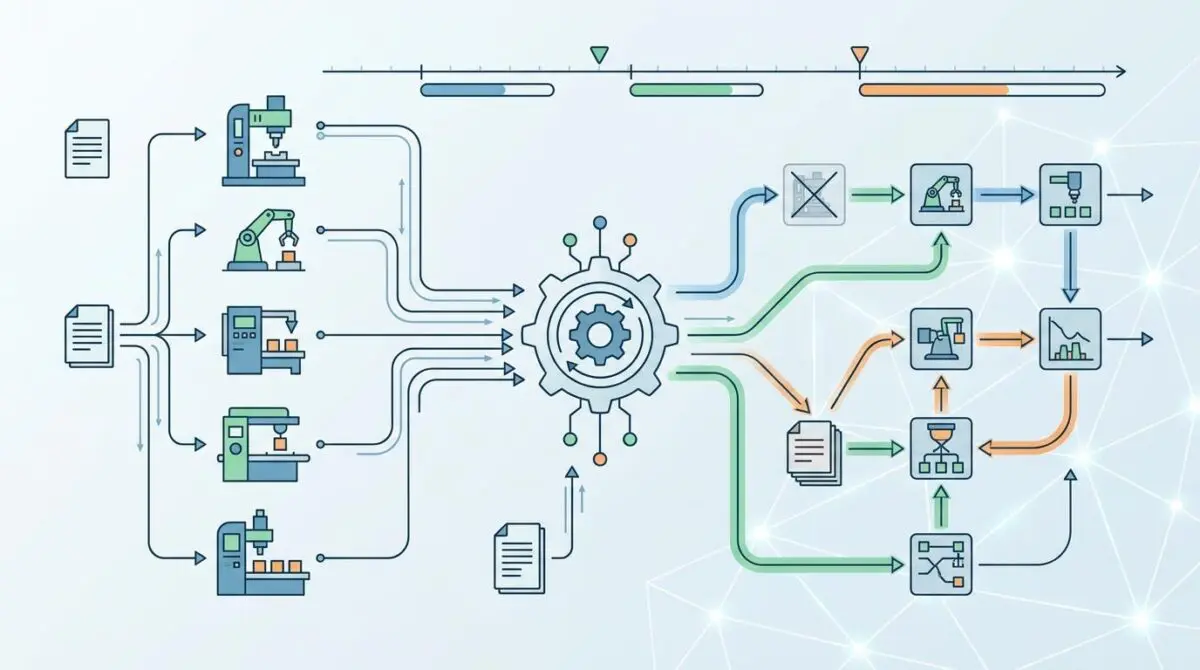
The ultimate solution to reclaiming this lost time is Real-time Dynamic Production Scheduling (DPS). Think of it as a highly intelligent GPS for your factory floor. Instead of rigidly following a printed map, DPS constantly ingests live data and automatically reroutes workflows to avoid bottlenecks before they happen.
The Financial Impact of Live Factory Telemetry
Market Intelligence & Data
Reduction in Production Cycle Time
Enterprises implementing AI-driven dynamic scheduling saw a 35% faster order-to-shipment time according to the Gartner 2025 Manufacturing Excellence Study.
Adoption of Real-Time Monitoring
A 2026 survey by Smart Industry found that 82% of Tier-1 manufacturers have now integrated live machine telemetry directly into their scheduling logic.
Industrial Automation Market Size
The global industrial automation market is projected to reach $1.4 trillion by the end of 2026, driven largely by software-defined production (Source: Fortune Business Insights 2026).
OEE Improvement
The World Economic Forum’s 2026 Lighthouse Network report indicates that dynamic rescheduling increases Overall Equipment Effectiveness (OEE) by an average of 22%.
Implementing AI-driven dynamic scheduling directly attacks production delays, yielding a massive 35% faster order-to-shipment time. When factory floors adapt instantly to changing conditions, idle time vanishes. Parts move seamlessly from one station to the next without waiting for manual schedule approvals.
This speed is made possible by the fact that 82% of Tier-1 manufacturers are now integrating live machine telemetry into their daily logic. This allows facilities to simulate thousands of potential production permutations in seconds, much like how NVIDIA’s Omniverse platform for digital twin simulation tests complex environments before physical hardware ever moves. The result is a highly proactive approach to factory management.
The financial ripple effect of this technology is staggering, accelerating the projected growth of the global industrial automation market to a massive $1.4 trillion by 2026. This growth is largely driven by software-defined production environments. Facilities are shifting from rigid hardware constraints to flexible, code-driven agility.
Ultimately, this dynamic rescheduling dramatically boosts Overall Equipment Effectiveness (OEE) by an average of 22%. Machines spend more time cutting, assembling, and processing rather than waiting for instructions. It turns reactive maintenance and scheduling into a seamless, continuous flow of optimized productivity.
Bridging the Disconnect Between Software and Reality
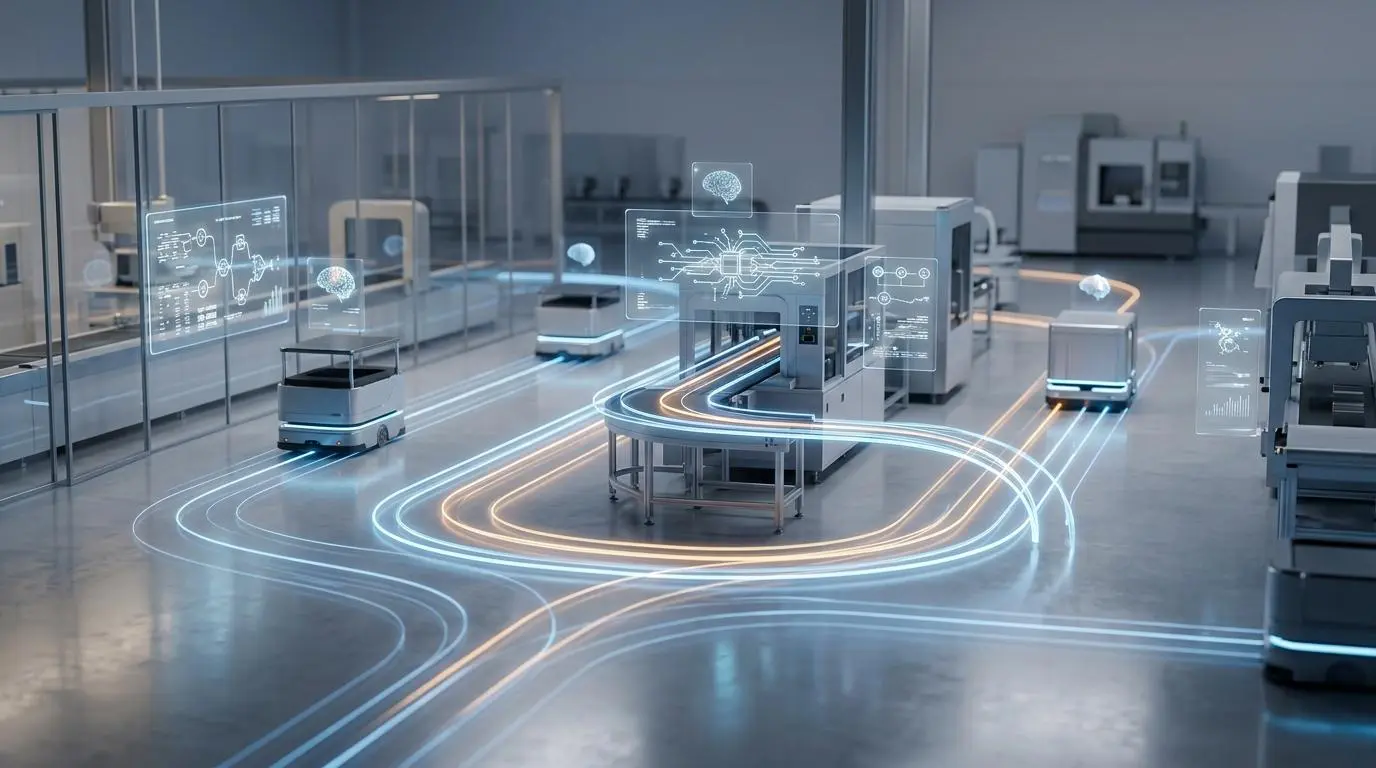
Shop floor managers traditionally spend three to five hours every single day manually reconciling exported data with actual machine logs. Heavyweight tools like SAP S/4HANA Manufacturing and Oracle Cloud SCM often fail to reflect the immediate reality of the factory floor. When a machine goes down, these legacy systems simply do not know about it in time.
Because of this lag, supervisors often bypass expensive enterprise software entirely. They rely on shadow IT spreadsheets to manage the chaos. Unfortunately, these manual documents do not update automatically when a critical tool bit breaks or a material shipment is delayed.
This manual rescheduling lag creates a devastating domino effect. Late deliveries stack up, and production supervisors are trapped in a constant state of high-stress firefighting. Real-time dynamic scheduling eliminates this manual reconciliation entirely by syncing live machine states directly with production queues.
Predictive Routing via Cognitive Industrial Agents
Standard algorithms struggle to account for soft data, like an operator calling in sick or a technician mentioning premature wear on a tool bit. Modern dynamic scheduling systems solve this by integrating cognitive agents powered by GPT-4o-Industrial and Siemens Industrial Copilot. These AI agents actively monitor unstructured data sources across the facility.
By ingesting chatter from technician Slack channels alongside raw telemetry from vibration sensors, these agents can predict downtime before a failure ever occurs. They connect the dots between a slightly vibrating motor and an upcoming heavy production run. The system then intelligently proposes schedule shifts to avoid the impending bottleneck.
This shifts the factory from a reactive posture to a predictive one. Instead of waiting for a machine to break and ruin the daily quota, the workflow automatically reroutes jobs to healthy equipment. It ensures continuous production flow without requiring human supervisors to constantly monitor every single sensor.
Connecting Silos with Low-Code Edge Workflows
Legacy Manufacturing Execution Systems are notoriously closed off and difficult to integrate with modern digital storefronts. This creates a massive gap between incoming e-commerce orders and the actual factory floor. Low-code platforms like n8n and Tulip are now acting as the vital glue to bridge this divide.
These platforms allow operations teams to build custom edge applications without waiting for IT intervention. Operators can now use rugged tablets on the shop floor to instantly trigger re-routing workflows. If an urgent Shopify order drops in, the system dynamically updates the MES queue in real time.
This low-code revolution democratizes factory automation. It gives the people actually running the machines the power to adjust workflows on the fly. Real-time visibility is finally achieved across the entire production lifecycle, from the customer clicking purchase to the final assembly.
Empowering Operators with Interactive Approvals
Total automation is often met with heavy skepticism by veteran floor staff who have seen automated systems fail in unpredictable ways. To build trust, modern dynamic scheduling relies heavily on Human-in-the-Loop triggers. This approach blends the speed of AI with the nuanced decision-making of experienced managers.
When the scheduling AI detects a sudden 15% drop in efficiency, it does not just blindly change the entire factory plan. Instead, it pushes a suggested re-route notification directly to the plant manager’s mobile device via Microsoft Teams or Slack. The manager can review the AI’s logic and approve the change with a single tap.
This interactive approval process ensures that human expertise remains at the center of production. It provides a safety net against algorithmic blind spots while still stripping away the hours of manual data entry previously required to adjust the schedule.
Slashing Work-in-Progress Inventory Costs

Excess inventory sitting half-finished on the factory floor represents massive amounts of dead capital. Traditional scheduling inefficiencies force facilities to stockpile Work-in-Progress inventory just to keep stations busy during unexpected delays. Dynamic scheduling attacks this bloat directly.
Software platforms like Plex and Katana MRP are now achieving sub-second recalculation times for incredibly complex assemblies. When the schedule adapts instantly to material availability, parts flow continuously without piling up in staging areas. The factory operates much closer to a true just-in-time model.
The direct ROI of this real-time agility is a dramatically leaner operation. By reducing dead capital tied up in unfinished goods, manufacturers free up significant cash flow. Operations become more profitable simply by moving materials more intelligently.
Tackling Exponential Complexity with Quantum Logic
As factories scale past five hundred connected machines, the math required to optimize schedules in real time becomes exponentially complex. Traditional CPUs simply cannot calculate these NP-hard scheduling problems fast enough. By the time a standard computer finds the optimal route, the factory floor has already changed.
To solve this, quantum-inspired optimization algorithms are rapidly entering the mainstream manufacturing space. Systems pioneered by companies like D-Wave process thousands of variables simultaneously rather than sequentially. They can map out the most efficient global production schedule in milliseconds.
This marks a massive leap forward for enterprise-scale manufacturing. It ensures that even the largest, most complex facilities on earth can operate with the same real-time agility as a small, highly connected machine shop.

Pioneering Energy-Cognizant Factory Ecosystems
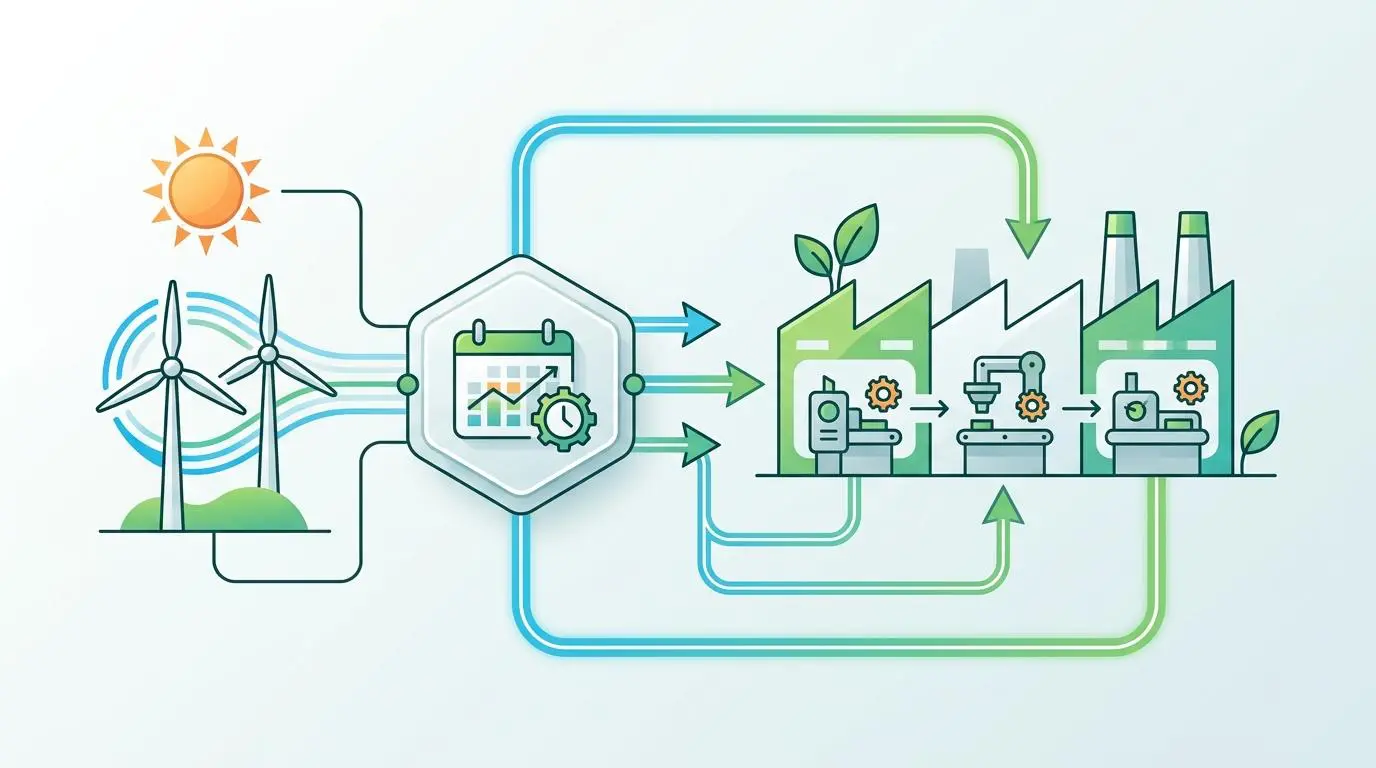
Looking ahead to late 2026, the definition of an optimal schedule will expand far beyond simple machine availability. We are entering the era of energy-cognizant scheduling. Production runs will be dynamically re-ordered based on real-time electricity spot prices and the live availability of on-site solar storage.
Imagine a factory that automatically shifts its most power-hungry milling operations to the exact hour when local wind energy is cheapest. This evolution will transform manufacturing facilities into highly adaptive, grid-aware ecosystems. It represents the ultimate fusion of operational efficiency and sustainable production.
Navigating the intersection of technology, workflows, and operational efficiency requires a sharp strategy. To future-proof your business architecture and scale with precision, connect with Andres at Andres SEO Expert.
Frequently Asked Questions
What is Real-time Dynamic Production Scheduling (DPS) in manufacturing?
Real-time Dynamic Production Scheduling (DPS) is an intelligent system that constantly ingests live machine telemetry and data to automatically reroute factory workflows. Unlike static plans, DPS adjusts to unexpected breakdowns, supply delays, or rush orders in real time, effectively closing the “schedule-reality gap.”
How does AI-driven dynamic scheduling improve OEE?
AI-driven dynamic scheduling increases Overall Equipment Effectiveness (OEE) by an average of 22% by minimizing idle machine time and ensuring equipment remains productive rather than waiting for manual instruction updates. It transforms reactive firefighting into a continuous, optimized flow of productivity.
Why do traditional ERP systems like SAP and Oracle struggle with live factory floor changes?
Legacy enterprise systems often suffer from data lag because they are not natively integrated with live machine telemetry. This disconnect forces shop floor managers to manually reconcile records, often leading them to rely on “shadow IT” spreadsheets rather than the core enterprise software during disruptions.
What are cognitive industrial agents in the context of production scheduling?
Cognitive industrial agents, powered by models like GPT-4o-Industrial, monitor unstructured data such as technician chat logs and sensor vibration patterns. They can predict equipment failure before it occurs, allowing the scheduling system to shift jobs proactively to avoid impending bottlenecks.
How does dynamic scheduling reduce Work-in-Progress (WIP) inventory costs?
By achieving sub-second recalculation times, dynamic scheduling ensures that parts move continuously based on real-time material availability and machine status. This eliminates the need to stockpile unfinished goods in staging areas, freeing up dead capital and improving cash flow.
What is energy-cognizant scheduling in manufacturing?
Energy-cognizant scheduling is an emerging practice where production runs are dynamically re-ordered based on real-time electricity spot prices and the availability of renewable energy. This allows factories to optimize power-heavy operations for times when costs are lowest or green energy is most abundant.