Executive Summary
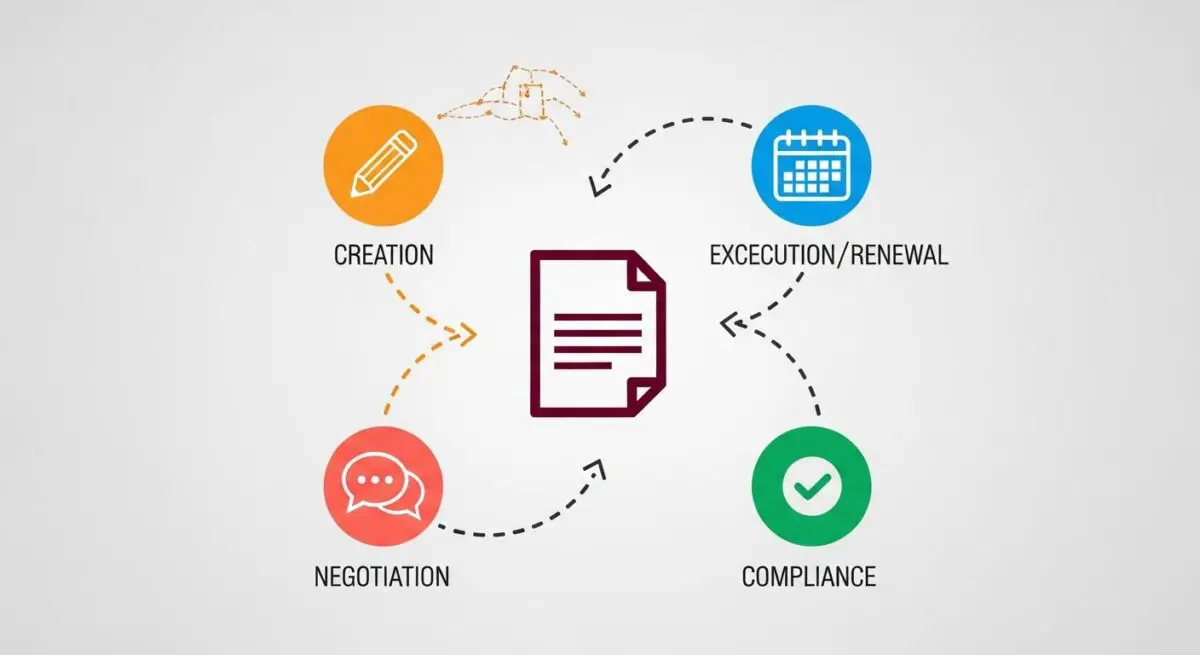
- CLM systems automate the entire contract journey from initial request through negotiation to final renewal, significantly reducing manual administrative overhead.
- Advanced CLM platforms leverage Artificial Intelligence and Natural Language Processing to extract metadata and identify high-risk clauses within legacy document silos.
- Strategic integration of CLM with CRM and ERP ecosystems enables seamless data flow, ensuring that financial obligations and sales milestones are automatically tracked.
What is CLM (Contract Lifecycle Management)?
CLM (Contract Lifecycle Management) is a comprehensive, technology-driven methodology used to manage the entire lifecycle of a contract from its initial request through to its final expiration or renewal. In a modern enterprise tech stack, CLM serves as the central nervous system for legal and commercial agreements, transforming static documents into dynamic, actionable data points.
By utilizing advanced software solutions, organizations can automate the drafting, negotiation, and approval processes, ensuring that all stakeholders are aligned with corporate standards and regulatory requirements. This systematic approach eliminates the inefficiencies of manual document handling and provides a single source of truth for all contractual obligations across the enterprise.
Technically, CLM platforms often incorporate Artificial Intelligence (AI) and Machine Learning (ML) to perform Optical Character Recognition (OCR) and Natural Language Processing (NLP). These technologies allow the system to parse complex legal language, extract key metadata, and flag non-standard clauses that may pose financial or legal risks to the organization.
The Real-World Analogy
To understand CLM, imagine a high-frequency international airport where every contract is a flight. Without a centralized air traffic control system, pilots would have to manually coordinate landings via radio with individual ground crews, leading to massive delays, potential collisions, and total operational chaos.
CLM acts as that air traffic control tower, providing a real-time dashboard that tracks every flight from takeoff to landing. It ensures that every contract follows a pre-defined flight path, stays within safety parameters, and reaches its destination on time without manual intervention from the pilots for every routine maneuver.
How CLM (Contract Lifecycle Management) Drives Strategic Growth & Market Competitiveness?
CLM drives strategic growth by drastically reducing the time-to-contract, which directly accelerates the Quote-to-Cash (Q2C) cycle. In competitive markets, the ability to finalize agreements faster than competitors can be the deciding factor in securing high-value partnerships and revenue streams.
Furthermore, CLM mitigates revenue leakage by providing automated alerts for price escalations, volume discounts, and renewal dates. Many organizations lose significant percentages of their bottom line simply because they fail to act on favorable contract terms or miss the window to renegotiate expiring agreements.
From a risk management perspective, CLM enhances market competitiveness by ensuring global compliance with evolving regulations such as GDPR or CCPA. By maintaining a standardized clause library, legal teams can push updates across thousands of active contracts simultaneously, protecting the brand from massive fines and reputational damage.
Data integrity is another critical factor where CLM provides a competitive edge. By integrating contractual data with Business Intelligence (BI) tools, executives can gain insights into vendor performance, procurement spending patterns, and sales velocity, allowing for more informed, data-driven strategic decisions.
Scalability is also achieved through CLM automation. As a company grows, the volume of contracts increases exponentially; a robust CLM system allows the organization to handle this increased load without a linear increase in legal or administrative headcount, maintaining high operational efficiency.
Strategic Implementation & Best Practices
- Centralize and Normalize Data: Migrate all legacy and active contracts into a single, cloud-based digital repository with standardized metadata tagging to ensure full searchability and visibility across departments.
- Automate Workflow Orchestration: Define and implement standardized approval chains and role-based access controls (RBAC) to ensure that contracts move through the organization without bottlenecks while maintaining strict security protocols.
- Integrate with the Core Tech Stack: Utilize robust API layers to connect the CLM platform with CRM systems like Salesforce and ERP systems like SAP, ensuring that contractual data flows seamlessly into sales and finance workflows.
- Establish a Clause Library: Create a pre-approved library of legal clauses and templates that allow non-legal staff to generate standard agreements, freeing up the legal department for high-value, complex negotiations.
- Monitor Post-Execution Obligations: Set up automated triggers and notifications for key performance indicators (KPIs) and milestones within contracts to ensure that all parties are meeting their technical and financial commitments.
Common Pitfalls & Strategic Mistakes
One frequent error is treating a CLM implementation as a simple digital filing project rather than a fundamental process transformation. Organizations that fail to re-engineer their workflows before digitizing them often find that they have simply automated their existing inefficiencies, leading to poor ROI.
Another common pitfall is the lack of data hygiene during the migration of legacy contracts. If metadata is incorrectly extracted or if duplicate documents are uploaded, the system’s reporting and search capabilities will be compromised, leading to a lack of trust in the platform by end-users.
Finally, many enterprises ignore the importance of user adoption and change management. A CLM system is only effective if it is used consistently across the organization; failing to provide adequate training or ignoring the user experience (UX) can lead to shadow processes where employees continue to use manual methods.
Conclusion
CLM is a critical architectural component for any data-driven enterprise seeking to optimize its legal operations and maximize commercial value. By transforming contracts into structured data, organizations can mitigate risk, accelerate revenue, and maintain a significant competitive advantage in an increasingly complex global market.