Key Points
- Eradicating Black Swan Blindness: Deploying Multi-Agent Systems to map Tier-3 and Tier-4 supplier dependencies eliminates the catastrophic risks associated with opaque global value chains.
- Transitioning to Autonomous Remediation: Modern enterprises are leveraging AI to proactively negotiate spot-freight rates and reroute shipments instantly, bypassing the latency of human intervention.
- Executing Zero-Latency Procurement: Implementing predictive Generative AI models allows organizations to anticipate shortages and secure alternative inventory weeks before market prices spike.
Table of Contents
The Core Friction of Global Logistics
Recent data reveals that AI-integrated supply chains now recover from global logistical shocks significantly faster than traditional systems. This rapid recovery rate actively saves billions in annual lost revenue globally. For modern enterprise leaders, this metric fundamentally changes how we view operational risk.
The era of relying on predictive alerts and reactive procurement teams is over. The new standard for enterprise survival is AI-Driven Supply Chain Resilience (ASCR). This is not merely a software upgrade, but a complete structural overhaul of how global value chains operate under pressure.
ASCR transforms supply chain management from a reactive cost center into a strategic resilience moat. It allows executives to maintain inventory availability during geopolitical shifts that would have previously paralyzed operations. The core friction it solves is the inherent fragility of human-managed logistics in a hyper-connected world.
Traditional ERP systems fail during crises because they rely heavily on historical data rather than real-time contextual awareness. This creates a dangerous lag in decision-making when unprecedented disruptions occur. AI bridges this critical gap by functioning as a proactive intelligence layer operating continuously in the background.
Market Intelligence and Smart Capital
Market Intelligence & Data
Market Valuation
The projected global expenditure on AI-based supply chain risk solutions by the end of 2026, according to research from Forrester.
Fortune 500 Adoption
The percentage of Fortune 500 firms utilizing Multi-Agent Systems for deep-tier supplier visibility as of Q2 2026, per a Bain & Company analysis.
Reporting Accuracy
The average reduction in Scope 3 carbon reporting errors through AI-automated tracking systems, as reported by the Carbon Disclosure Project (CDP) in 2026.
Response Velocity
The average time for an AI-enabled firm to execute a global re-routing strategy, down from 3 days in 2023, according to DHL’s 2026 Resilience Report.
The data clearly illustrates a massive migration of enterprise capital toward autonomous logistics platforms. Dominance is currently shared between legacy giants embedding agentic AI layers into their ERPs and disruptive pure-plays mapping millions of global entities. Smart money is paying close attention to this rapid consolidation.
Significant institutional capital is flowing into sovereign supply chain tech startups. These emerging platforms focus heavily on friend-shoring and automated compliance with modern traceability standards. Investors recognize that compliance and visibility are no longer optional, but existential requirements.
This valuation surge is driven by the urgent need to eliminate market friction caused by opaque vendor networks. When a single port strike or climate event can wipe out quarterly earnings, the ROI on deep-tier supplier visibility becomes undeniable. The market aggressively rewards companies that can guarantee uninterrupted product flow.
Furthermore, the geopolitical fragmentation of trade routes has accelerated the adoption of these platforms. As near-shoring initiatives become more complex, enterprises require AI to map new vendor ecosystems efficiently and securely. This macroeconomic shift is a primary catalyst driving the massive valuation of the ASCR market.
The Strategic Deep Dive into Autonomous Mitigation
Solving Black Swan Blindness
The primary vulnerability in modern logistics is black swan blindness. This is the critical inability of human procurement teams to monitor deep-tier suppliers in real time. ASCR platforms solve this by mapping sub-tier dependencies through automated document scraping and AI-driven entity resolution.
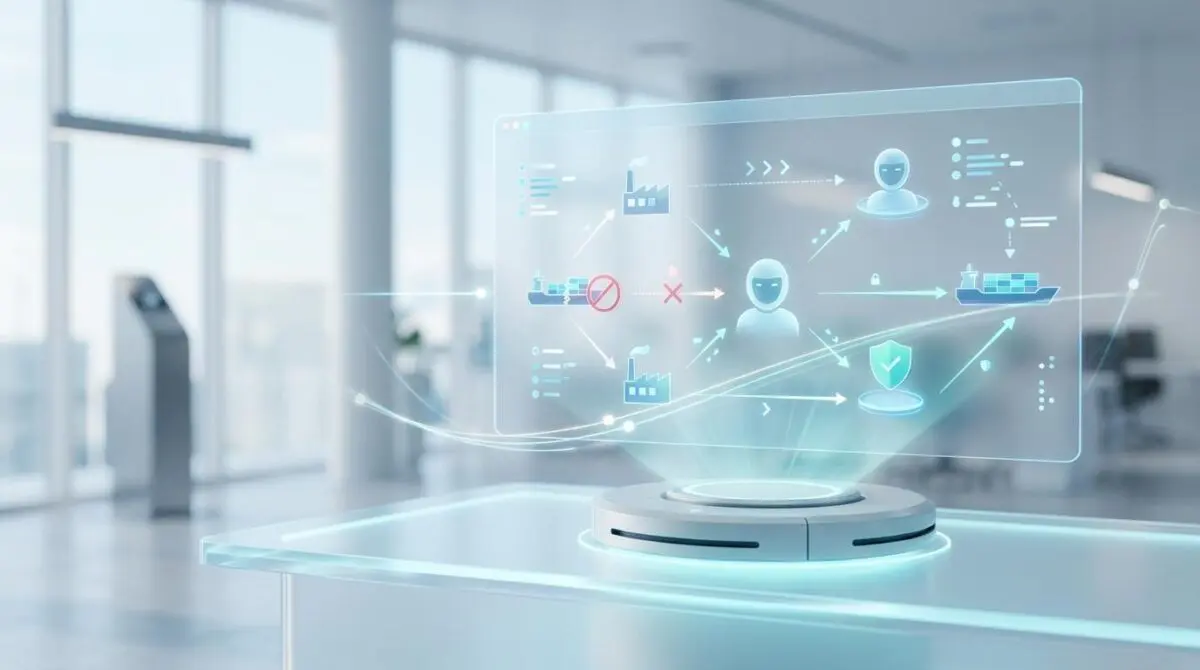
The killer strategy deployed by top-tier firms is the integration of Live-State Digital Twins. These virtual mirrors of the global value chain use multimodal AI to process satellite imagery, social sentiment, and IoT sensor data simultaneously. They allow executives to simulate complex what-if scenarios for every SKU in a company’s portfolio.
To achieve this level of precision, enterprise architects are turning to specialized infrastructure. Advanced high-fidelity supply chain simulation has become the gold standard for rendering these complex logistical networks. This technology provides the computational muscle required to process millions of variables without latency.
Entity resolution is the invisible engine powering these simulations. AI cleanses unstructured data from global customs documents to reveal hidden connections between seemingly unrelated suppliers. This prevents cascading network failures when a single obscure raw material provider unexpectedly goes offline.
The Shift to Autonomous Remediation
The strategy has decisively shifted from predictive alerts to autonomous remediation. Enterprises are deploying Multi-Agent Systems that do not just flag risks, but proactively negotiate spot-freight rates and reroute shipments. All of this happens in real time without requiring human intervention.
Industry leaders are already testing advanced anticipatory shipping models. In these programs, Generative AI predicts local regional disruptions so accurately that inventory is moved into safe zones days before a major weather event or labor strike is officially announced.
This level of anticipation completely rewrites the rules of market competition. Companies leveraging these autonomous systems can secure alternative components before the market price spikes. It creates a massive competitive advantage where slower competitors are left paying premium rates for delayed freight.
This shift also fundamentally changes the psychology of procurement teams. Human buyers often panic during crises, leading to the infamous bullwhip effect of over-ordering. Autonomous agents operate without emotion, executing mathematically optimal procurement strategies based strictly on probability matrices.
The Executive Action Plan for Resilience
Strategic Trajectory
- Architect a ‘Self-Healing Supply Chain’ framework to facilitate autonomous recovery and operational continuity.
- Implement blockchain-integrated digital wallets for AI agents to enable automated execution of micro-transactions.
- Streamline risk mitigation by triggering instant insurance claims upon the detection of logistical disruptions.
- Transition to ‘Zero-Latency Procurement’ to identify potential shortages at least 30 days in advance.
- Secure alternative component sourcing dynamically to bypass market price spikes during supply fluctuations.
The next evolution of this technology is the self-healing supply chain. Innovators are actively preparing for a landscape where AI agents hold their own digital wallets via blockchain integration. This allows the system to execute micro-transactions and secure freight capacity instantly when a disruption is detected.
We are rapidly moving toward an era of zero-latency procurement. In this model, the AI anticipates a component shortage weeks in advance and secures alternative sourcing dynamically. Executives must begin restructuring their procurement departments to oversee these AI agents rather than manually executing trades.
Another critical advancement is the ability to trigger instant insurance claims through smart contracts. Parametric insurance models can now integrate directly with supply chain AI. When an IoT sensor detects a temperature drop in a refrigerated container, the AI automatically files the claim and orders replacement inventory simultaneously.
To implement this roadmap, leadership teams must prioritize data standardization across all vendor tiers. Without clean, interoperable data, even the most advanced Multi-Agent Systems will fail to execute routing decisions accurately. The foundation of autonomous resilience is uncompromising data hygiene.
Conclusion
The integration of autonomous AI into global logistics represents a fundamental shift in how businesses absorb external shocks. Organizations that fail to adopt these resilient frameworks will find themselves outmaneuvered by faster, digitally native competitors. The future belongs to those who can predict the unpredictable and automate their recovery.
The ultimate goal is a frictionless global trade network where disruptions are localized and neutralized instantly. This technological leap elevates supply chain leaders from operational managers to true business strategists driving enterprise value.
Navigating the intersection of technology, capital, and market psychology requires a sharp strategy. To future-proof your business architecture and scale with precision, connect with Andres at Andres SEO Expert.
Frequently Asked Questions
What is AI-Driven Supply Chain Resilience (ASCR)?
ASCR is a structural overhaul of global logistics that utilizes a proactive AI intelligence layer to manage supply chain risks. Unlike traditional ERP systems that rely on historical data, ASCR provides real-time contextual awareness, allowing enterprises to maintain operational continuity during major geopolitical or environmental disruptions.
How much faster can AI-integrated supply chains recover from disruptions?
According to 2026 data from the Logistics Management Institute, AI-integrated supply chains recover from global shocks 4.5x faster than traditional systems. This increased velocity allows firms to execute global re-routing strategies in under two hours, compared to an average of three days in 2023.
How do Digital Twins solve ‘black swan’ supply chain blindness?
Live-State Digital Twins create a virtual mirror of the value chain by processing multimodal data, including satellite imagery and IoT sensors. This allows procurement teams to monitor deep-tier (Tier-3 and Tier-4) suppliers in real time and simulate ‘what-if’ scenarios to identify hidden dependencies before a failure occurs.
What role do Multi-Agent Systems play in autonomous logistics?
Multi-Agent Systems enable autonomous remediation by proactively negotiating spot-freight rates and rerouting shipments without human intervention. These systems use probability matrices to execute optimal procurement strategies, effectively neutralizing the ‘bullwhip effect’ caused by human panic during crises.
What is a self-healing supply chain?
A self-healing supply chain uses AI agents integrated with blockchain-based digital wallets. This architecture allows the system to instantly execute micro-transactions to secure freight capacity or trigger parametric insurance claims automatically the moment a logistical disruption is detected by IoT sensors.
How does AI improve Scope 3 carbon reporting accuracy?
AI-automated tracking systems reduce Scope 3 carbon reporting errors by an average of 70%. By providing deep-tier visibility and automating data collection across complex vendor networks, AI ensures more accurate environmental impact reporting for Fortune 500 firms.