Key Points
- Transition from manual coordination to Agentic FSM platforms to eliminate the 15 to 20 percent billable hour loss caused by the Dispatch Death Loop.
- Integrate Point-of-Execution invoicing powered by computer vision to instantly compress the service-to-cash cycle and drastically lower Days Sales Outstanding.
- Pivot your core revenue strategy toward Outcome-Based Service Orchestration by selling guaranteed uptime rather than traditional hourly labor.
Table of Contents
The Dispatch Death Loop and Core Market Friction
According to recent industry benchmarks for field service management, enterprises implementing AI-led autonomous dispatching have seen a 38% reduction in fuel costs and a 25% increase in technician productivity over the last 12 months.
This data signals a brutal reality for legacy service companies relying on outdated logistics. The era of manual scheduling is officially dead, rapidly replaced by algorithmic precision and predictive routing.
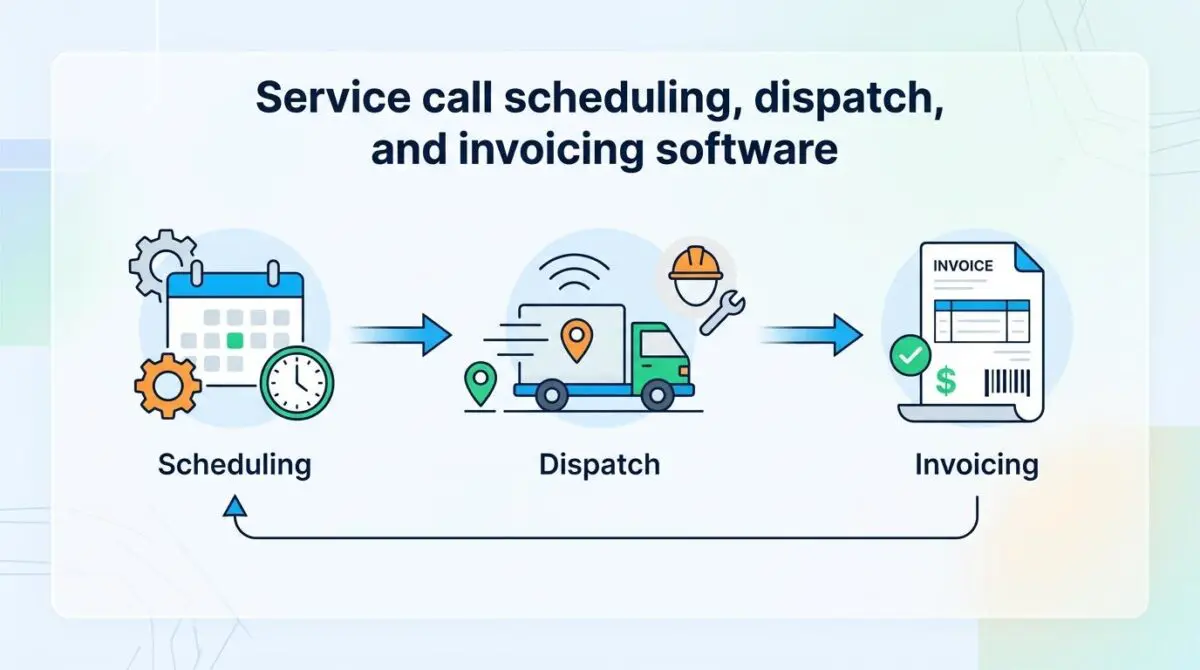
The modern service call lifecycle requires an entirely new operational thesis to survive in a hyper-competitive landscape. We are witnessing a radical shift toward Autonomous Field Service Management (FSM) Systems to handle complex frontline operations.
The primary friction these systems solve is the notorious Dispatch Death Loop. This represents the administrative lag between a customer request, the arrival of a qualified technician, and the eventual receipt of payment.
Traditional manual scheduling inherently results in a staggering 15 to 20 percent loss in billable hours due to sheer logistical errors. You simply cannot scale a service business when your dispatchers are playing a high-stakes game of telephone with field technicians.
Solving how to schedule, dispatch, and invoice your service calls is no longer a back-office administrative task. It is a frontline revenue strategy that dictates your ultimate market valuation and capital efficiency.
Every minute a technician spends idling in traffic or driving to a site without the proper parts is margin evaporating into thin air. Autonomous systems eliminate this cognitive load from human operators entirely, allowing dispatchers to transition into strategic oversight roles.
Furthermore, manual dispatching creates immense psychological friction and burnout among field workers who constantly battle inefficient routes. By adopting self-optimizing service loops, companies drastically reduce employee churn while simultaneously elevating the customer experience.
Market Intelligence and the Flow of Smart Capital
Smart money is aggressively targeting the infrastructure that powers the global field service management market. Leading venture capital firms are pouring massive funds into AI-native disruptors.
They recognize that whoever controls the dispatch routing algorithms ultimately controls the profit margins of the entire trade service industry. The financial upside of solving this logistical nightmare is virtually limitless, driving unprecedented valuation multiples in the M&A sector.
Market Intelligence & Data
Global FSM Market Valuation
Data from Fortune Business Insights confirms the global field service management market reached $12.4 billion in early 2026, fueled by rapid AI integration.
First-Time Fix Rate
According to IDC, companies using real-time AI-triage and dispatching have achieved a record 91% first-time fix rate in 2026, up from 74% in 2024.
Average DSO Reduction
Research by Deloitte indicates that mobile-first, automated invoicing has compressed the average Days Sales Outstanding for trade services to just 4.2 days.
Shift to Autonomous Dispatch
A 2026 Forrester survey found that 65% of field service leaders have fully transitioned from human dispatchers to AI-driven optimization engines.
The data presented above paints a clear picture of shifting market dominance across the enterprise landscape. Established giants are now facing aggressive competition from nimble, AI-native platforms.
These disruptors are utilizing Large Action Models to handle complex, multi-vendor dispatching without a single human keystroke. It is a complete reimagining of the service supply chain from the ground up, prioritizing machine-to-machine communication.
When a massive percentage of the industry has transitioned from human dispatchers to AI-driven optimization engines, holding onto manual processes is financial suicide. The market is exclusively rewarding speed, precision, and automation.
Private equity firms are catching onto this trend, buying up regional service providers and immediately injecting autonomous FSM software to drive rapid EBITDA expansion. The primary arbitrage opportunity lies in modernizing outdated scheduling frameworks to unlock trapped capital.
The Strategic Deep Dive into Agentic FSM
The transition from manual coordination to self-optimizing service loops is the defining business transformation of this decade. Companies are now deploying autonomous AI agents that analyze real-time traffic patterns, technician skill levels, and inventory proximity.
These agents dispatch service calls dynamically, constantly recalculating routes every thirty seconds based on live field data. The system automatically matches the exact right technician to the exact right job at the exact right moment.
This level of orchestration completely eliminates the friction of human guesswork and logistical bias. It ensures that every dispatch decision is mathematically optimized for maximum profitability and minimal windshield time.
Eliminating Administrative Lag with Self-Optimizing Service Loops
The killer strategy for modern enterprises is the direct integration of predictive maintenance sensors into the core scheduling engine. Internet of Things devices now communicate directly with Autonomous Field Service Management (FSM) Systems without any human oversight.
This allows the software to autonomously dispatch a technician before the customer even realizes a critical fault has occurred. It transforms the service model from reactive firefighting to proactive revenue generation.
Imagine a commercial HVAC unit detecting a slight voltage drop in a compressor on a Friday afternoon. The system instantly cross-references parts inventory, locates the nearest qualified technician, and books the appointment automatically.
This is the true power of an agentic FSM platform operating at scale. It acts as an invisible, highly efficient profit-center manager that never sleeps, never takes a break, and never makes a routing error.
Furthermore, these dynamic routing capabilities dramatically reduce fuel consumption and carbon footprints. This allows enterprise service companies to easily meet stringent ESG mandates while simultaneously cutting operational overhead.
Point-of-Execution Invoicing and Financial Fluidity
Fixing the dispatch loop is only half the battle for modern service enterprises looking to dominate their sector. The other critical component of how to schedule, dispatch, and invoice your service calls involves entirely rethinking your cash flow mechanics.
Invoicing is no longer a delayed, back-office task managed by a team of administrators pushing paper. It has evolved into a Point-of-Execution event that occurs the exact second the work order is successfully closed.
Recent industry reports reveal that ‘Hyper-Automated Invoicing’—where AI audits service photos against work orders for instant billing—has reduced dispute rates by 72% for commercial HVAC and plumbing conglomerates.
This hyper-automation involves biometric verification and automated service-to-payment protocols embedded directly into the technician’s mobile device. These systems ensure instantaneous revenue recognition the moment the technician completes the job.
Furthermore, automated invoicing solves the chronic cash-flow issue of high Days Sales Outstanding that has plagued the industry for decades. By leveraging fintech-integrated service platforms, companies achieve split-second credit approvals and automated lien waivers.
This transforms the notoriously slow service-to-cash cycle from weeks to literal minutes. Financial fluidity becomes a massive competitive advantage when you can reinvest capital faster than your regional competitors.
Significant capital is flowing into companies specializing in this concept of Edge Invoicing. Investors know that accelerating capital velocity and eliminating legal friction through automated lien waivers is the key to dominating a fragmented service market.
The Executive Action Plan for Outcome-Based Service
The next evolution of this industry is a massive pivot toward Outcome-Based Service Orchestration. Forward-thinking CEOs are moving away from billing for hours, materials, or individual reactive service calls.
Instead, they are selling guaranteed uptime and performance metrics to their enterprise clients. In this advanced model, the FSM system autonomously decides when a preventive service call is necessary to avoid a costly breach of contract.
Strategic Trajectory
- Pivot revenue models toward Outcome-Based Service Orchestration, prioritizing uptime over billable hours.
- Reposition the FSM system as an autonomous profit-center manager that mitigates contract breach risks.
- Implement performance guarantees as the primary value proposition for long-term service contracts.
- Prepare operational infrastructure for the late 2026 emergence of Zero-Touch Dispatch systems.
- Integrate humanoid robots and autonomous drones into centralized FSM cloud management.
Implementing this strategic trajectory requires a fundamental rewiring of your operational infrastructure. You must reposition your service department from a reactive cost center to a proactive, autonomous profit driver.
In the near future, we expect the widespread emergence of Zero-Touch Dispatch systems in heavy industrial settings. Humanoid robots and autonomous drones will handle simple, routine service calls without human intervention.
These robotic assets will be managed by the exact same centralized FSM cloud that dispatches your human technicians today. Preparing your data architecture for this multi-agent reality is absolutely non-negotiable for future market leaders.
The transition requires a cultural shift within your organization as much as a technological one. Your dispatchers must evolve into system orchestrators, managing the AI algorithms rather than micromanaging the field technicians.
Final Thoughts on Zero-Touch Dispatch
The modernization of how to schedule, dispatch, and invoice your service calls is a ruthless filter for the global trade industry. Those who embrace Autonomous Field Service Management (FSM) Systems will capture unprecedented market share and drive massive enterprise value.
Those who hesitate will be systematically crushed by the sheer operational efficiency and capital velocity of their AI-native competitors. The smart money has already placed its bets on hyper-automation, predictive maintenance, and edge invoicing.
Now is the time to audit your dispatching logistics, eliminate administrative lag, and integrate predictive maintenance into your core revenue model. The future of field service belongs exclusively to the autonomous.
Navigating the intersection of technology, capital, and market psychology requires a sharp strategy. To future-proof your business architecture and scale with precision, connect with Andres at Andres SEO Expert.
Frequently Asked Questions
What is the Dispatch Death Loop in field service management?
The Dispatch Death Loop is the administrative lag and logistical friction between a customer request, the arrival of a qualified technician, and the receipt of payment, which typically results in a 15-20% loss in billable hours for manual systems.
How does autonomous AI dispatching reduce operational costs?
Autonomous AI dispatching reduces fuel costs by 38% and increases technician productivity by 25% by utilizing predictive routing and real-time data to eliminate idling, traffic delays, and manual scheduling errors.
What is Point-of-Execution Invoicing?
Point-of-Execution Invoicing is a hyper-automated billing event that occurs instantly when a work order is closed. It uses AI and biometric verification to audit work in real-time, reducing Days Sales Outstanding (DSO) to approximately 4.2 days.
How does AI improve first-time fix rates (FTFR)?
AI-driven triage and dispatching systems have elevated first-time fix rates to 91% by ensuring technicians arrive with the correct parts, skill sets, and situational intelligence required to solve the issue on the first visit.
What is Outcome-Based Service Orchestration?
Outcome-Based Service Orchestration is a business model where companies sell guaranteed equipment uptime and performance metrics rather than labor hours, using autonomous systems to manage preventive service calls and mitigate contract risks.
What role does IoT play in modern field service dispatching?
IoT devices communicate directly with Autonomous FSM systems to detect equipment faults and trigger service calls automatically, transitioning the service model from reactive firefighting to proactive revenue generation.