Key Points
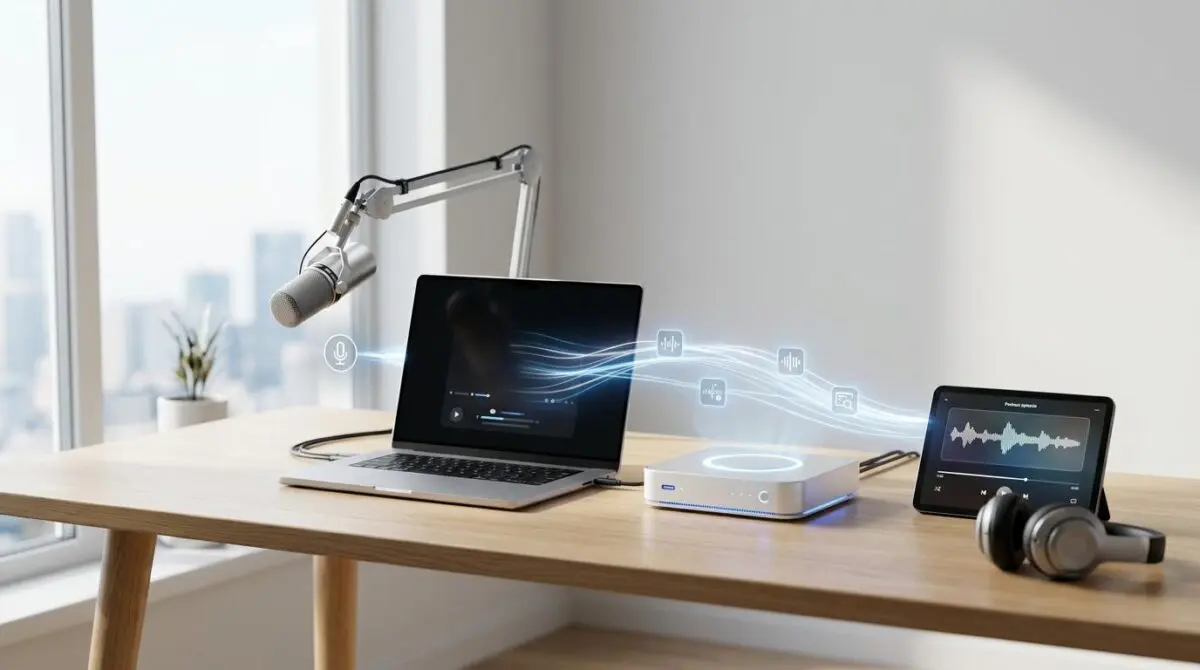
- AI-driven audio processors and text-based editing environments eliminate the 40+ hours typically wasted on manual noise reduction and timeline splicing.
- Zero-shot voice cloning enables creators to dynamically patch script errors and inject mid-roll ads purely through text, bypassing the need for re-recording.
- The shift toward Agentic AI workflows allows for the autonomous generation and distribution of highly localized, real-time audio content at a fraction of traditional costs.
Table of Contents
- The 40-Hour Production Trap
- The Economics of Automated Audio
- Eradicating the Audio Cleanup Bottleneck
- Synthetic Voices and Zero-Shot Cloning
- Slashing Production Costs with SaaS
- The Rise of Text-Based Editing
- The AI Co-Pilot for Creative Structuring
- Agentic Workflows and Content Velocity
- The Era of the Zero-Touch Podcast
The 40-Hour Production Trap
Picture this: you just wrapped up a brilliant, high-energy interview guaranteed to resonate with your audience. Instead of celebrating, a sense of dread washes over you as you stare at the raw audio file. You know the next phase involves painstakingly hunting down every rogue breath, background hum, and filler word.
This manual grind typically eats up over 40 hours every month just to get episodes out the door. This relentless production latency prevents most creators from maintaining a consistent publishing schedule. It quickly turns a creative endeavor into a tedious administrative chore.
You are effectively spending more time fixing audio than generating the ideas that actually build your audience. The solution is not to hire a larger team of editors or buy more expensive microphones. Instead, modern creators are deploying an AI-Orchestrated Podcast Content Engine.
This framework completely modernizes the post-production workflow. It turns a multi-day slog into a frictionless process that takes mere hours.
The Economics of Automated Audio
Market Intelligence & Data
AI-Generated New Feeds
According to Podcast Index data cited by Gizmodo in May 2026, over one-third of all new podcast feeds are now classified as machine-generated.
Voice Cloning Market Size
A 2026 report from Intel Market Research projects the AI voice cloning segment specifically will reach this valuation this year due to surge in audio content needs.
Marketer AI Adoption
According to a 2026 study by Siege Media and Wynter, nearly all content marketers now plan to use AI to support their production efforts.
Consumer Engagement
Edison Research’s 2026 findings indicate that over one-fifth of weekly podcast consumers in the U.S. have now listened to a show narrated by an AI voice.
The staggering reality that over one-third of new podcast feeds are machine-generated highlights a massive shift in content velocity. Creators are no longer constrained by the physical limits of human recording time. Instead, they leverage intelligent orchestration to scale their output and dominate niche markets.
This means smaller teams can now compete directly with massive media networks. Financial projections for the voice cloning sector demonstrate how critical synthetic audio has become for modern business operations. As the market surges toward a $1.5 billion valuation, we are seeing a massive influx of platforms that offer lifelike AI voices and voice cloning to everyday creators.
This technology eliminates the need for emergency re-recording sessions, allowing hosts to patch audio errors dynamically. With nearly all content marketers planning to adopt AI, the competitive baseline for production quality has fundamentally changed.
Teams are rushing to integrate advanced tools that popularize text-based editing, where deleting a word in the transcript automatically deletes the corresponding audio. This rapid adoption proves that intelligent automation is no longer a luxury, but a baseline requirement for survival in digital marketing.
The fact that over a fifth of consumers actively engage with AI-narrated shows proves that audience resistance is rapidly fading. Listeners care far more about the value and relevance of the information than the biological origin of the voice. This acceptance unlocks entirely new formats, such as daily micro-podcasts and localized audio feeds, that were previously impossible to produce.
Eradicating the Audio Cleanup Bottleneck

For years, the most exhausting part of podcasting has been the manual removal of ambient noise and verbal stumbles. This tedious cleanup typically accounts for a staggering 60% of total production time. Creators find themselves trapped in a cycle of endless tweaking rather than focusing on high-level strategy.
Today, intelligent audio processors have essentially eradicated this bottleneck. Advanced platforms utilize machine learning to analyze and clean audio tracks instantly. They can isolate the human voice and strip away background interference with surgical precision.
By automating this tedious cleanup, an AI-Orchestrated Podcast Content Engine frees up massive blocks of creative time. You no longer need to be a sound engineer to achieve studio-quality acoustics. The software handles the technical heavy lifting while you focus on delivering a compelling message.
Synthetic Voices and Zero-Shot Cloning
Nothing derails a production schedule faster than discovering a mispronounced sponsor name or a missing script segment after the recording session has ended. Historically, this meant setting up the microphone again, matching the room tone, and trying to replicate your original energy. It is a frustrating friction point that severely delays publishing.
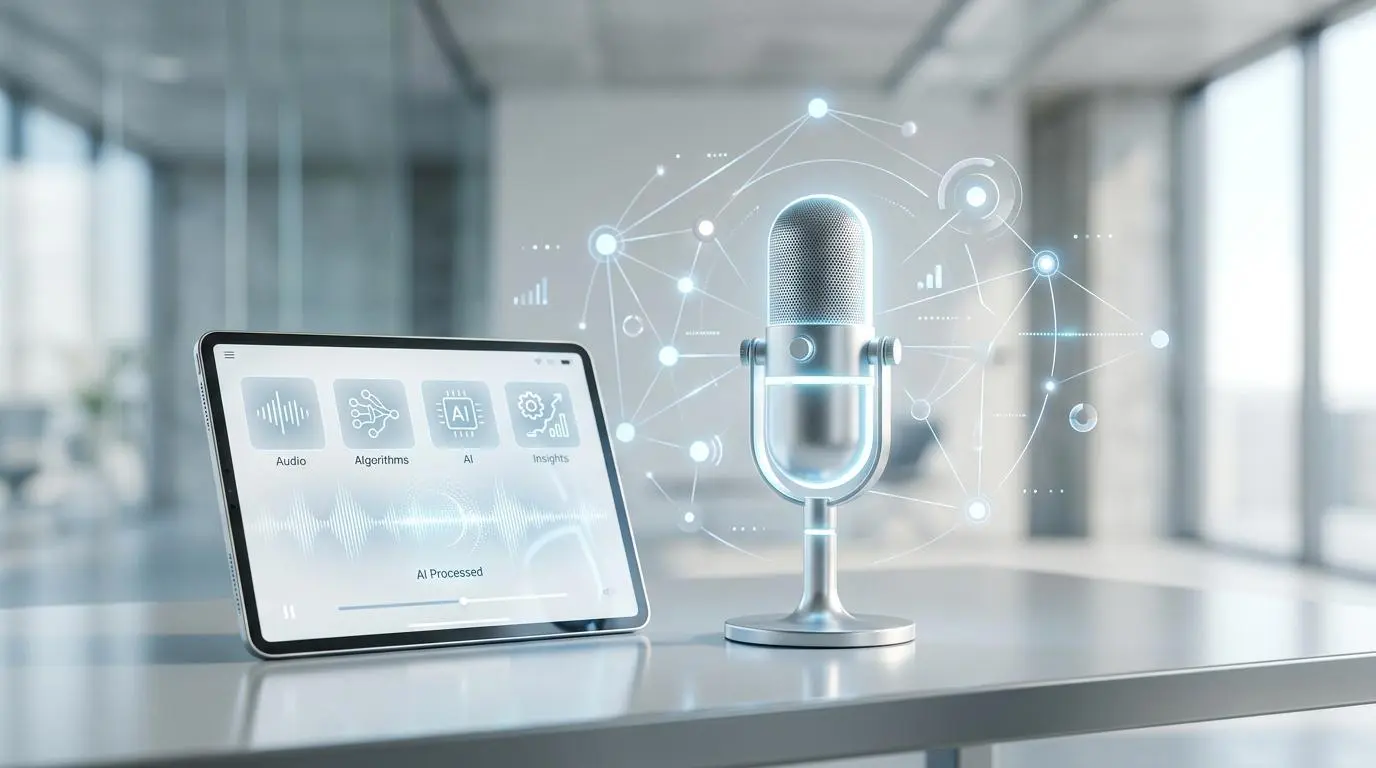
Modern voice synthesis platforms have completely neutralized this threat through zero-shot voice cloning. These systems can analyze a brief sample of your voice and generate highly accurate synthetic replicas. This allows hosts to simply type out the missing dialogue and generate the audio instantly.
You can now inject mid-roll ads, correct factual errors, or update outdated statistics purely through text. This capability transforms the audio file from a static recording into a dynamic, easily editable asset. It provides unprecedented flexibility for creators who need to pivot quickly.
Slashing Production Costs with SaaS

The financial barrier to entry for professional-grade audio has historically been incredibly steep. Small businesses and independent creators simply could not afford to keep dedicated sound engineers and editing teams on retainer. This financial friction kept many brilliant voices locked out of the medium entirely.
The landscape has shifted dramatically as enterprise-grade AI podcast production services become highly democratized. Instead of paying hundreds of dollars per episode in freelance fees, creators can now leverage affordable monthly SaaS subscriptions. These tools provide the exact same mixing and mastering capabilities at a fraction of the cost.
This drastic reduction in overhead allows businesses to achieve a rapid return on investment within their first 90 days of implementation. By reallocating that budget toward marketing and distribution, shows can scale their audience much faster. The cost per episode is no longer an excuse to delay your launch.
The Rise of Text-Based Editing

Traditional digital audio workstations come with an incredibly steep learning curve. Navigating complex timelines, waveforms, and multi-track routing is intimidating for the average content marketer. This technical complexity is a massive roadblock for rapid content creation.
The industry has responded by shifting toward intuitive, text-based editing environments. Modern platforms transcribe the raw audio immediately, presenting the user with a simple text document. Editing the podcast is now exactly like editing a standard word processing document.
If you highlight and delete a paragraph in the transcript, the software automatically splices the corresponding audio with perfectly smooth crossfades. This user experience breakthrough completely removes the need for specialized audio engineering skills. It empowers anyone on your marketing team to step in and finalize an episode.
The AI Co-Pilot for Creative Structuring
Maintaining a high-volume content schedule often leads directly to severe creator burnout. The cognitive load required to constantly research, outline, and structure new episodes is immense. Even the most passionate hosts eventually hit a wall when staring at a blank page week after week.
To combat this, advanced creators are treating AI as a collaborative co-pilot rather than a simple automation script. By feeding existing show transcripts and raw research into intelligent tools, hosts can instantly synthesize comprehensive episode outlines. The AI connects disparate ideas and suggests logical narrative arcs.
This workflow ensures that the host’s unique voice and perspective remain front and center, while the machine handles the heavy lifting of structural organization. It dramatically reduces the friction of the blank page. You get to step up to the microphone with a fully fleshed-out roadmap ready to go.
Agentic Workflows and Content Velocity
In the fast-paced world of digital media, content decay is a very real threat. By the time a human team researches, records, edits, and publishes a take on a trending topic, the conversation has often moved on. This latency renders highly valuable insights completely irrelevant.
The near future of the industry points directly toward agentic AI systems that operate with total autonomy. These intelligent agents are capable of actively monitoring real-time data trends and conducting their own rapid research. They can instantly draft scripts that capitalize on breaking news the moment it happens.
Industry data reveals that automated production firms can churn out thousands of podcast episodes per week at a fraction of traditional costs. Once the script is finalized, the system can generate the audio and distribute it directly to RSS feeds in under 30 minutes. This unprecedented content velocity completely eliminates the gap between idea generation and audience consumption.
The Era of the Zero-Touch Podcast
The concept of the zero-touch podcast is rapidly becoming the gold standard for data-driven niches. We are entering an era where AI agents autonomously ingest real-time data streams and draft highly engaging scripts without human intervention. The entire production pipeline is shifting from a manual grind to a seamless, automated flow.
These systems will not only generate full audio episodes but will simultaneously localize them into dozens of languages. This hyper-scalable approach allows brands to achieve immediate global reach without building international studios. The technology fundamentally changes how we think about media distribution and audience growth.
Navigating the intersection of modern technology, software architecture, and business growth requires a sharp strategy. To future-proof your tech stack and scale with precision, connect with Andres at Andres SEO Expert.
Frequently Asked Questions
What is an AI-Orchestrated Podcast Content Engine?
An AI-Orchestrated Podcast Content Engine is a strategic framework that modernizes the post-production workflow. It uses intelligent automation to handle audio cleanup, editing, and distribution, transforming a manual 40-hour monthly grind into a frictionless process that takes only a few hours.
How does AI help reduce podcast production time?
AI tools like Adobe Enhance Speech and Auphonic eliminate the ‘cleanup bottleneck’ by automatically removing ambient noise, filler words, and verbal stumbles. This automation typically addresses the 60% of production time previously spent on tedious manual editing.
What are the benefits of text-based podcast editing?
Text-based editing allows creators to edit audio files as easily as a word processing document. By deleting text in a transcript, platforms like Descript or Riverside.fm automatically splice the corresponding audio, removing the need for specialized engineering skills and steep learning curves.
How does zero-shot voice cloning work for podcasters?
Zero-shot voice cloning enables systems like ElevenLabs to create a synthetic replica of a host’s voice from a brief sample. This allows creators to inject mid-roll ads, correct factual errors, or update scripts instantly through text without needing to set up a microphone for re-recording.
Are listeners receptive to AI-generated voices in podcasts?
Consumer data from 2026 shows that over 22% of weekly podcast listeners in the U.S. have engaged with AI-narrated content. Market trends suggest that audience resistance is fading as listeners prioritize the value and relevance of information over the biological origin of the voice.
What is a zero-touch podcast workflow?
A zero-touch podcast refers to an autonomous production model where AI agents monitor real-time data, draft scripts, generate audio, and localize content into multiple languages. This allows for unprecedented content velocity, enabling brands to publish episodes in under 30 minutes for as little as $1 per episode.