Key Points
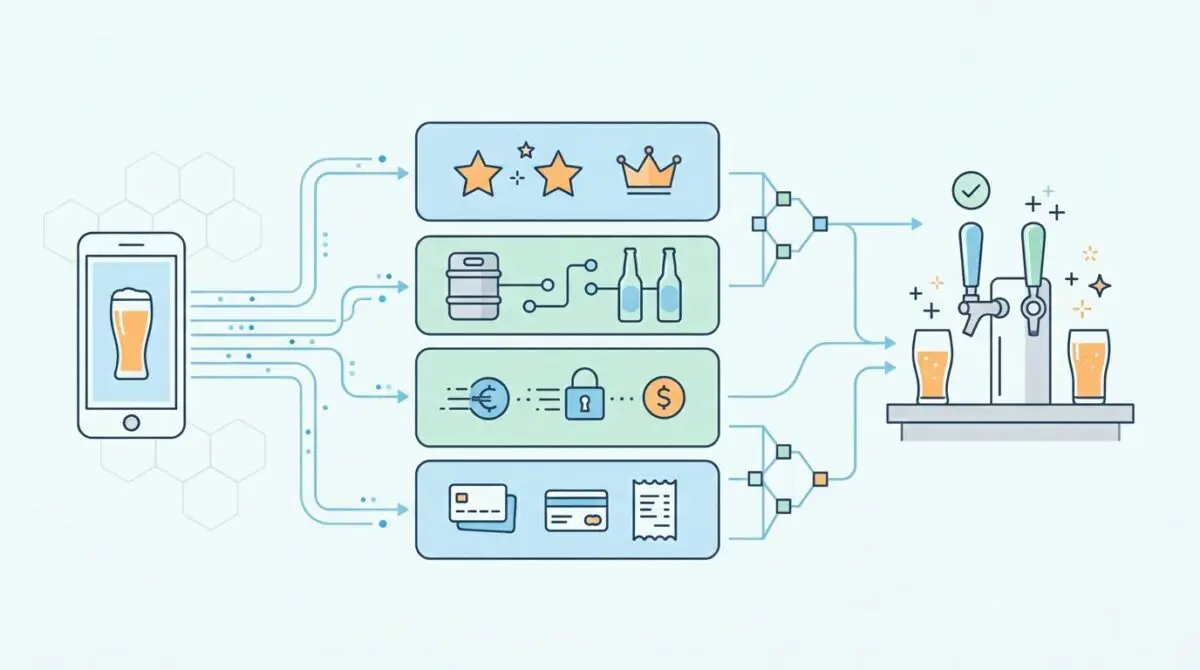
- Supply Chain Liquidity: CBEFE platforms utilize predictive analytics for Instant Grain Factoring, collateralizing the brewing process to provide immediate working capital.
- Invisible Checkout Infrastructure: Integrating biometric identity with digital wallets eliminates physical age verification and payments, reducing venue wait times by up to 40%.
- Dynamic Profit Optimization: AI-driven pricing models combined with real-time A2A settlement allow taprooms to adjust costs based on capacity and weather, increasing off-peak margins by 22%.
Table of Contents
The Financial Tech Friction
According to a May 2026 report by J.P. Morgan Payments, Account-to-Account (A2A) transaction volume in the specialty beverage sector has surged 54% year-over-year. This massive shift is happening as venues move aggressively to recapture billions lost annually to legacy credit card processing fees.
The traditional hospitality payment rails are obsolete. They bleed margin from an industry that relies heavily on volume and speed.
Enter Craft-Beverage Embedded Finance Ecosystems (CBEFE). This is not merely a payment processor update, but a total restructuring of taproom liquidity and consumer engagement.
By fusing invisible payments with AI-driven supply chain financing, CBEFE represents the ultimate financial technology stack. It serves both the modern beer lover and the operators who cater to them.
The 2026 landscape is defined by this seamless integration of financial technology into everyday consumer experiences. Institutional capital now recognizes the glaring inefficiencies of the legacy hospitality model.
Smart money is pivoting toward these hyper-verticalized solutions. Operators who fail to adopt this embedded financial architecture risk being priced out by competitors with vastly superior cash flow dynamics.
Market Intelligence & Capital Flow
Market Intelligence & Data
Embedded Finance TAM
The total addressable market for embedded financial services within the global craft beverage industry is projected to hit $12.8 billion by 2027, according to Goldman Sachs.
Biometric Adoption
Visa’s 2026 Global Consumer Pulse report indicates that 68% of high-frequency hospitality patrons prefer biometric age-and-pay verification over physical cards or IDs.
Settlement Speed
With the 2026 expansion of FedNow, the average B2B settlement time between distributors and retailers has dropped from 3 days to just 1.2 seconds, per Federal Reserve data.
RWA Tokenization Growth
The market for tokenized rare alcohol assets has grown by 315% since 2024, as institutional investors seek inflation-hedged yields in niche commodities, according to BlackRock Digital Assets.
Analyzing the Smart Money
The data reveals a clear mandate for embedded financial services within the craft beverage space. Smart money is flowing heavily into verticalized fintech platforms like TapFlow and BrewPay.
These specialized platforms have collectively raised over $450 million in Series B rounds this year alone. Investors recognize that capturing the transaction at the point of pour unlocks unprecedented data monetization.
Tech giants like Stripe and Block are aggressively rolling out inventory-linked credit lines to capture this market. These credit vehicles use real-time IoT data from smart kegs to automate lending.
This ensures taprooms never run dry due to cash flow bottlenecks. This real-time collateralization represents a fundamental shift in how small business credit is underwritten.
Furthermore, institutional interest is peaking in tokenization platforms that fractionalize ownership of rare barrel-aged reserves. This innovation turns liquid assets into tradeable financial instruments.
It offers inflation-hedged yields in niche commodities. The financialization of craft beverages proves that any physical asset with scarcity and demand can be successfully integrated into the blockchain economy.
The FinTech Deep Dive
Solving the Production-to-Payment Gap
The primary friction solved by modern CBEFE platforms is the production-to-payment gap that historically throttled small breweries. In the past, operators waited up to 90 days for retail settlement.
This delay trapped crucial working capital inside fermentation tanks. Today, predictive analytics power instant grain factoring to provide brewers with immediate capital the moment a batch is started.
This immediate liquidity transforms the operational ceiling for independent beverage brands. By collateralizing the brewing process itself, founders can scale production without taking on predatory debt or diluting equity.
It is a masterclass in supply chain liquidity, driven entirely by granular IoT and financial data. As these platforms mature, the underwriting process becomes entirely invisible and automated.
Algorithms assess the historical sales velocity of specific beer styles and instantly deploy capital to fund raw materials. This creates a self-sustaining financial loop that entirely bypasses traditional commercial banking constraints.
Biometrics and the Invisible Checkout
On the consumer side, the ultimate financial stack relies on eliminating physical friction. Biometric identity mapping, utilizing palm and facial recognition, is being integrated seamlessly with digital wallets.
This allows patrons to automate age verification and payment in a single tap-and-go motion. It bypasses physical identification cards entirely.
Much of this infrastructure mirrors the underlying technology of the biometrics system for payments and age verification, adapting it for high-volume hospitality environments. These invisible checkouts reduce venue wait times by an average of 40% in high-density urban areas.
The frictionless nature of these transactions fundamentally rewires consumer psychology. This results in measurably higher average ticket sizes across the board.
Meanwhile, AI sommelier agents within banking apps provide personalized spending insights based on craft beer flavor profiles and scarcity ratings. These intelligent agents analyze past purchases to recommend new taproom releases.
They effectively act as an automated marketing engine for the brewery. The consumer experiences a highly curated social event, while the backend processes a complex web of biometric and financial data.
Dynamic Pricing and Real-Time Settlement
The shift away from legacy card rails is accelerating rapidly. Cutting-edge stacks now utilize account-to-account real-time settlement.
By leveraging the instant payment service by the Federal Reserve and SEPA Instant, taprooms bypass traditional networks to save up to 3% in fees. This instantaneous capital movement fundamentally alters how venues manage nightly cash flow.
Data from the 2026 Fintech Association for Small Business reveals a striking trend. Breweries utilizing AI-driven dynamic happy hour pricing have seen a 22% increase in off-peak net margins.
This intelligent pricing algorithm adjusts beer costs in real-time based on taproom capacity and local weather patterns. When combined with instant settlement, venues can dynamically optimize their profitability minute by minute.
Furthermore, this ecosystem enables micro-payments per ounce poured, aligning perfectly with modern consumption habits. The integration of CBDC or stablecoin wallets ensures that these micro-transactions settle instantly.
They also feature integrated real-time tax calculations. This level of financial automation drastically reduces the backend accounting burden for taproom operators.
Navigating state-by-state liquor compliance and data privacy regulations remains a hurdle. However, the automated reporting built into these stacks minimizes administrative drag.
The focus has firmly shifted from regulatory defense to aggressive, AI-enabled revenue generation.
The Strategic Action Plan
Over the next 18 months, the industry will undergo a massive digital transformation. Founders and institutional investors must pivot their technological focus to capture the next wave of consumer adoption.
Strategic Trajectory
- Transition toward Programmable Loyalty Ledgers where reward points are tokenized and interoperable across global craft networks.
- Implement Smart Tap infrastructure to enable IoT-connected beverage taps to communicate directly with digital wallets.
- Enable automated micro-payments per ounce poured using CBDC or stablecoin wallets with integrated real-time tax calculation.
- Integrate Carbon-Credit-as-a-Service within the core payment stack to meet the ESG demands of Gen Z consumers.
Executing this strategic trajectory requires a fundamental upgrade to existing point-of-sale architectures. Transitioning toward programmable loyalty ledgers ensures that reward points become interoperable across global craft networks.
This interoperability drives unprecedented customer retention. Simultaneously, deploying smart tap infrastructure bridges the gap between physical hardware and consumer digital wallets.
Founders should also prepare for the integration of carbon-credit-as-a-service within the payment stack. This proactive move appeals directly to environmentally conscious Gen Z consumers.
It turns every micro-payment into a verifiable sustainability action. By embedding these values directly into the financial transaction, brands can foster deep, technology-driven loyalty.
Conclusion
The fusion of invisible payments, AI-driven liquidity, and IoT hardware is redefining the hospitality economy. Craft-Beverage Embedded Finance Ecosystems are no longer a futuristic concept.
They are a baseline requirement for scaling high-volume venues. Those who adopt this stack will dominate market share, while those clinging to legacy rails will watch their margins evaporate.
Navigating the intersection of financial technology, institutional capital, and market psychology requires a sharp strategy. To future-proof your FinTech architecture and scale with precision, connect with Andres at Andres SEO Expert.
Frequently Asked Questions
What is a Craft-Beverage Embedded Finance Ecosystem (CBEFE)?
A Craft-Beverage Embedded Finance Ecosystem (CBEFE) is a hyper-verticalized financial stack that integrates invisible payments, AI-driven supply chain financing, and IoT hardware directly into the hospitality experience. It moves beyond traditional payment processing to automate taproom liquidity, inventory-linked credit, and consumer engagement data.
How do Account-to-Account (A2A) payments reduce hospitality overhead?
A2A transactions utilize real-time rails like FedNow and SEPA Instant to bypass legacy credit card networks. This allows venues to avoid traditional processing fees, potentially recapturing billions in lost margin, while reducing settlement times from several days to as little as 1.2 seconds.
What role does biometric technology play in high-volume taproom environments?
Biometric mapping, utilizing palm or facial recognition, serves as a combined tool for automated age verification and “invisible” payments. This technology reduces physical friction at the point of sale, cutting venue wait times by an average of 40% in high-density urban areas and increasing average ticket sizes through frictionless transactions.
How does AI-driven Grain Factoring solve the production-to-payment gap?
Instant Grain Factoring leverages predictive analytics and IoT data from smart kegs to provide immediate working capital to brewers the moment a production batch begins. This eliminates the 60-90 day retail settlement delay, allowing brands to scale production based on real-time sales velocity without accumulating predatory debt.
What is RWA tokenization in the context of rare alcohol assets?
Real-World Asset (RWA) tokenization involves fractionalizing the ownership of rare barrel-aged reserves or vintage spirits into tradeable digital instruments on the blockchain. This innovation allows institutional investors to access inflation-hedged yields in niche commodities while providing breweries with immediate liquidity for their aged inventory.
How does dynamic pricing affect taproom net margins?
By utilizing AI algorithms that adjust beverage costs in real-time based on venue capacity and local weather patterns, operators can implement “Dynamic Happy Hours.” Data from 2026 indicates that this intelligent pricing model can increase off-peak net margins by an average of 22% by optimizing profitability during variable demand periods.