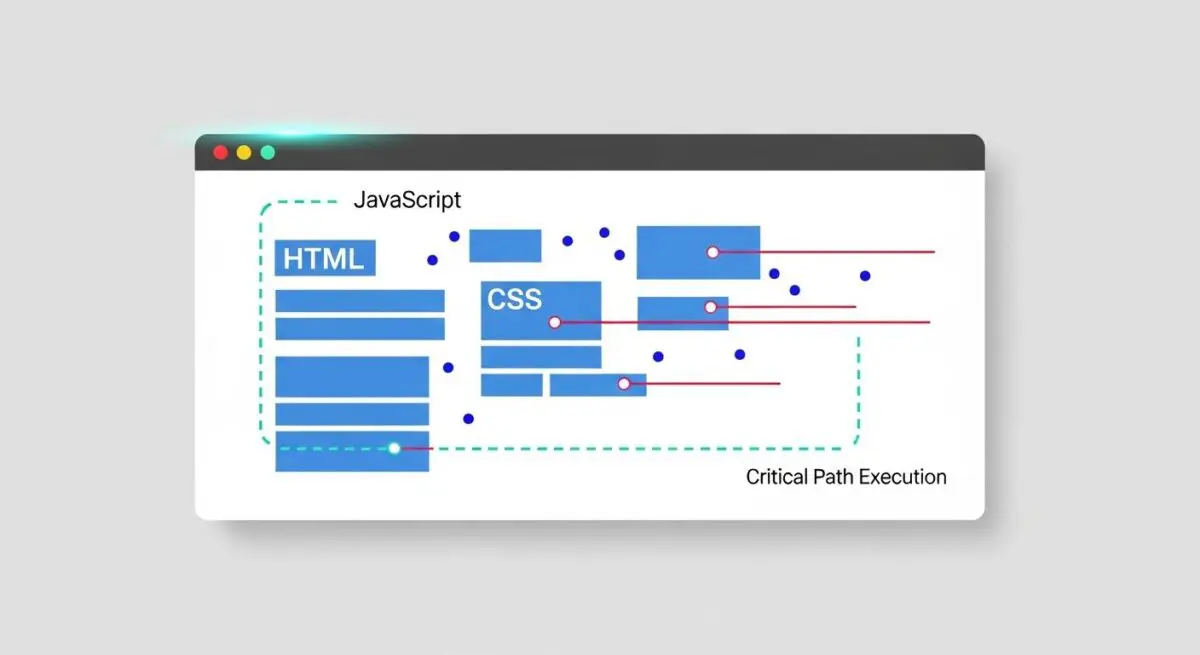
Executive Summary
- The Critical Rendering Path (CRP) is the linear sequence of events—DOM, CSSOM, Render Tree, Layout, and Paint—required for a browser to display a webpage.
- Render-blocking resources, particularly synchronous CSS and JavaScript, are the primary bottlenecks that delay the First Contentful Paint (FCP).
- Optimization of the CRP involves minimizing the number of critical resources, reducing the critical path length, and decreasing the critical bytes.
What is Critical Rendering Path?
The Critical Rendering Path (CRP) is the sequence of steps the browser undergoes to convert HTML, CSS, and JavaScript into actual pixels on the screen. This process begins with the construction of the Document Object Model (DOM) as the browser parses HTML. Simultaneously, the browser processes CSS to build the CSS Object Model (CSSOM). These two independent tree structures are then combined to create the Render Tree, which contains only the nodes required to render the page.
Once the Render Tree is established, the browser enters the Layout stage (also known as reflow), where it calculates the exact position and size of each object within the viewport. The final stage is Painting, where the browser renders the individual pixels to the screen. Any delay in these stages—such as waiting for a large CSS file or a synchronous script—stalls the entire pipeline, resulting in a blank screen for the user.
The Real-World Analogy
Imagine you are building a custom-designed house. The DOM is the structural blueprint (walls, rooms, doors). The CSSOM is the interior design specification (paint colors, wallpaper, flooring types). You cannot start the Render Tree (the final construction plan) until you know both where the walls go and what goes on them. The Layout phase is the actual framing and positioning of the furniture based on the dimensions of the rooms. Finally, Painting is the actual application of finishes. If the interior designer is late with the specs (render-blocking CSS), the builders must stop and wait, delaying the moment the owner can move in.
Why is Critical Rendering Path Critical for Website Performance and Speed Engineering?
The efficiency of the Critical Rendering Path directly dictates a website’s perceived performance and its scores in Core Web Vitals. Specifically, the Largest Contentful Paint (LCP) and First Contentful Paint (FCP) are heavily dependent on how quickly the browser can navigate the CRP. If the path is cluttered with unoptimized, render-blocking resources, the browser is forced to pause DOM construction, leading to higher Total Blocking Time (TBT) and a poor user experience.
In modern speed engineering, optimizing the CRP is the most effective way to reduce the “time to glass.” By streamlining this path, developers ensure that the browser performs the minimum amount of work necessary to display the initial viewport, thereby improving conversion rates and search engine visibility in AI-driven search environments.
Best Practices & Implementation
- Eliminate Render-Blocking Resources: Identify CSS and JavaScript not required for the initial fold and use the defer or async attributes for scripts, and media queries for non-critical CSS.
- Inline Critical CSS: Extract the CSS required for the above-the-fold content and place it directly in the
<head>to avoid an extra network round-trip. - Minify and Compress Assets: Reduce the total “critical bytes” by stripping unnecessary characters from HTML, CSS, and JS files using Gzip or Brotli compression.
- Optimize the DOM Depth: A complex, deeply nested DOM increases the time spent in the Layout and Paint stages; maintain a shallow and efficient HTML structure.
Common Mistakes to Avoid
One frequent error is the over-reliance on large, monolithic CSS frameworks that load thousands of lines of unused code, blocking the CSSOM construction. Another common mistake is placing script tags at the top of the document without asynchronous execution, which halts the HTML parser entirely. Finally, many brands fail to prioritize the delivery of critical assets, treating all resources with equal importance regardless of their impact on the initial render.
Conclusion
Mastering the Critical Rendering Path is fundamental to high-performance web architecture. By minimizing the dependencies between the DOM and CSSOM, engineers can achieve near-instantaneous load times and superior Core Web Vitals scores.