Executive Summary
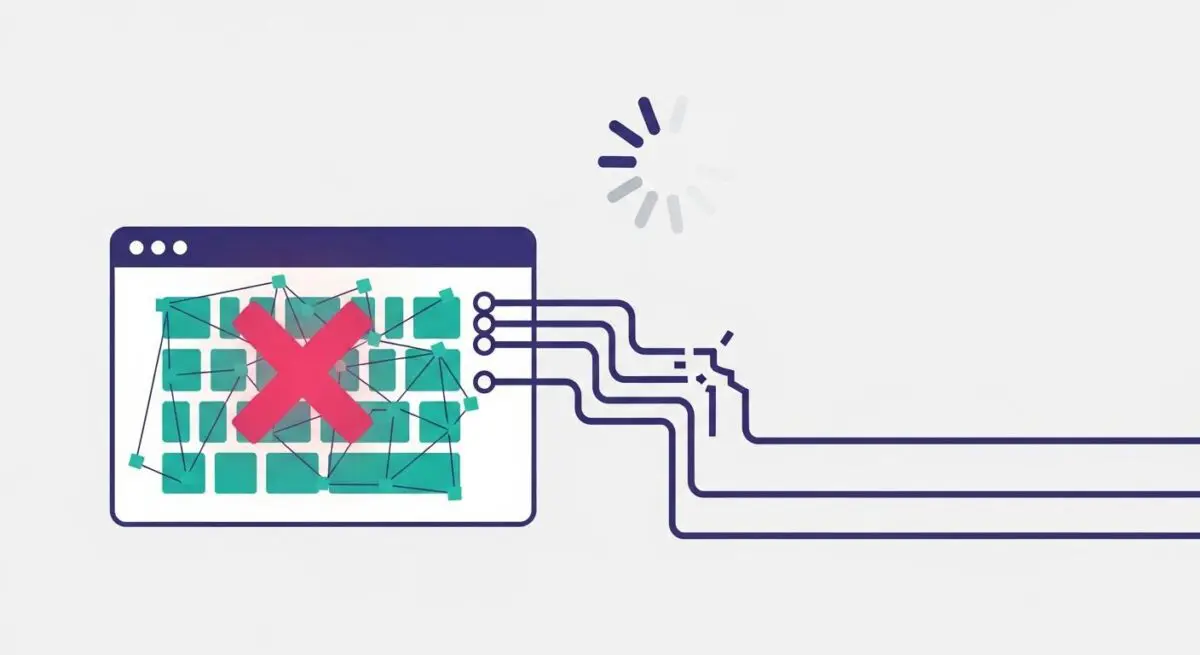
- Main thread blocking occurs when long-running JavaScript tasks exceed the 50ms threshold, preventing the browser from responding to user inputs or updating the UI.
- It is the primary technical cause for poor performance in Interaction to Next Paint (INP) and Total Blocking Time (TBT) metrics.
- Effective mitigation involves offloading heavy computations to Web Workers, implementing code splitting, and utilizing asynchronous execution patterns.
What is Main Thread Blocking?
In the context of modern web browsers, the main thread is the primary execution environment where the browser processes the majority of tasks required to display a webpage. This includes parsing HTML and CSS, building the DOM (Document Object Model) and CSSOM (CSS Object Model), performing layout and paint operations, and executing JavaScript. Because the main thread is essentially single-threaded, it can only process one task at a time. If a specific task—typically a complex JavaScript function—takes a significant amount of time to execute, it “blocks” the thread.
Technically, any task that occupies the main thread for more than 50 milliseconds is classified as a “Long Task.” During this period, the browser is unable to respond to user interactions such as clicks, scrolls, or keyboard inputs, nor can it perform visual updates. This leads to a perceived freeze or “jank” in the user interface, directly impacting the fluidity of the user experience and the site’s performance profile.
The Real-World Analogy
Imagine a single-lane bridge that serves as the only entrance to a busy city. Under normal conditions, cars (small tasks like rendering text or handling a click) flow through quickly. However, if a massive, slow-moving oversized load (a heavy JavaScript execution) enters the bridge, all other traffic must stop and wait until that single vehicle reaches the other side. Even if a driver at the front of the line is honking (a user clicking a button), the bridge is physically occupied, and no progress can be made until the oversized load clears the path.
Why is Main Thread Blocking Critical for Website Performance and Speed Engineering?
Main thread blocking is a critical bottleneck because it directly dictates a website’s responsiveness. In the era of Core Web Vitals, Google heavily weights metrics that measure interactivity. Specifically, Total Blocking Time (TBT) measures the total amount of time between First Contentful Paint (FCP) and Time to Interactive (TTI) where the main thread was blocked for long enough to prevent input responsiveness. Furthermore, the Interaction to Next Paint (INP) metric assesses the latency of all interactions throughout the entire page lifecycle.
When the main thread is blocked, the browser’s event loop is stalled. This results in high latency, which frustrates users and signals to search engines that the page is technically unoptimized. For enterprise-level sites, excessive main thread activity often stems from bloated third-party scripts, unoptimized tracking pixels, and inefficient client-side rendering frameworks, all of which must be audited to maintain competitive search rankings and conversion rates.
Best Practices & Implementation
- Implement Web Workers: Offload CPU-intensive logic, such as data processing or complex calculations, to a background thread using the Web Workers API, keeping the main thread free for UI updates.
- Code Splitting and Tree Shaking: Reduce the initial JavaScript payload by breaking bundles into smaller, route-specific chunks and removing unused code to minimize the time spent parsing and compiling scripts.
- Yield to the Main Thread: Break up “Long Tasks” into smaller micro-tasks using requestIdleCallback or setTimeout(fn, 0), allowing the browser to interleave high-priority user input handling between script executions.
- Optimize Third-Party Scripts: Audit and defer non-critical third-party tags. Use the async or defer attributes to ensure they do not block the initial construction of the DOM.
Common Mistakes to Avoid
One frequent error is the synchronous execution of large JSON parsing or data transformation logic during the initial page load, which can lock the UI for several hundred milliseconds. Another common mistake is the over-reliance on heavy JavaScript frameworks for simple content delivery, leading to excessive “hydration” costs. Finally, many developers fail to monitor the impact of third-party marketing and analytics scripts, which often introduce unpredictable long tasks that degrade INP scores without the development team’s direct knowledge.
Conclusion
Main thread blocking is a fundamental performance barrier that necessitates a shift toward asynchronous architecture and disciplined resource management. Minimizing main thread contention is no longer optional; it is a technical requirement for achieving elite Core Web Vitals scores and ensuring a seamless user experience.