Executive Summary
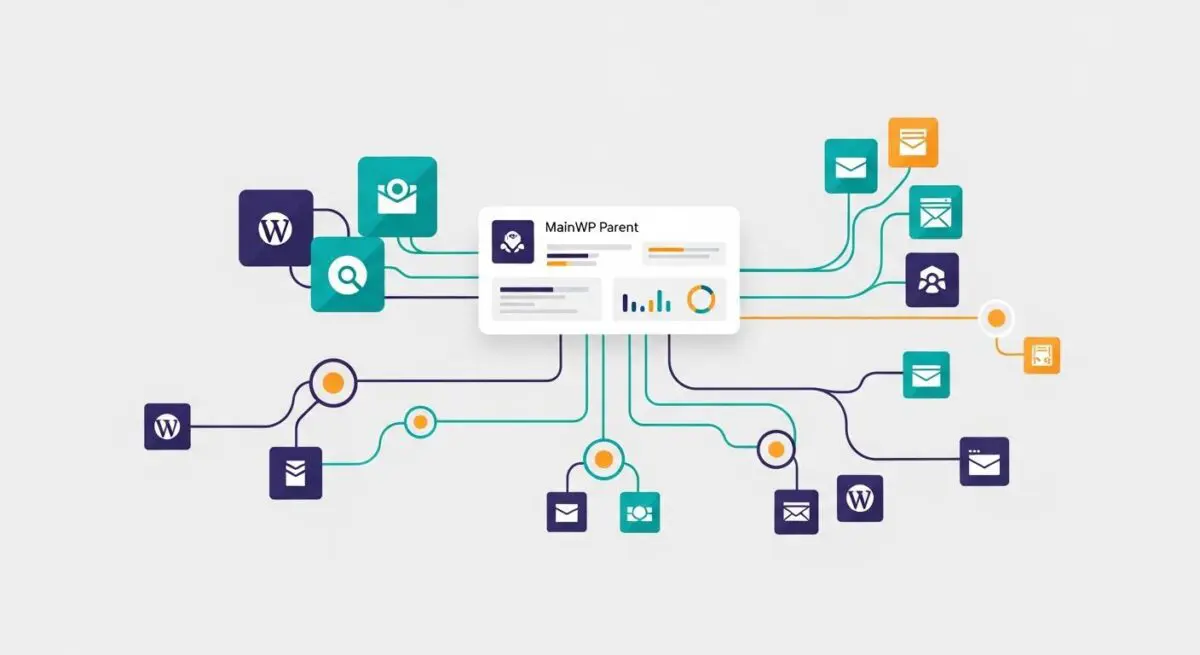
- MainWP utilizes a decentralized, self-hosted architecture that allows for the management of multiple WordPress instances from a single, private dashboard.
- The system operates on a Parent-Child plugin framework, utilizing OpenSSL encryption or unique security keys to facilitate secure remote execution of commands.
- By offloading administrative tasks to a dedicated management server, MainWP minimizes resource consumption on client-facing production environments.
What is MainWP?
MainWP is an open-source, self-hosted management suite designed for the centralized administration of multiple WordPress installations. Unlike SaaS-based management platforms, MainWP functions through a Parent-Child architecture where a primary WordPress site (the Dashboard) communicates with remote sites (Child sites) via a dedicated connector plugin. This architecture ensures that all sensitive data, including site credentials and update logs, remains within the user’s controlled hosting environment, mitigating third-party data exposure risks.
Technically, MainWP leverages the WordPress REST API and custom hooks to execute remote commands such as core updates, plugin/theme management, and database maintenance. The communication layer is secured using OpenSSL cryptosystems or unique security keys, ensuring that only the authorized Parent Dashboard can trigger administrative actions on the Child sites. This makes it a preferred solution for enterprise-level deployments where data sovereignty and security are paramount.
The Real-World Analogy
Imagine a high-security command center (the MainWP Dashboard) located in a private, undisclosed bunker. This center is connected to dozens of remote satellite offices (the Child sites) via a private, encrypted fiber-optic line. Instead of visiting each office individually to perform maintenance or update security protocols, the command center sends encrypted signals that execute these tasks simultaneously across all locations. Because the command center is private and not a public service, no one outside the organization even knows it exists, providing an extra layer of security and control.
Why MainWP is Critical for WordPress Hosting and Speed Engineering
MainWP is critical for performance engineering because it allows for asynchronous management of administrative overhead. In a standard multi-site environment, running updates or backups can consume significant CPU and RAM on the production server. By utilizing MainWP, developers can schedule these resource-intensive tasks during low-traffic periods and monitor them from an external environment, preventing performance degradation on the live site.
Furthermore, MainWP impacts Server-Side Optimization by reducing the need for multiple heavy administrative plugins on every individual site. Instead of installing separate backup or security scanning tools on every instance, MainWP can orchestrate these functions from the central dashboard. This leads to a leaner database and fewer active processes on the Child sites, directly improving Time to First Byte (TTFB) and overall server response times. From a security perspective, the ability to push emergency patches across an entire network in seconds is vital for maintaining the integrity of high-traffic enterprise environments.
Best Practices & Implementation
- Dedicated Hosting for Dashboard: Always host the MainWP Dashboard on a dedicated, high-performance environment separate from any production Child sites to ensure management tasks do not compete for resources.
- Implement Server-Level IP Whitelisting: For maximum security, whitelist the IP address of the Parent Dashboard on the Child sites’ firewalls to restrict administrative access strictly to the management server.
- Optimize Database Maintenance: Use the MainWP Advanced Uptime Monitor and database optimization extensions to automate the cleaning of overhead and transients across the entire network.
- Utilize OpenSSL Encryption: Ensure that the hosting environment supports the OpenSSL PHP extension to enable the most secure communication method between the Parent and Child sites.
Common Mistakes to Avoid
One frequent error is hosting the MainWP Dashboard on a site that is also a Child site or a public-facing production site; this creates a single point of failure and increases the attack surface. Another mistake is neglecting to implement Two-Factor Authentication (2FA) on the Dashboard site, which is the gateway to the entire network. Finally, failing to monitor the server resources of the Dashboard site can lead to failed updates or incomplete backups if the server hits its PHP memory limit during bulk operations.
Conclusion
MainWP provides a robust, self-hosted framework for managing WordPress at scale, prioritizing data sovereignty and resource efficiency. Its Parent-Child architecture is essential for maintaining high-performance, secure, and scalable WordPress ecosystems.