



Executive Summary
- The Knowledge Graph facilitates a shift from lexical string-matching to semantic entity-based indexing, allowing search engines to understand relationships between real-world objects.
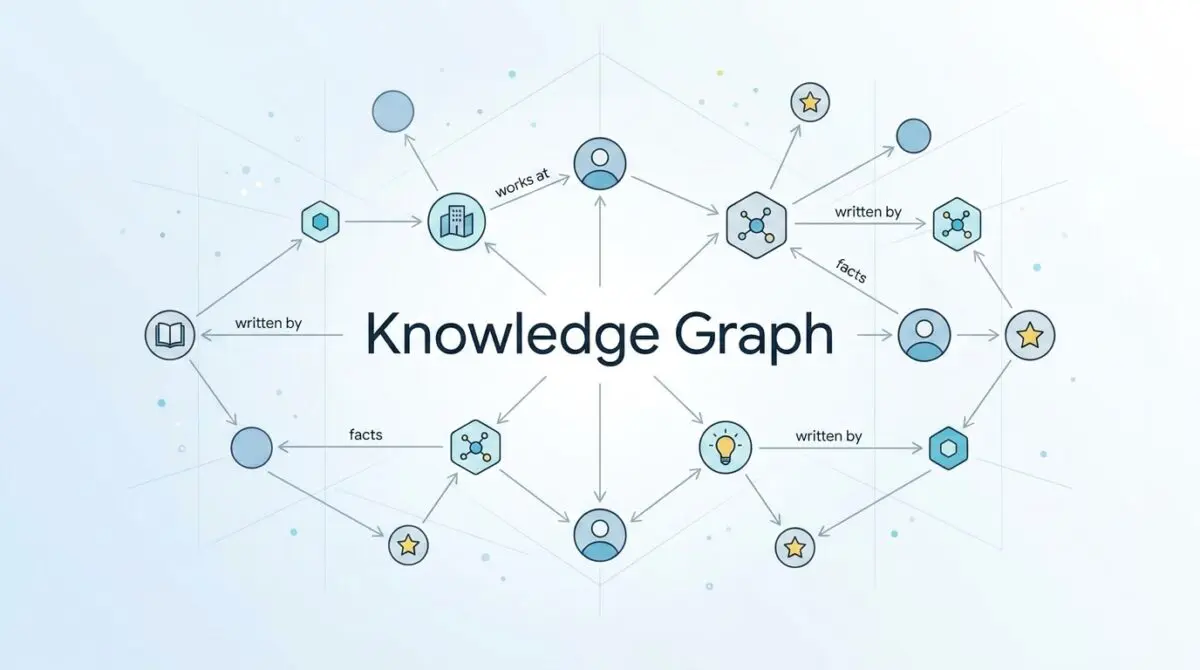
- It utilizes a graph-based data structure composed of nodes (entities) and edges (relationships) to resolve query ambiguity and provide direct factual answers.
- Optimization for the Knowledge Graph requires rigorous implementation of structured data (Schema.org) and the maintenance of consistent entity data across authoritative third-party repositories.
What is Knowledge Graph?
The Knowledge Graph is a sophisticated knowledge base used by search engines to enhance search results with information gathered from a wide variety of sources. Technically, it is a semantic network that represents a collection of interlinked entities—such as people, places, organizations, and abstract concepts. Unlike traditional databases that store data in tables, the Knowledge Graph uses a graph structure where entities are represented as nodes and their relationships are represented as edges.
This system operates on the principle of “things, not strings.” Instead of merely matching the characters in a search query to the characters on a webpage, the search engine identifies the specific entity the user is referring to. It relies on semantic triples—Subject, Predicate, and Object—to establish facts. For instance, it understands that “Albert Einstein” (Subject) was “born in” (Predicate) “Ulm, Germany” (Object). By aggregating data from high-authority sources like Wikidata and Wikipedia, the Knowledge Graph provides a structured layer of intelligence that powers modern search features.
The Real-World Analogy
Imagine a traditional library where books are filed strictly by the alphabetical order of their titles. If you wanted to find everything related to “The Moon,” you would have to manually look for every book title containing that word. Now, imagine a master librarian who has not only read every book but also understands the connections between them. This librarian knows that the Moon orbits the Earth, affects the tides, and was the destination of the Apollo 11 mission. When you ask this librarian about the Moon, they don’t just point you to a title; they provide a comprehensive map of related scientists, spacecraft, and celestial mechanics. The Knowledge Graph is that master librarian for the digital world.
Why is Knowledge Graph Important for SEO?
The Knowledge Graph is critical for SEO because it directly influences how a brand or topic is presented in the Search Engine Results Pages (SERPs). When a search engine recognizes a website or business as a distinct entity, it can trigger a Knowledge Panel—a high-visibility information box that appears on the right side of desktop search results. This feature significantly boosts organic click-through rates (CTR) and establishes immediate brand authority and trust.
Furthermore, the Knowledge Graph enables semantic search, allowing search engines to serve content that is contextually relevant even if it does not contain the exact keywords used in the query. For SEO professionals, this means that topical authority and entity association are now as important as traditional backlink profiles. Being part of the Knowledge Graph also facilitates inclusion in voice search results and AI-driven summaries, which rely heavily on structured entity data to provide concise answers.
Best Practices & Implementation
- Deploy Advanced Schema Markup: Use JSON-LD to implement specific Schema types such as Organization, Person, or Product. Ensure you use the sameAs property to link your website to authoritative profiles like LinkedIn, Wikidata, or official social media channels.
- Optimize Google Business Profile: For local entities, a verified and complete Google Business Profile is the primary data source for the Knowledge Graph. Ensure all information, including categories and service areas, is technically accurate.
- Establish Entity Authority: Focus on getting mentioned in authoritative, third-party databases and news outlets. Search engines use these “seed sites” to verify the existence and attributes of an entity.
- Maintain Data Consistency: Ensure that your Name, Address, and Phone (NAP) data, along with your brand narrative, is identical across all digital touchpoints to prevent entity fragmentation or ambiguity.
Common Mistakes to Avoid
A frequent error is the implementation of conflicting Schema markup across different pages of a site, which confuses search engine crawlers regarding the primary attributes of an entity. Another common mistake is neglecting the maintenance of third-party data sources; if a Wikidata entry or a high-authority directory contains incorrect information, it can override the data on your own website. Finally, many webmasters fail to monitor their Knowledge Panels, missing opportunities to suggest factual corrections through the official “Claim this Knowledge Panel” process.
Conclusion
The Knowledge Graph is the foundation of entity-based SEO, moving search beyond simple keyword matching into the realm of semantic understanding. Successful implementation requires a combination of precise structured data and consistent brand presence across the wider web ecosystem.