



Executive Summary
- Semantic search shifts retrieval from lexical keyword matching to intent-based vector space analysis.
- It utilizes transformer-based architectures and knowledge graphs to understand entity relationships and contextual nuances.
- Optimization for semantic search is foundational for visibility in Retrieval-Augmented Generation (RAG) and AI-driven discovery engines.
What is Semantic Search?
Semantic search is a sophisticated data retrieval methodology that prioritizes the intent and contextual meaning of a query over literal keyword matching. Unlike traditional Boolean or frequency-based search models, semantic systems leverage Natural Language Processing (NLP) and machine learning to interpret the underlying relationships between concepts, entities, and phrases. By mapping data into high-dimensional vector spaces, these systems can identify relevant information even when the specific terminology used in a query does not appear in the source text.
At a technical level, semantic search relies on embeddings generated by Large Language Models (LLMs) such as BERT or RoBERTa. These embeddings represent the semantic “essence” of a document as a numerical vector. When a user submits a query, the search engine converts that query into a vector and calculates the mathematical proximity (often via cosine similarity) to indexed content. This allows for the resolution of polysemy—where one word has multiple meanings—and synonymy, ensuring that the most conceptually relevant results are surfaced in the context of Generative Engine Optimization (GEO).
The Real-World Analogy
Imagine walking into a world-class library and asking a master librarian for “material on the device that prevents a vehicle from moving.” A traditional, keyword-reliant system would scan every book title for those exact words and likely find nothing. A semantic librarian, however, understands the concept of automotive mechanics and the intent behind your request; they would immediately direct you to the section on “Braking Systems,” recognizing that while you didn’t use the word “brake,” your conceptual meaning was clear.
Why is Semantic Search Important for GEO and LLMs?
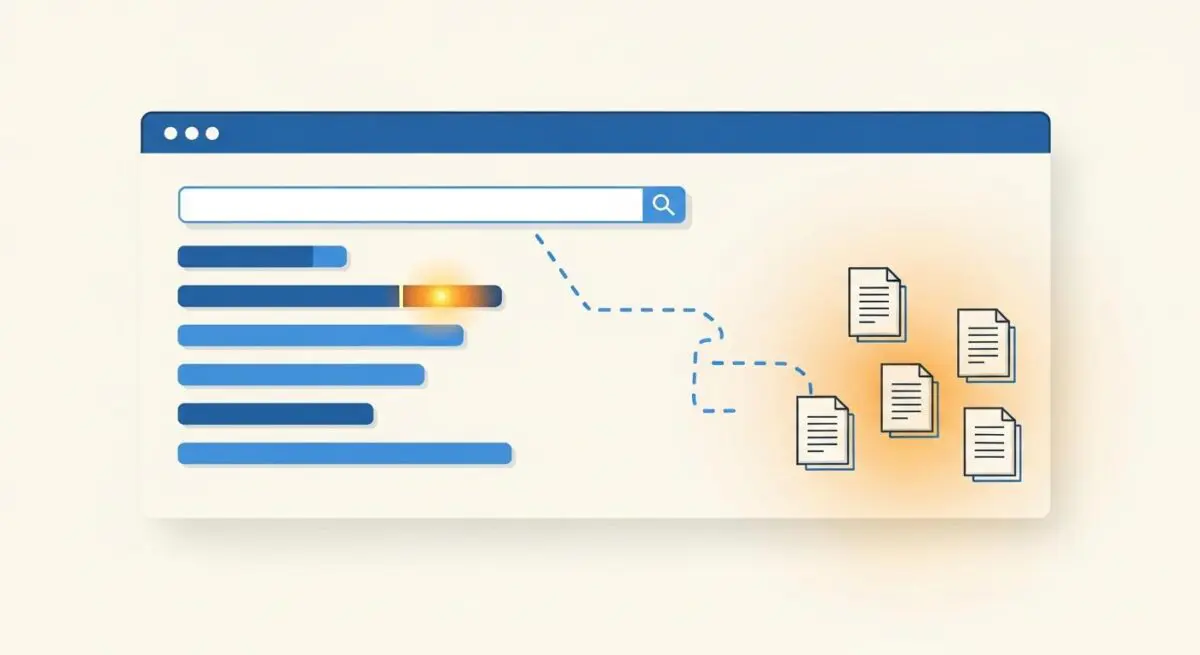
In the landscape of AI Search and LLMs, semantic search serves as the primary mechanism for Retrieval-Augmented Generation (RAG). When an AI agent like Perplexity or ChatGPT processes a query, it first performs a semantic retrieval to gather contextually relevant snippets from the web. If content is not semantically optimized—meaning it lacks clear entity relationships and contextual depth—it will fail to be retrieved, effectively becoming invisible to the AI’s response generation process.
Furthermore, semantic search is the engine behind entity authority. AI systems use semantic signals to determine which sources are the most authoritative on specific topics. By establishing a dense network of related concepts and clear factual statements, a brand can increase its “semantic density,” making it more likely to be cited as a primary source in AI-generated answers. This shift from ranking for keywords to ranking for concepts is the core challenge of modern GEO.
Best Practices & Implementation
- Deploy Comprehensive Schema Markup: Utilize advanced JSON-LD to explicitly define entities, their attributes, and their relationships to other known entities in the global knowledge graph.
- Build Topical Authority Hubs: Instead of isolated pages, create interconnected content clusters that cover a subject exhaustively, reinforcing the semantic relevance of the entire domain.
- Optimize for Natural Language Intent: Structure content to answer the “why” and “how” behind a query, mirroring the conversational and complex nature of LLM-based interactions.
- Prioritize Entity-Centric Writing: Use clear, unambiguous language to define terms and maintain consistent nomenclature across all digital assets to assist vector engines in accurate indexing.
Common Mistakes to Avoid
A frequent error is the persistence of keyword stuffing, which disrupts the natural semantic flow and can confuse neural embeddings. Another critical mistake is the creation of “thin” content that lacks the necessary contextual signals for an AI to determine its relevance to a broader topic. Finally, many organizations fail to optimize their internal linking structures, which are vital for establishing the semantic hierarchy and relationship between different pieces of information on a website.
Conclusion
Semantic search represents the evolution from string-matching to thing-matching, serving as the critical infrastructure for visibility in an AI-dominated search ecosystem.