Executive Summary
- CNAME records function as DNS aliases, mapping one hostname to another rather than to a direct IP address.
- They are critical for WordPress scalability, allowing for seamless integration with CDNs, WAFs, and managed hosting providers.
- Proper implementation requires avoiding root domain usage and minimizing lookup chains to maintain optimal Time to First Byte (TTFB).
What is CNAME Record?
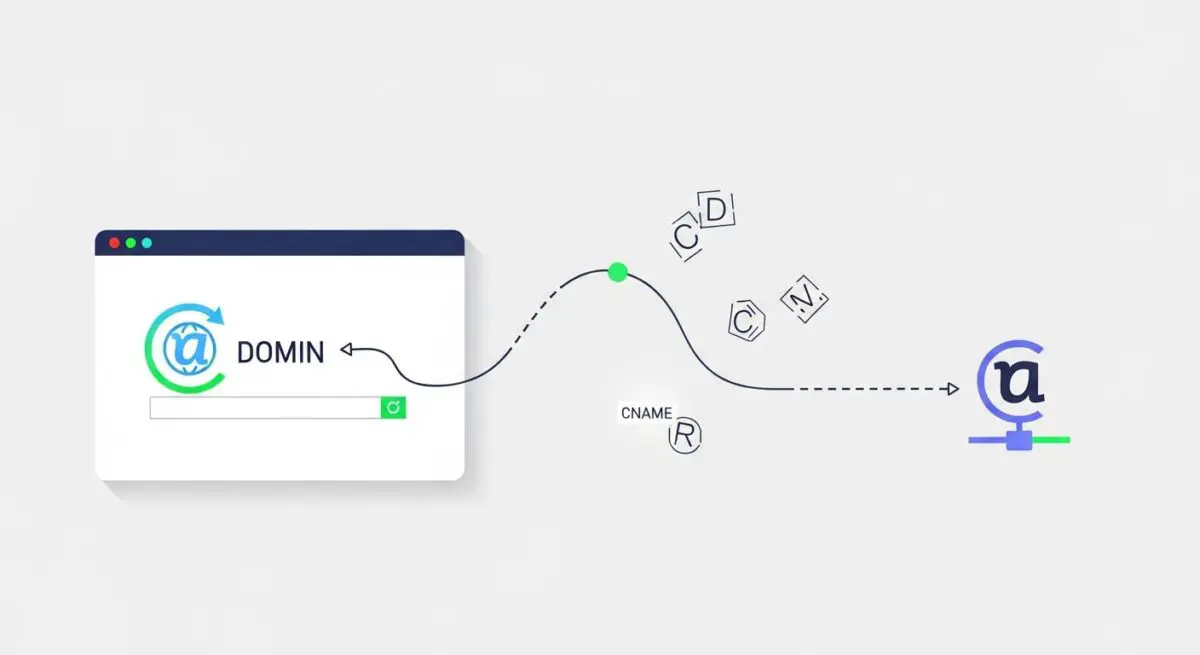
A Canonical Name (CNAME) record is a fundamental component of the Domain Name System (DNS) architecture that maps an alias domain name to a canonical (true) domain name. Unlike an A record, which maps a hostname directly to a static IPv4 address, a CNAME record creates a pointer from one hostname to another. In the context of WordPress hosting, CNAME records are frequently utilized to point subdomains—such as www or cdn—to the primary domain or an external service provider’s infrastructure.
Within enterprise WordPress environments, CNAME records are essential for integrating Managed WordPress Hosting platforms and Content Delivery Networks (CDNs). When a DNS resolver encounters a CNAME record, it restarts the lookup process using the canonical name specified in the record. This abstraction layer allows system administrators to change the underlying server IP addresses at the canonical level without requiring manual updates to every associated alias record, ensuring high availability and simplified infrastructure management.
The Real-World Analogy
Imagine a large corporation where the “Chief Financial Officer” is a specific role (the CNAME alias) currently held by an individual named “Robert Smith” (the canonical name). If you need to send a report to the CFO, you address it to the “CFO” rather than Robert personally. If Robert leaves and is replaced by Sarah, the company simply updates the “CFO” designation to point to Sarah. You do not need to change how you address your reports; the alias remains the same, while the destination it points to is updated internally. In DNS terms, the CNAME is the “CFO” title, and the canonical name is the specific person currently occupying that role.
How CNAME Record Impacts Server Performance & Speed Engineering?
CNAME records significantly influence WordPress performance through DNS resolution latency and resource distribution. While CNAMEs provide flexibility, they introduce an additional step in the DNS lookup process. A resolver must first identify the CNAME and then perform a subsequent lookup for the canonical name’s A record. This “CNAME chaining” can add several milliseconds to the Time to First Byte (TTFB) if not managed correctly. However, from a speed engineering perspective, CNAMEs are vital for offloading static assets. By pointing a subdomain (e.g., assets.example.com) to a CDN via a CNAME, developers can leverage edge caching and parallelize browser requests, effectively bypassing the limitations of the primary server’s concurrent connection limits.
Best Practices & Implementation
- Avoid CNAME Chaining: Ensure that a CNAME points directly to an A record whenever possible to minimize the number of DNS lookups required for resolution.
- Apex Domain Restrictions: Never attempt to use a CNAME record for a root domain (e.g., example.com), as this violates DNS RFC specifications and can break mail exchange (MX) records; use ALIAS or ANAME records if supported by your DNS provider.
- Optimize TTL Settings: Set lower Time to Live (TTL) values during migrations to ensure rapid propagation, but increase them for stable production environments to improve DNS caching efficiency.
- CDN Integration: Utilize CNAME records to map custom subdomains to CDN endpoints, allowing for branded asset URLs while benefiting from global edge distribution.
Common Mistakes to Avoid
A frequent error is the “CNAME at the Root” mistake, where administrators try to point their main domain to a service provider using a CNAME, which inadvertently suppresses other record types like MX or TXT. Another common issue is creating circular CNAME references, where Record A points to Record B, and Record B points back to Record A, resulting in a resolution failure. Finally, failing to account for the extra DNS lookup latency in high-performance environments can lead to degraded Core Web Vitals, specifically impacting Largest Contentful Paint (LCP).
Conclusion
CNAME records are indispensable tools for modern WordPress architecture, enabling scalable CDN integration and flexible hosting migrations. When implemented with an understanding of DNS lookup overhead and RFC constraints, they provide the necessary abstraction for high-availability enterprise web environments.