



Executive Summary
- Word of Mouth Marketing (WOMM) functions as a decentralized growth engine, significantly lowering Customer Acquisition Cost (CAC) by leveraging peer-to-peer trust.
- The technical challenge of WOMM lies in ‘Dark Social’ attribution, where organic recommendations occur outside tracked digital environments.
- Strategic WOMM integration requires aligning Net Promoter Score (NPS) data with automated referral loops and social listening MarTech.
What is Word of Mouth Marketing?
Word of Mouth Marketing (WOMM) is a strategic framework centered on the organic or incentivized dissemination of brand information through interpersonal communication. In the context of a modern MarTech stack, WOMM is no longer merely ‘buzz’; it is a quantifiable channel that operates at the intersection of behavioral economics and network effects. It involves the systematic cultivation of brand advocates who act as decentralized nodes, transmitting high-trust signals to potential customers within their social or professional circles. This process bypasses traditional advertising fatigue by utilizing existing social capital to validate a product or service’s value proposition.
From a technical perspective, WOMM is integrated into Data Analytics and SEO through the monitoring of brand mentions, sentiment analysis, and the tracking of referral traffic. While traditional paid media relies on interruptive models, WOMM leverages the ‘social proof’ heuristic, which is a critical component of the conversion funnel. In the era of AI-Search and Generative Engine Optimization (GEO), WOMM provides the essential ‘human-verified’ data points that Large Language Models (LLMs) and search algorithms prioritize when determining brand authority and topical relevance.
The Real-World Analogy
Imagine you are looking for a highly specialized neurosurgeon. You could look at a billboard (Paid Advertising) or a directory (Search Engine), but those sources are incentivized or purely functional. Instead, you ask a colleague who recently underwent a successful procedure. That colleague’s recommendation carries more weight because it is based on a successful outcome and a pre-existing relationship of trust. In the business world, Word of Mouth Marketing is that ‘trusted colleague’ at scale. It is the difference between a brand shouting its own merits and a community of experts and peers verifying those merits, effectively acting as a high-fidelity filter in an environment saturated with marketing noise.
How Word of Mouth Marketing Impacts Marketing ROI & Data Attribution?
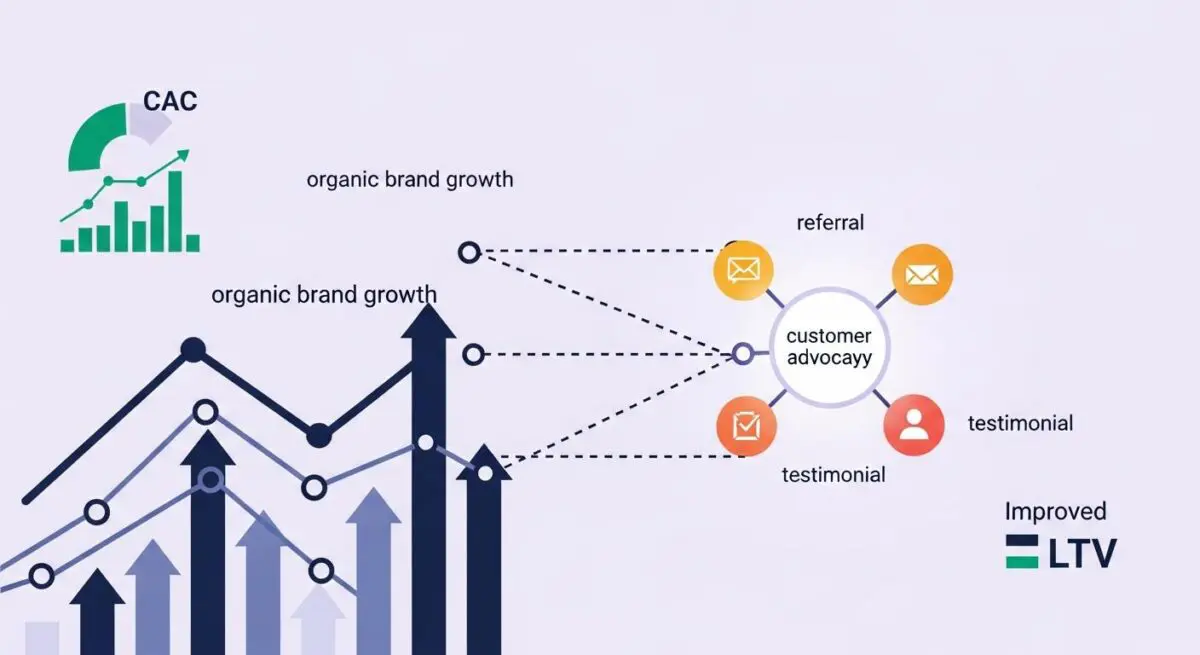
The primary impact of WOMM on Marketing ROI is the drastic reduction of Customer Acquisition Cost (CAC) and the simultaneous increase in Customer Lifetime Value (LTV). Because WOMM-generated leads enter the funnel with a pre-established level of trust, they typically exhibit higher conversion rates and shorter sales cycles. However, the technical complexity arises in attribution. Much of WOMM occurs in ‘Dark Social’—private messaging apps, emails, or offline conversations—making it difficult for standard last-click attribution models to accurately credit the source of the conversion.
To solve this, advanced marketing organizations utilize multi-touch attribution (MTA) and media mix modeling (MMM) to estimate the lift provided by organic advocacy. By analyzing the correlation between brand sentiment velocity and organic traffic spikes, data scientists can quantify the impact of WOMM. Furthermore, WOMM creates a ‘flywheel effect’ where the cost of maintaining the channel decreases over time as the network of advocates grows, unlike paid channels where costs often scale linearly or exponentially with competition.
Strategic Implementation & Best Practices
- Implement Automated Referral Loops: Integrate referral software directly into the CRM via API to trigger personalized advocacy invitations based on positive customer milestones, such as a high NPS score or a successful product deployment.
- Leverage Social Listening for Sentiment Analysis: Use NLP-driven social listening tools to monitor brand mentions across the web. This data should be used to identify ‘super-advocates’ and address negative sentiment before it impacts the brand’s organic reputation.
- Optimize for ‘Shareable’ Data Points: Create high-value, technical content or tools (e.g., calculators, whitepapers) that provide immediate utility, encouraging professionals to share them within their internal networks, thus generating organic WOMM.
- Integrate UGC with SEO Strategy: Encourage and curate user-generated content, such as technical reviews or case studies. This content provides the ‘social proof’ that search engines use to verify E-E-A-T (Experience, Expertise, Authoritativeness, and Trustworthiness).
Common Pitfalls & Strategic Mistakes
A frequent error is the over-incentivization of referrals, which can lead to ‘incentive-driven’ rather than ‘value-driven’ advocacy. This often results in lower-quality leads and can damage brand integrity if the recommendations feel forced or insincere. Another pitfall is the failure to account for ‘Dark Social’ in attribution models, leading marketing directors to over-allocate budget to easily trackable but less efficient paid channels while neglecting the organic engines that actually drive long-term growth.
Conclusion
Word of Mouth Marketing remains the most potent form of brand validation, requiring a sophisticated blend of behavioral psychology and data-driven tracking to master. For the modern enterprise, it is an essential component of a resilient, low-CAC marketing architecture that thrives on trust and community verification.