

Key Points
- Eradicating Extrovert Bias: AI-driven inclusion nudges bypass office politics to surface critical insights from quiet subject matter experts.
- Capitalizing on Meeting Equity: Teams utilizing AI to minimize ‘ghost mode’ grow three times faster by optimizing their internal human capital.
- Autonomous C-Suite Agents: The future of enterprise strategy involves AI transitioning from passive transcription to active, voting board observers.
Table of Contents
The Core Friction: Silencing the Ghost Mode Epidemic
According to a February 2026 study by Read AI reported in Forbes, women contributed 9% more airtime than men relative to their representation when an AI notetaker was present. This effectively reversed historical gender-based meeting power dynamics in a single stroke. The era of passive transcription is officially dead, replaced by a much more disruptive operational framework.
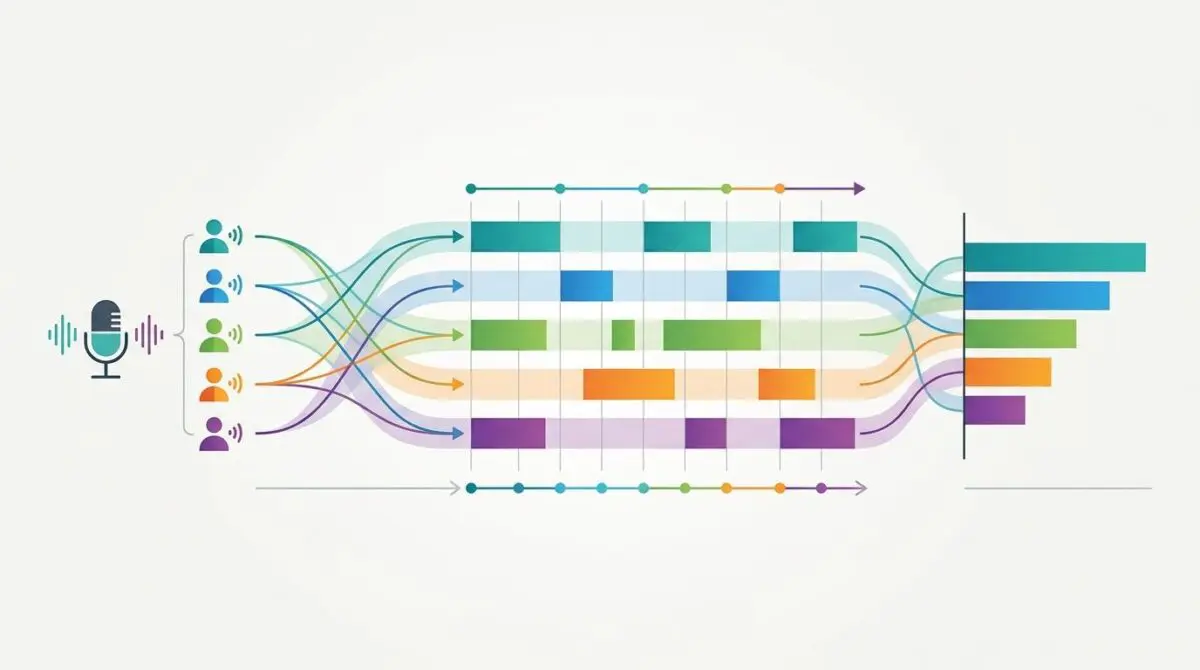
Enter Intelligent Meeting Orchestration (IMO), a structural overhaul of how corporate decisions are made. For decades, enterprise boardrooms have been plagued by the “Meeting Ghosting” epidemic. This is a toxic environment where extrovert bias dominates, leading directly to groupthink and massive missed innovative opportunities.
IMO solves this by introducing an objective, algorithmic layer that actively bypasses office politics. It mitigates seniority-based silencing by quantifying participation and engagement in real-time. For executives, this permanently eliminates the “Decision Blind Spot” by ensuring dissenting or niche expert voices are surfaced automatically.
Market Intelligence & Smart Capital
Market Intelligence & Data
Market Projection
The global AI Meeting Assistant market is forecast to reach $72.17 billion by 2034, growing at a 34.7% CAGR, according to Market.us research.
Performance Multiplier
Teams that utilize AI to minimize ‘ghost mode’ and maximize participation grow nearly three times faster than those with high levels of disengagement, per Read AI’s 2026 analysis.
Fortune 500 Adoption
More than 80% of Fortune 500 companies are now running production-level AI agents to handle meeting and workflow orchestration, according to 2026 data from Brian Sykes.
Bias Monitoring
Gartner predicts that 40% of organizations deploying AI will implement dedicated observability tools by 2028 to specifically monitor for model bias and non-inclusive outputs.
The capital markets are aggressively pricing in the financial value of meeting equity. Institutional capital is flowing rapidly toward tools that solve the organizational culture gap and optimize human output. This rapid expansion is mirrored by a Market.us research report projecting massive adoption across global enterprises.
Investors recognize that unengaged participants represent a direct leak in operational alpha. Teams that leverage AI to minimize “ghost mode” are seeing exponential returns on their human capital investments.
The Strategic Deep Dive: Engineering Meeting Equity
Bypassing Extrovert Bias and Office Politics
The psychology of the traditional boardroom is inherently flawed, often rewarding the loudest voice rather than the smartest idea. Intelligent Meeting Orchestration dismantles this dynamic through real-time “Agentic Facilitation.” These AI facilitators actively moderate virtual and hybrid spaces to ensure an equitable share of voice.
When the system identifies unengaged participants, it uses sentiment analysis to prompt quiet subject matter experts for their input. Simultaneously, private haptic or visual alerts are sent to dominant speakers to encourage space-sharing. This creates a frictionless environment where data-driven objectivity replaces ego-driven monologues.
Key mechanisms driving this boardroom revolution include:
- Meeting Equity Scorecards: Correlating talk-time with actual team output to identify hidden talent.
- Inclusion Nudges: Private alerts sent to dominant speakers to enforce conversational balance.
- Distributed Intelligence: Transitioning from autocratic decision-making to algorithmic consensus.
The Rise of Agentic Facilitation
We are witnessing a profound transition from autocratic leadership to Distributed Intelligence models. Enterprise leaders are leveraging AI to manage the structural flow of the conversation itself. This shift is turning AI from a passive observer into an active behavioral coach.
A comprehensive 2026 survey by Writer reveals that 75% of C-suite executives expect AI agents to occupy formal, named roles within their leadership teams within the next five years. This indicates a massive paradigm shift from AI as a mere software tool to AI as a collaborative colleague.
Venture capital is heavily backing this transition, with firms like Haun Ventures launching a $1B AI-focused fund in May 2026. Startups like EquiMeet have already raised significant Series B funding to pioneer human-centric AI coaching. Tech giants Zoom and Microsoft are scrambling to integrate similar metrics into their core suites to remain competitive.
The Executive Action Plan: Autonomous Orchestration
Strategic Trajectory
- Accelerate the deployment of Autonomous C-Suite Agents to streamline executive workflows.
- Transition AI agents from moderation roles to Digital Board Observers for real-time compliance monitoring.
- Implement automated inclusivity audits during high-stakes strategic planning to ensure all voices are captured.
- Evaluate the integration of AI agents as formal voting entities to balance human intuition with data-driven objectivity.
- Scale toward fully autonomous meeting management including automated agenda preparation and debate facilitation.
- Automate post-meeting execution by utilizing AI to assign tasks and track milestone completion across the organization.
The trajectory of Intelligent Meeting Orchestration points directly toward Autonomous C-Suite Agents. As of April 2026, 97% of executives have already deployed AI agents within their daily workflows. The next evolution involves AI holding voting seats or acting as Digital Board Observers.
These digital observers will provide real-time compliance and inclusivity audits during high-stakes strategic planning. Eventually, the market will move toward fully autonomous meeting management. In this future state, the AI prepares the agenda, facilitates the debate, and assigns post-meeting tasks without human intervention.
Founders and C-level executives must proactively integrate these behavioral algorithms into their daily operations. Delaying adoption means risking severe competitive disadvantage as rival firms optimize their human capital output. The smart money is already building the infrastructure for autonomous, equitable decision-making.
Conclusion: The New Era of Distributed Intelligence
The integration of Intelligent Meeting Orchestration is no longer a speculative HR initiative. It is a fundamental restructuring of enterprise intelligence and capital allocation. By ensuring every critical voice is heard, organizations can permanently eradicate the decision blind spots that derail innovation.
Navigating the intersection of technology, capital, and market psychology requires a sharp strategy. To future-proof your business architecture and scale with precision, connect with Andres at Andres SEO Expert.