Key Points
- Context-Aware Orchestration: Transitioning from command-response AI to passive-anticipatory systems eliminates the billion-dollar context-switching tax.
- Agentic Infrastructure: Specialized edge-native hardware is replacing legacy cloud latency to process spatial and biometric data in real-time.
- Predictive Autonomy: The future of enterprise scaling relies on Physical-AI Twins simulating operations to neutralize bottlenecks before they manifest.
Table of Contents
The Context-Switching Tax
According to a May 2026 report from McKinsey & Company, 62% of Fortune 500 companies have now implemented at least one ‘invisible interface’ workflow. This shift has resulted in an average 22% increase in operational throughput. The era of the screen-bound worker is rapidly coming to an end.
We are entering the age of Enterprise Ambient Intelligence (EAmI). EAmI is not merely a technological upgrade; it is a fundamental rewiring of corporate infrastructure. It transitions organizations from ‘command-response’ AI to ‘passive-anticipatory’ systems.
Historically, businesses have paid a massive financial penalty known as the context-switching tax. This invisible drain costs enterprises billions in lost productivity due to manual data entry and disjointed software silos. EAmI solves this systemic friction by bridging the gap between physical actions and digital records.
By automating the capture of offline interactions, EAmI eliminates administrative dark tasks entirely. It creates a Zero-UI environment where the workspace itself functions as a distributed CPU. Employees no longer log data; the building logs the reality of the work being done.
This level of integration transforms the physical office into an active participant in business operations. The space itself begins to anticipate operational needs before a human ever touches a keyboard.
Every time an executive pauses to log a metric, pull a report, or adjust a system, momentum is lost. This friction is the enemy of scale in the modern enterprise. EAmI removes this friction by making the environment itself the primary interface.
The concept of Zero-UI means the best interface is no interface at all. The technology fades into the background, operating silently through spatial audio and computer vision.
Market Intelligence & Capital
Market Intelligence & Data
Total Addressable Market
The global market for ambient intelligence in enterprise settings is projected to reach $485 billion by the end of 2026, according to IDC.
Active Edge AI Nodes
Counterpoint Research reports that as of Q2 2026, there are over 4.2 billion enterprise-grade edge AI sensors deployed globally, a 300% increase since 2024.
Energy Efficiency Gains
Smart-grid ambient sensors have reduced average corporate real estate energy costs by 18.5% year-over-year in 2026, per data from BloombergNEF.
Executive Adoption Rate
A 2026 Deloitte survey found that 74% of C-suite executives now prioritize ‘Ambient Automation’ over traditional SaaS investments.
The data reveals a stark reality for legacy software models. Smart money is aggressively abandoning isolated SaaS tools in favor of unified, spatial ecosystems. As IDC forecasts ambient computing growth to reach unprecedented levels, capital allocators are pivoting their portfolios.
Venture capital is no longer interested in applications that require manual human input. Instead, funds are flowing heavily into systems that provide a continuous, real-time stream of physical-world business intelligence. This allows executives to make high-stakes decisions based on floor reality rather than delayed quarterly reports.
The C-suite is fully recognizing this paradigm shift across global markets. A recent Deloitte ambient computing report underscores that ambient automation is now outranking traditional cloud investments. The strategic mandate is clear: automate the physical environment, not just the digital software.
The valuation multiples for startups building in the ambient space are reflecting this new reality. Investors recognize that capturing physical data in real-time is the ultimate competitive moat. It is no longer about who has the best dashboard, but who has the most accurate physical world data.
This shift is forcing legacy tech giants to rapidly acquire edge-native startups to remain relevant. The race to dominate the physical layer of the enterprise has officially begun.
Those who fail to adapt will find their operational costs remaining stagnant while competitors scale exponentially. The financial upside of ambient intelligence is simply too massive to ignore.
The Edge-Native Disruption
Dominance in this new frontier is currently split between tech incumbents and agile hardware disruptors. Microsoft and Apple have already begun integrating ambient layers into office ecosystems via Windows Vision and Spatial WorkOS. However, the true disruptive power lies at the edge of the network.
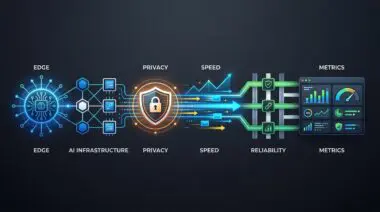
Hardware disruptors are capturing massive market share by processing data locally. This approach completely bypasses the latency issues traditionally associated with cloud computing. Smart money from firms like Andreessen Horowitz and Founders Fund is actively backing these specialized edge-native startups.
These startups are building the vital connective tissue that allows Large Language Models to interact with physical sensors. For example, advancements in Cerebras high-speed inference are enabling edge devices to process complex spatial audio instantly.
Cloud computing, while powerful, introduces latency that is unacceptable in a fully ambient environment. When a building needs to adjust to human biometrics in real-time, a round-trip to a remote server is a liability. This is why edge-native processing is becoming the gold standard for EAmI.
By keeping the computation local, enterprises also solve massive data privacy and security concerns. Sensitive biometric and spatial data never leaves the physical premises. This localized security model is highly attractive to compliance-heavy industries like healthcare and finance.
This raw computational speed allows computer vision systems to operate without any perceptible delay. The physical workspace becomes as responsive as a high-performance digital application.
Agentic Infrastructure
This connective tissue is known within venture circles as Agentic Infrastructure. It serves as the critical bridge between digital intelligence and physical robotics.
With Agentic Infrastructure, meetings are automatically transcribed into actionable workflows without human prompting. Environmental conditions adjust dynamically based on the biometric cognitive load of the occupants.
Inventory is managed via real-time spatial mapping, entirely bypassing human data entry. This is Context-Aware Orchestration functioning in its purest, most profitable form.
The system acts as an invisible manager, constantly optimizing the flow of resources and human capital. It represents the ultimate convergence of hardware, software, and human psychology.
The Physical-AI Twin
Deploying these complex systems requires a flawless, mathematically sound integration strategy. You cannot simply install thousands of sensors and hope the network adapts organically. The risk of operational disruption is simply too high for enterprise-scale deployments.
Data from the 2026 NVIDIA GTC Enterprise Briefing reveals a critical shift in deployment methodology. Jensen Huang has pivoted the company’s Omniverse strategy to focus exclusively on Physical-AI Twins.
According to the briefing, 90% of industrial ambient deployments are now simulated in virtual environments for 1,000 hours. This rigorous digital testing occurs before a single physical sensor is installed in the real world. By simulating the physical space, companies can identify friction points and optimize sensor placement virtually.
The concept of a Physical-AI Twin goes far beyond basic 3D modeling. It involves creating a hyper-accurate, physics-based simulation of the entire corporate ecosystem. Every employee movement, supply chain variable, and environmental shift is mapped and analyzed.
This allows algorithms to run millions of scenario permutations in a matter of hours. Executives can literally see the future impact of an operational change before committing capital. The digital twin becomes the ultimate sandbox for corporate strategy.
This simulation-first approach guarantees that the ambient network operates perfectly from day one. It mitigates capital risk and ensures a rapid return on infrastructure investment.
The Executive Action Plan
Strategic Trajectory
- Pivot toward Predictive Organizational Autonomy to move beyond reactive operations.
- Develop simulation engines capable of modeling and optimizing future workflows.
- Engineering self-correcting infrastructure to neutralize bottlenecks before they manifest.
- Architect the ‘Cognitive Building’ to serve as a unified, sentient enterprise operating system.
- Eliminate the friction between human intent and machine execution via non-invasive sensing.
- Integrate biometric and neural inputs to create seamless ambient intelligence environments.
The next logical evolution for enterprise leaders is the pursuit of Predictive Organizational Autonomy. Founders must prepare for systems that do not merely react to present conditions. They must engineer platforms that simulate future workflows and self-correct infrastructure before bottlenecks ever occur.
This requires a fundamental psychological shift in how executives view corporate real estate. The office is no longer a passive container for workers; it is a proactive, revenue-generating participant in the business model.
Leaders must invest heavily in simulation engines capable of modeling complex human-machine interactions. They must prioritize edge-native hardware over legacy cloud contracts to ensure real-time responsiveness.
Most importantly, they must eliminate the friction between human intent and machine execution. This is achieved by embracing non-invasive biometric and neural sensing technologies.
The Sentient Operating System
We are rapidly moving toward the realization of the Cognitive Building. This is an enterprise environment that functions as a single, fully sentient operating system.
In this advanced environment, the barrier between human thought and digital action disappears entirely. Non-invasive neural and biometric sensing will soon allow physical spaces to anticipate operational needs before they are vocalized.
The transition to a sentient operating system will fundamentally alter the nature of management. Managers will no longer need to monitor output or track KPIs manually. The Cognitive Building will handle all oversight, allowing human leaders to focus entirely on high-level strategy and empathy.
This represents a massive leap forward in organizational psychology. By removing the burden of micromanagement, enterprises can foster a culture of deep work and unprecedented innovation. The ultimate goal of EAmI is not just to automate tasks, but to elevate the human experience within the corporate structure.
The building will adjust lighting, temperature, and data access based on the real-time cognitive state of the workforce. It will become an empathetic infrastructure designed to maximize human potential and minimize cognitive load.
Those who cling to traditional screen-based interfaces will find themselves unable to compete with the speed of ambiently automated organizations. The future of business belongs entirely to the invisible interface.
Navigating the intersection of technology, capital, and market psychology requires a sharp strategy. To future-proof your business architecture and scale with precision, connect with Andres at Andres SEO Expert.
Frequently Asked Questions
What is Enterprise Ambient Intelligence (EAmI)?
Enterprise Ambient Intelligence (EAmI) is a paradigm shift in corporate infrastructure that transitions organizations from reactive “command-response” AI to passive-anticipatory systems. It creates a Zero-UI environment where the workspace itself functions as a distributed CPU, automatically capturing data from physical interactions without human input.
How does EAmI eliminate the context-switching tax?
EAmI eliminates the context-switching tax by bridging the gap between physical actions and digital records. By automating administrative tasks and data entry through spatial audio and computer vision, it removes the friction and productivity loss associated with manually toggling between disjointed software silos.
Why is edge-native processing critical for ambient automation?
Edge-native processing is the gold standard for EAmI because it eliminates the latency issues inherent in cloud computing. By processing data locally, systems can react to human biometrics in real-time while ensuring that sensitive spatial and biometric data remains secure within the physical premises of the enterprise.
What is a Physical-AI Twin and why is it used?
A Physical-AI Twin is a hyper-accurate, physics-based digital simulation of a corporate ecosystem. It is used to virtually test ambient sensor placements and workflows for thousands of hours before physical installation, significantly reducing capital risk and ensuring the infrastructure operates flawlessly from day one.
What is the role of Agentic Infrastructure in the modern enterprise?
Agentic Infrastructure serves as the critical bridge between digital intelligence and physical robotics. It enables context-aware orchestration, allowing systems to automatically transcribe meetings into workflows, manage inventory through spatial mapping, and dynamically adjust environmental conditions based on occupant cognitive load.
How does a Cognitive Building change corporate management?
A Cognitive Building functions as a sentient operating system that handles all oversight and KPI tracking automatically. This removes the burden of micromanagement, allowing human leaders to shift their focus from monitoring output to high-level strategy and fostering a culture of innovation.