Executive Summary
- Data Governance and Stewardship: The CDO establishes the technical frameworks and policies required to ensure data integrity, security, and compliance across the entire enterprise architecture.
- Strategic Asset Monetization: This role shifts data from a passive storage cost to an active business asset by implementing advanced analytics, machine learning, and business intelligence pipelines.
- Cross-Functional Data Integration: The CDO bridges the gap between IT infrastructure and business operations, breaking down data silos to create a single source of truth for decision-making.
What is Chief Data Officer (CDO)?
The Chief Data Officer (CDO) is a high-level corporate executive responsible for the enterprise-wide governance and utilization of information as a strategic asset. Unlike traditional IT roles that focus on the hardware and software infrastructure, the CDO focuses specifically on the data itself, ensuring its quality, availability, and security.
This role has evolved significantly with the rise of Big Data and the necessity for organizations to comply with complex regulatory frameworks like GDPR and CCPA. The CDO oversees the entire data lifecycle, from ingestion and storage in data lakes or warehouses to the deployment of sophisticated data models for predictive analytics.
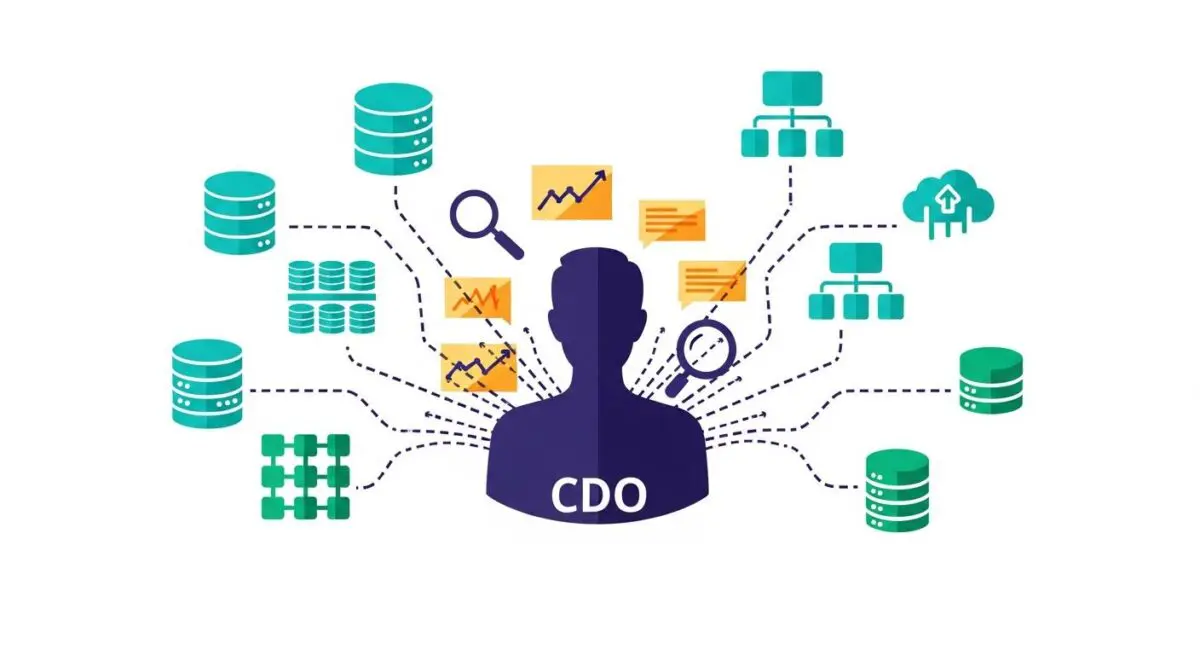
In a modern tech stack, the CDO manages the intersection of data engineering, data science, and business strategy. They are responsible for defining the data architecture that supports scalable growth, ensuring that data is not just collected but is structured in a way that provides actionable insights for stakeholders.
The CDO also plays a critical role in the deployment of Artificial Intelligence (AI) and Machine Learning (ML). By maintaining high standards for data hygiene and metadata management, the CDO ensures that the training sets used for AI models are accurate and free from bias, which is essential for maintaining the integrity of automated systems.
The Real-World Analogy
To understand the role of a Chief Data Officer, imagine a massive metropolitan water system. The Chief Information Officer (CIO) is the engineer responsible for the pipes, the pumps, and the physical infrastructure that moves the water from the reservoir to the city.
The Chief Data Officer, however, is the scientist responsible for the quality, purity, and composition of the water itself. They ensure the water is safe to drink, determine which minerals should be added for health, and decide how to distribute it efficiently to different neighborhoods based on their specific needs.
Without the CIO, the water has no way to travel; without the CDO, the water might be contaminated, wasted, or delivered to the wrong places, rendering the entire multi-million dollar infrastructure useless or even dangerous to the citizens.
How Chief Data Officer (CDO) Drives Strategic Growth & Market Competitiveness?
The CDO directly influences the bottom line by transforming raw data into a competitive advantage. By implementing a robust data strategy, the CDO enables the organization to identify market trends and consumer behaviors long before they become obvious to competitors.
In the realm of digital marketing and sales, the CDO optimizes Customer Acquisition Costs (CAC) by refining attribution models. They ensure that marketing teams have access to clean, first-party data, allowing for hyper-personalized campaigns that significantly increase conversion rates and Customer Lifetime Value (LTV).
Strategic growth is further accelerated through the elimination of data silos. When departments like sales, marketing, and product development share a unified data view, the organization can achieve operational efficiencies that were previously impossible, reducing friction in the customer journey.
Furthermore, the CDO mitigates financial risk by ensuring data compliance and security. In an era where data breaches can result in catastrophic fines and loss of brand equity, the CDO’s focus on data ethics and governance protects the company’s market position and long-term viability.
By championing a data-driven culture, the CDO empowers every level of the organization to make decisions based on empirical evidence rather than intuition. This shift leads to more accurate forecasting, better inventory management, and a more agile response to shifting market conditions.
Strategic Implementation & Best Practices
- Establish a Data Governance Framework: Implement a formal set of rules and processes, such as the DAMA-DMBOK, to define data ownership, quality standards, and security protocols across the organization.
- Prioritize Master Data Management (MDM): Create a single, consistent, and accurate version of core business entities, such as customers and products, to ensure data consistency across all platforms and applications.
- Invest in Scalable Data Architecture: Transition from legacy systems to modern, cloud-native data environments like Snowflake or Databricks that support real-time processing and high-concurrency analytical workloads.
- Foster Data Literacy: Develop internal training programs to ensure that non-technical staff can interpret data visualizations and use self-service analytics tools effectively for daily decision-making.
- Implement Automated Data Quality Monitoring: Use AI-driven tools to continuously scan data pipelines for anomalies, ensuring that errors are identified and remediated before they impact downstream business processes.
Common Pitfalls & Strategic Mistakes
One frequent error is treating the CDO role as a purely technical position within the IT department. When the CDO lacks the authority to influence business strategy, data initiatives often become disconnected from the company’s actual commercial goals, leading to low ROI on data investments.
Another common mistake is focusing exclusively on data collection while neglecting data quality. Organizations often hoard massive amounts of “dark data” that is unstructured and unmanaged, which increases storage costs and security risks without providing any measurable business value.
Many enterprise brands also fail to address the cultural resistance to data-driven change. If leadership continues to make decisions based on gut feeling while ignoring the insights provided by the CDO’s team, the organization will struggle to achieve the digital transformation required to compete in an AI-driven market.
Conclusion
The Chief Data Officer is the essential architect of a modern, data-centric enterprise, turning information into a high-yield strategic asset. By balancing rigorous governance with innovative analytics, the CDO ensures that an organization remains agile, compliant, and hyper-competitive in an increasingly complex digital landscape.