Key Points
- Agent-First Architectures: Legacy templates are being replaced by multi-agent systems that autonomously query engineering and financial databases to synthesize bids.
- Knowledge Governance: Smart capital is flowing into verification layers that ensure AI outputs are grounded in absolute corporate truth and legal compliance.
- Predictive Bid Intelligence: Market leaders are deploying adversarial AI to stress-test proposals and draft proactive bids before formal RFPs are even published.
Table of Contents
The Core Friction: Shattering the Sales-Engineering Bottleneck
According to Gartner’s 2026 Sales Tech Report, 80% of B2B organizations have now replaced legacy template-based RFP software with AI-driven autonomous orchestration systems to handle the surge in procurement complexity.
This is not merely an operational upgrade. It represents a fundamental rewiring of how modern enterprises compete for high-stakes contracts.
At the center of this transformation is AI-Driven Autonomous RFP Response Orchestration. This technology directly targets the most agonizing friction point in enterprise sales workflows.
Historically, the primary hurdle has been the sales-engineering bottleneck. Brilliant technical staff previously lost 15 to 20 hours per week answering mundane procurement questionnaires.
By automating this workflow, AI reduces the manual burden by up to 85%. Technical experts are finally freed to focus on actual product innovation rather than administrative drudgery.
Furthermore, this autonomous orchestration ensures that every proposal submitted is perfectly aligned with the latest product updates and security protocols. This drastically reduces the risk of non-compliance penalties that often plague fast-moving tech firms.
Market Intelligence: The Capital Flow of RFP Automation
Market Intelligence & Data
Global Market Valuation
Grand View Research projects the AI-driven proposal automation market will reach this valuation by the end of 2026 due to mass enterprise adoption.
Operational Speed Increase
Deloitte AI Institute reports that firms utilizing multi-agent RAG for RFP responses have reduced their total bid-to-submission cycle from 21 days to less than 5 days.
Accuracy in Technical Compliance
According to McKinsey & Company, advanced AI knowledge bases now exceed human accuracy in mapping complex security requirements to internal documentation.
ROI on AI Integration
IDC data shows that for every dollar spent on AI RFP automation, enterprises realize an average of $4.50 in recovered labor costs and increased win rates within 12 months.
The financial data paints a clear picture of a market undergoing massive disruptive innovation. Market dominance is currently held by incumbents like Responsive and Loopio.
These giants have aggressively pivoted to agent-first architectures to defend their market share. However, they face intense pressure from a new breed of AI-native startups.
Disruptors like AutoRFP.ai and ProposalZen have secured over $450M in Series B and C funding throughout 2025. This influx of capital signals a major shift in investor confidence.
Smart money is currently flowing heavily into knowledge governance startups. These niche firms provide the critical verification layer that ensures LLM outputs are grounded in verified corporate truth.
Investors recognize that an AI’s ability to write a proposal is useless without strict legal and technical compliance. Governance is the moat that separates enterprise-grade AI from experimental novelties.
Strategic Deep Dive: The Architecture of Autonomous Bidding
The Shift to Agentic RAG Frameworks
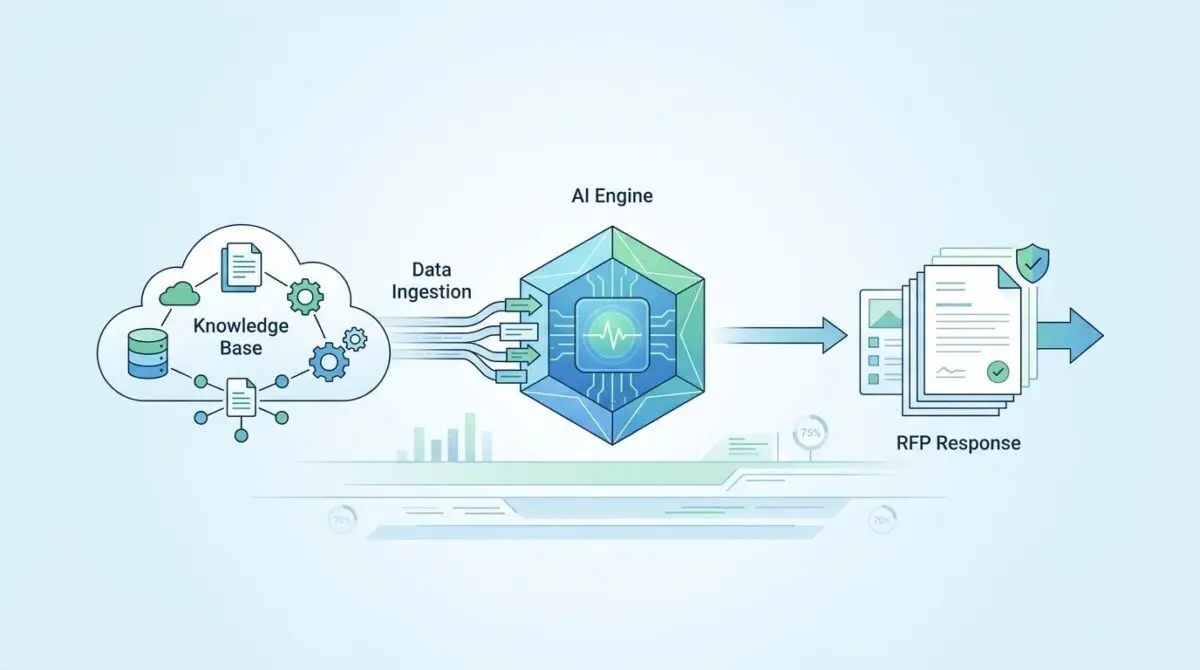
In 2026, the innovation landscape has completely shifted from basic text completion models to highly sophisticated Agentic RAG (Retrieval-Augmented Generation) frameworks.
Enterprise knowledge bases are no longer static repositories of outdated PDFs. They have evolved into living entities where multi-agent systems independently query engineering docs, Slack history, and financial databases.
These AI agents synthesize hyper-accurate bids by cross-referencing thousands of internal data points in seconds. They understand context, nuance, and the specific technical demands of the buyer.
High-performing sales teams are mastering Human-in-the-Loop workflows to maximize this technology. In these systems, AI generates 95% of the response, including complex security questionnaires.
This means human executives are no longer bogged down by repetitive RFP queries. They step in only for strategic final approvals, narrative refinement, and high-level relationship management.
Adversarial Agents and Stress-Testing
The psychology of enterprise bidding is also changing rapidly. Data from Forrester reveals that ‘Billionaire-backed’ enterprise labs are now deploying ‘Adversarial RFP Agents’ that simulate competitor responses to stress-test their own bids for pricing and technical superiority before submission.
This is a masterclass in predictive game theory applied to B2B sales. Instead of hoping a proposal is good enough, companies are mathematically proving its superiority against simulated rivals.
These adversarial agents analyze historical win-loss data, competitor pricing models, and public capability matrices. They actively try to defeat the company’s own proposal, forcing the primary AI to iterate and improve the bid.
This creates a closed-loop system of continuous improvement. By the time a human executive reviews the final document, it has already survived thousands of simulated procurement battles.
The Executive Action Plan: Predictive Bid Intelligence
The next evolution in this space is Predictive Bid Intelligence. The era of passively waiting for a request for proposal to drop is officially over.
AI systems will soon analyze market signals, executive job changes, and public procurement trends to draft proactive proposals. Businesses are preparing for a landscape where the winning bid is determined by the speed and precision of real-time data synthesis.
Strategic Trajectory
- Pivot to Predictive Bid Intelligence to anticipate market needs before RFP publication.
- Deploy AI systems to monitor public procurement trends and signals for automated lead generation.
- Adopt a Proactive Proposal methodology to draft responses prior to formal solicitation.
- Prioritize precision and speed in real-time data synthesis as the primary driver of win rates.
- Realign organizational focus from sales team volume to technological agility and data synthesis.
Founders and C-level executives must immediately audit their current knowledge governance infrastructure. If your internal data is siloed or inaccurate, your autonomous agents will fail.
The size of your sales team will soon matter less than the agility of your data architecture. Companies that fail to adopt these proactive methodologies will find themselves consistently outmaneuvered by smaller, AI-native competitors.
Conclusion: The Future of Procurement
The transition to AI-driven autonomous orchestration is a watershed moment for B2B commerce. It eliminates the operational friction that has historically stifled enterprise growth.
By leveraging multi-agent systems and predictive intelligence, visionary leaders can transform their bidding process from a reactive chore into a proactive weapon. The future belongs to those who control the synthesis of knowledge.
Navigating the intersection of technology, capital, and market psychology requires a sharp strategy. To future-proof your business architecture and scale with precision, connect with Andres at Andres SEO Expert.
Frequently Asked Questions
What is AI-driven autonomous RFP orchestration?
AI-driven autonomous RFP orchestration is a technology that replaces legacy template-based software with multi-agent systems to handle complex procurement questionnaires. It automates workflows, reduces manual labor by up to 85%, and ensures proposals are perfectly aligned with the latest security and technical protocols.
How does Agentic RAG differ from traditional RFP software?
Unlike static template-based systems, Agentic RAG (Retrieval-Augmented Generation) frameworks utilize AI agents that independently query live engineering docs, databases, and communication history. This allows for hyper-accurate, context-aware responses synthesized from thousands of real-time internal data points.
What are the primary benefits of automating the RFP process?
Key benefits include a 75% reduction in bid-to-submission cycles, higher technical accuracy exceeding 92%, and the elimination of the sales-engineering bottleneck. It allows technical experts to reclaim 15-20 hours per week while delivering a 4.5x average ROI through recovered labor and increased win rates.
What is the role of Adversarial RFP Agents in bidding?
Adversarial RFP Agents are specialized AI models that simulate competitor responses to stress-test a company’s own bid. By analyzing historical win-loss data and competitor pricing, these agents force the primary AI to iterate and mathematically prove a proposal’s superiority before submission.
How can companies prepare for Predictive Bid Intelligence?
To prepare for Predictive Bid Intelligence, executives must audit their knowledge governance infrastructure to ensure data is not siloed. Organizations should shift focus toward technological agility and real-time data synthesis to draft proactive proposals based on market signals before an RFP is formally published.
What is the projected market growth for AI proposal automation?
The global market for AI-driven proposal automation is projected to reach $6.8 billion by the end of 2026. This growth is fueled by mass enterprise adoption and massive capital influx into AI-native startups focusing on knowledge governance and agent-first architectures.