

Key Points
- Agentic RAG Integration: Transitioning from passive text retrieval to action-oriented RAG allows agents to autonomously query databases and execute multi-step resolutions.
- Confidence Thresholding: Implementing strict 85% confidence rules ensures unverified solutions are routed to human specialists, preventing costly technical outages.
- Enterprise Security Compliance: Utilizing frameworks like LlamaFirewall prevents goal hijacking and protects sensitive internal documentation from inadvertent data leaks.
Table of Contents
The Core Friction
Imagine a local baker drowning in hundreds of WhatsApp orders during a holiday rush. Now, picture an enterprise developer frantically tracing a massive data pipeline failure at three in the morning. Both scenarios share a universal and paralyzing pain point. They hit a solid wall when their basic automated systems fail to handle complex, multi-step problems.
We call this operational bottleneck the Resolution Gap. Traditional chatbots successfully deflect simple, repetitive Tier-1 questions but fail miserably at complex troubleshooting. They act like polite receptionists who can only hand out brochures. This forces high-cost human specialists to waste countless hours on repetitive technical diagnostics and manual data retrieval.
The solution is not hiring more people to do robotic, mind-numbing work. The true answer lies in deploying Autonomous AI Agents for Tier-2 Technical Support utilizing Agentic RAG and Backend Tool-Calling. These advanced systems do not just read manuals and spit out links. They actively query databases, analyze diagnostic logs, and execute backend resolutions in real time.
Mastering Market Data & Insights
Market Intelligence & Data
Contact Center AI Adoption
According to a March 2026 report from Lorikeet, 88% of contact centers now use AI, but only 25% have successfully moved past basic deflection to full ticket resolution.
Projected Labor Cost Savings
A 2026 Gartner analysis predicts that conversational AI and autonomous agents will reduce global contact center labor costs by $80 billion this year.
Average ROI Benchmark
The 2026 Intercom Customer Transformation Report found that enterprise organizations are seeing an average return of $3.50 for every $1 invested in AI support agents.
Autonomous Resolution Rate
The 2026 Oscar Chat Guide reports that mature AI agent deployments now autonomously resolve between 60% and 80% of total support volume including technical Tier-2 cases.
The transition from basic ticket deflection to autonomous resolution is entirely reshaping operational budgets across every industry. We are witnessing a massive shift where organizations realize that static, rule-based bots are no longer sufficient for modern support demands. As 88% of contact centers have deployed AI, the strategic focus is now entirely on closing the gap between initial deployment and actual, end-to-end ticket resolution.
The financial implications of this technological shift are staggering for businesses scaling their operations. Industry leaders are rapidly adopting these agentic workflows to offset rising operational costs and the relentless demand for 24/7 technical support. In fact, Gartner estimates $80 billion in contact center labor savings this year alone due to the aggressive deployment of conversational AI and autonomous agents.
Customer Experience (CX) Automation
Waiting 4 to 24 hours for a human escalation on a technical issue destroys customer trust and brand loyalty. This agonizing wait time is a massive real-world friction point for modern businesses trying to scale. Customers expect immediate answers, especially when their own software or hardware is malfunctioning.
Platforms like Zendesk, Intercom (Fin), and Sierra now deploy agentic workflows that resolve tickets end-to-end. They do not just provide generic links to help articles. These systems actually authenticate the user, check the backend status, and fix the configuration error on the spot.
Verified industry data shows these AI-native platforms achieve a 55 to 70 percent First Contact Resolution rate. They seamlessly handle complex technical cases with resolution times dropping under three minutes. This transforms a highly frustrating customer experience into a moment of operational magic.
AI-Agent Integration
Unstructured internal technical documentation is frequently updated and notoriously messy. This chaotic reality makes static, rule-based bots completely obsolete within weeks of deployment. You cannot hardcode a decision tree for a software environment that changes every single day.
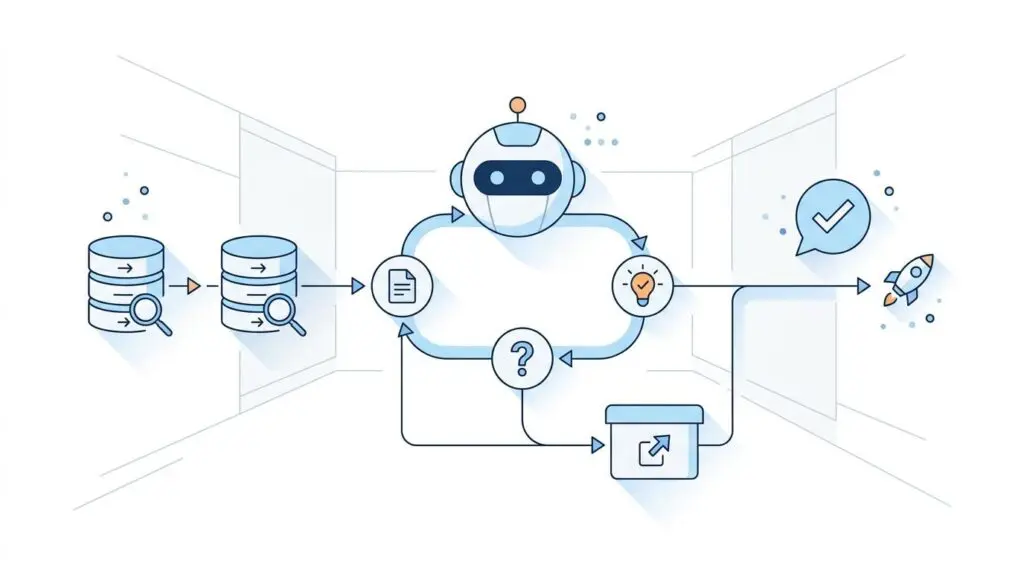
The paradigm has shifted entirely from Passive RAG to Agentic RAG using modern frameworks like LangGraph or LlamaIndex. Think of Passive RAG as a librarian pointing you to a book. Agentic RAG is an engineer reading the book, grabbing a wrench, and fixing the engine for you.
These frameworks allow agents to execute complex, multi-step reasoning. Modern agents use action-oriented RAG to directly query CRMs like Salesforce via secure APIs. They dive deep into internal databases and parse raw diagnostic logs to actively solve the root issue without human intervention.
The Human-in-the-Loop Factor
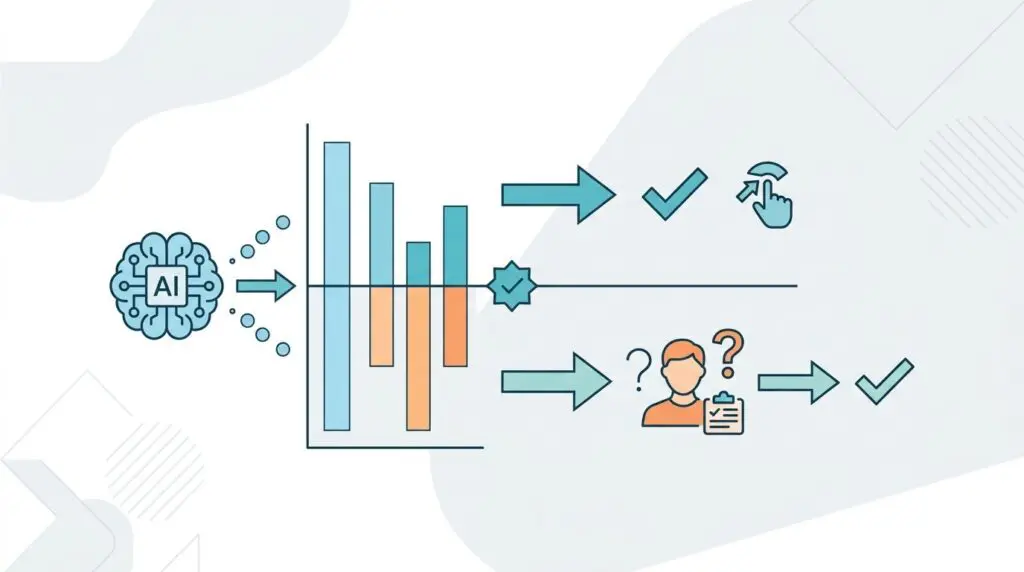
In highly technical environments, the fear of hallucinated solutions is a very valid and dangerous concern. An unmonitored AI making a wrong configuration change could lead to massive service outages or severe data loss. Automation must be paired with intelligent guardrails.
This is exactly where Confidence Thresholding becomes a critical safety net for enterprise deployments. Agents are programmed to route tickets directly to Slack or Teams if their internal certainty score falls below 85 percent. The AI knows what it does not know, and it asks for help.
Tools like Decagon and Lorikeet allow human agents to coach the model in real time when these escalations occur. A human specialist reviews the AI’s proposed steps, corrects them, and approves the action. This continuous feedback loop refines the RAG retrieval strategy safely and permanently.
Security, Privacy & Compliance
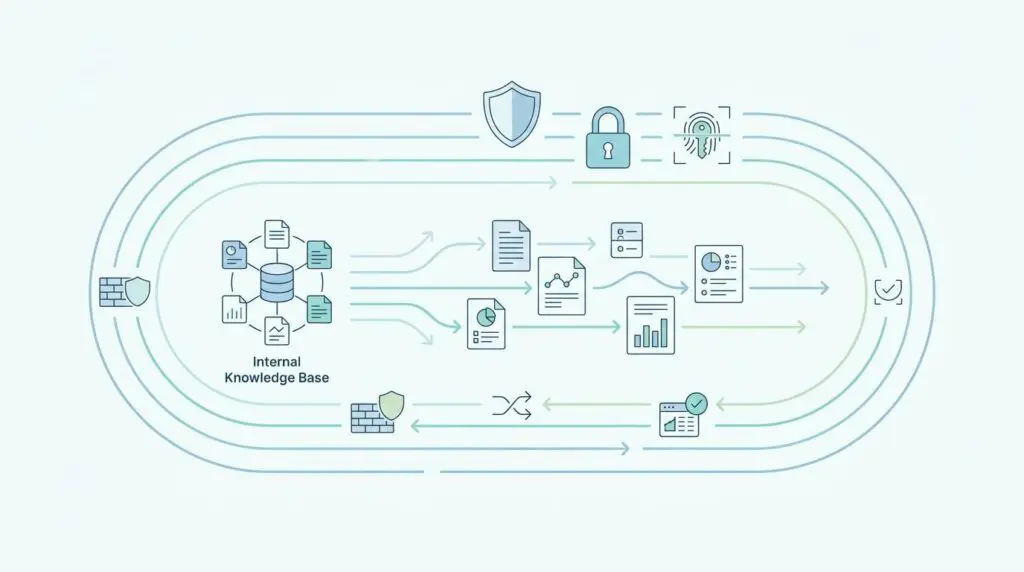
Internal knowledge bases often contain highly sensitive personally identifiable information and proprietary trade secrets. The major friction here is that agents might inadvertently leak this sensitive data during a complex RAG retrieval session. Security cannot be an afterthought in automation.
A critical security readiness gap has emerged across the tech industry. While most organizations have rushed to deploy AI agents, only 14.4 percent reached production with full security and IT approval as of May 2026, according to Responsible AI Labs. Moving fast and breaking things is no longer an acceptable strategy when handling enterprise data.
Compliance with the upcoming EU AI Act and achieving ISO 42001 certification is now non-negotiable for serious businesses. New defensive frameworks like LlamaFirewall and the OWASP Top 10 for Agentic Applications are absolutely essential. They actively monitor payloads to prevent dangerous vulnerabilities like Goal Hijacking and EchoLeak.
ROI & Time-Saving Metrics
Rising labor costs and the relentless demand for 24/7 support consistently outpace the budget for scaling human Tier-2 specialist teams. Businesses simply cannot hire, train, and retain talent fast enough to meet escalating technical support demands. The math no longer works for the traditional call center model.
Deploying autonomous agents drives a direct, massive cost-per-ticket reduction. Organizations are moving from a $15 to $25 human baseline down to a $0.99 to $2.00 AI baseline. This dramatic financial reduction applies directly to complex technical inquiries, not just password resets.
Industry benchmarks indicate a highly favorable three to six month payback period for enterprise-grade agentic deployments. Once the initial integration and vector databases are mapped, the marginal cost of resolving an additional thousand tickets drops to nearly zero. This unlocks unprecedented scalability.
Conclusion: The Future Outlook
The evolution of support automation is rapidly moving from read-only agents to fully self-healing network agents. Soon, these intelligent systems will autonomously generate and deploy infrastructure patches in real time. They will execute configuration updates via authenticated API hooks immediately after diagnosing a Tier-2 technical fault, completely eliminating system downtime.
Navigating the intersection of technology, workflows, and operational efficiency requires a sharp strategy. To future-proof your business architecture and scale with precision, connect with Andres at Andres SEO Expert.
Frequently Asked Questions
What is the difference between Passive RAG and Agentic RAG?
Passive RAG acts like a librarian pointing a user toward relevant documentation, whereas Agentic RAG functions like an engineer that reads the documentation and uses backend tools to actively resolve the issue. Using frameworks like LangGraph or LlamaIndex, Agentic RAG executes multi-step reasoning to fix configuration errors or parse diagnostic logs.
How do autonomous AI agents reduce contact center labor costs?
Autonomous AI agents can reduce global contact center labor costs by an estimated $80 billion by 2026. By automating Tier-2 technical support, organizations can shift from a human cost-per-ticket baseline of $15-$25 down to an AI baseline of $0.99-$2.00, achieving a payback period within three to six months.
What is the “Resolution Gap” in automated customer service?
The Resolution Gap refers to the operational bottleneck where traditional chatbots successfully deflect simple Tier-1 questions but fail at complex, multi-step troubleshooting. This forces high-cost human specialists to waste time on repetitive technical diagnostics that could be managed by autonomous agents.
How do AI agents ensure safety and prevent hallucinations during technical support?
AI agents utilize Confidence Thresholding, typically routing tickets to human specialists via Slack or Teams if their internal certainty score falls below 85 percent. This human-in-the-loop factor allows specialists to coach the model in real-time, ensuring that unauthorized or incorrect configuration changes are never executed.
What security frameworks protect AI agents from data leaks?
To prevent vulnerabilities like Goal Hijacking and EchoLeak, enterprises utilize defensive frameworks such as LlamaFirewall and follow the OWASP Top 10 for Agentic Applications. Compliance with the EU AI Act and ISO 42001 certification is also essential for protecting sensitive internal knowledge bases and proprietary data.
What is the typical First Contact Resolution (FCR) rate for AI-native support platforms?
Modern AI-native platforms like Zendesk, Intercom (Fin), and Sierra achieve a First Contact Resolution (FCR) rate between 55 and 70 percent. These systems resolve complex technical cases in under three minutes by authenticating users, checking backend statuses, and fixing configuration errors via API hooks.