




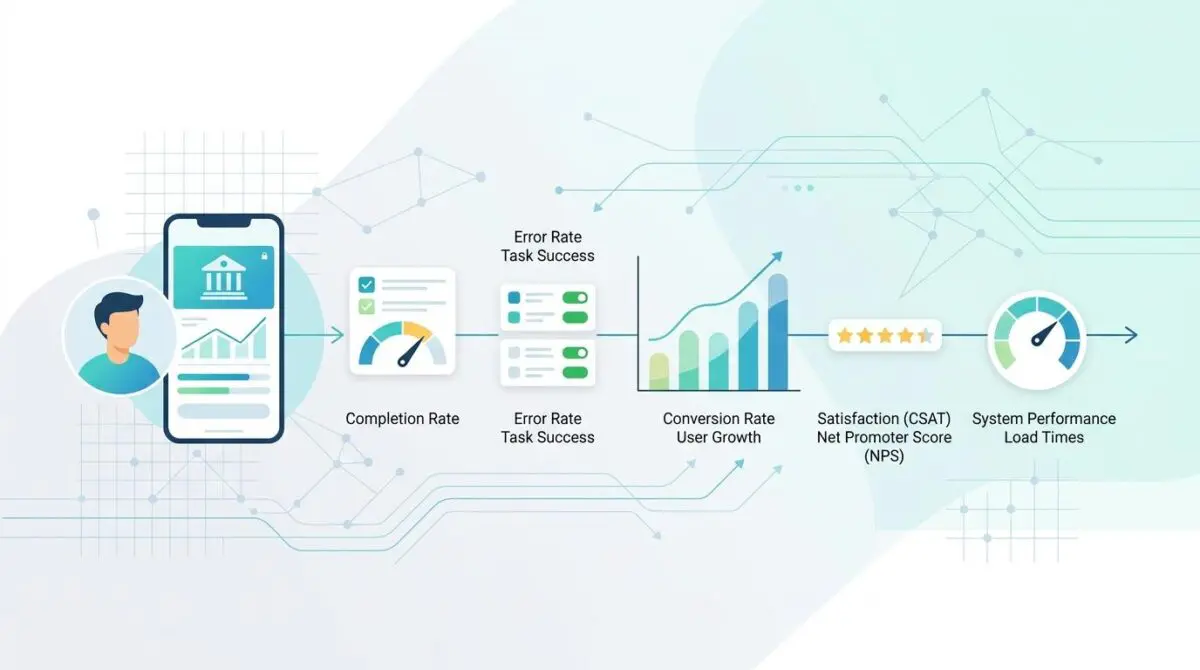
Key Points
- Generative UI Integration: Multimodal interfaces are actively replacing static applications to reduce cognitive load and optimize financial health autonomously.
- Capitalizing on Large Action Models: Smart capital is aggressively funding infrastructure to capture deposits and reduce operational engagement costs by up to 35 percent.
- The UI-Less Era: Sovereign AI Wealth Agents will soon usher in a frictionless landscape of invisible banking powered by advanced ambient wearables.
Table of Contents
The Financial Tech Friction
According to the April 2026 McKinsey Global Fintech Report, total industry revenues have hit $650 billion. AI-driven user experience is cited as the primary catalyst for a 21 percent year-on-year growth rate across the sector. This staggering influx of capital highlights a fundamental shift in how consumers and institutions interact with digital wealth.
The era of static, menu-driven banking applications has officially reached its expiration date. At the center of this massive liquidity opportunity is the rapid deployment of AI-Native Financial UX. This is not merely a cosmetic upgrade to existing mobile platforms.
Instead, it represents a complete architectural overhaul where the interface itself becomes a dynamic, intelligent entity. Historically, financial tech friction stemmed from a severe cognitive tax placed on the user. Legacy systems forced customers to navigate labyrinthine menus to execute basic wealth management strategies.
Today, disruptive technology is dismantling those barriers by anticipating user intent before a single tap occurs. Smart money is actively flowing toward infrastructure that eliminates this friction entirely. By transforming the user experience into an autonomous, predictive ecosystem, modern fintechs are capturing unprecedented market share.
The intersection of generative artificial intelligence and financial interaction is now the ultimate battleground for institutional dominance.
Market Intelligence and Capital Flow
Market Intelligence & Data
UX Switch Propensity
Data from Statista in 2026 indicates that nearly three-quarters of global consumers are prepared to switch their primary financial provider for a superior digital user experience.
AI FinTech Market Cap
Fortune Business Insights projects the global AI in fintech market will reach this valuation by mid-2026, driven by a 23.2% CAGR in generative infrastructure.
Churn Reduction Rate
Gartner forecasts that institutions utilizing AI-driven UI adaptation will see a 30% reduction in user churn by the end of 2026 as interfaces become predictive rather than reactive.
Deposit Retention Gains
Models from Engage fi suggest that AI-native personalization could retain over $200 billion in deposits industry-wide for US banks by 2026 through proactive, contextually relevant engagement.
The data presented above paints a clear picture of a rapidly evolving financial landscape. Institutional investors are recognizing that user experience is no longer a secondary metric. It is now the primary driver of deposit retention and customer lifetime value.
With a staggering 72 percent of consumers willing to abandon their current providers, loyalty is effectively dead without technological innovation. This massive flight risk has triggered an arms race among tier-one banks and agile neobanks alike. Capital is being aggressively deployed to build interfaces that actively prevent this attrition.
The projected $200 billion in deposit retention gains highlights the sheer economic weight of this transition. When an interface can predict a user’s financial distress and offer a preemptive solution, it secures that capital within the ecosystem. This is why venture capital powerhouses treat AI-native design as a core infrastructure play rather than a mere feature.
Furthermore, the 30 percent reduction in churn demonstrates the tangible return on investment of generative architecture. Institutions that fail to adapt to these predictive models will inevitably bleed deposits to more technologically advanced competitors. The smart money is already betting heavily on platforms that seamlessly merge behavioral psychology with real-time financial data.
The FinTech Deep Dive
Shifting to Generative UI and Autonomous Finance
In 2026, the paradigm has shifted entirely from static mobile-first applications to sophisticated Generative UI systems. These advanced frameworks assemble modular components in real-time based on a complex matrix of user intent, cognitive load, and environmental context. The digital interface is no longer a rigid map but a fluid, adaptive environment.
Multimodal interfaces combining voice, vision, and touch are rapidly replacing traditional menu-driven navigation. This evolution allows users to interact with their wealth through natural language and intuitive gestures. As detailed in the April 2026 McKinsey Global Fintech Report, this level of interaction is critical for capturing the next generation of high-net-worth individuals.
The technology actively reduces the friction between thought and financial execution. Perhaps the most fascinating development is the advent of Sentient Design within these platforms. This architecture actually adjusts UI aesthetics, such as color palettes and information density, to manage user stress levels during high-stakes financial decisions.
It is a brilliant fusion of biometric feedback and algorithmic wealth management. This evolution moves the industry far beyond surface-level personalization into the realm of Autonomous Finance. The interface now anticipates complex needs and self-configures to optimize the user’s financial health without requiring manual input.
It acts as a proactive digital fiduciary operating tirelessly in the background.
Solving the Cognitive Tax and Deposit Attrition
The UX revolution directly solves the crippling cognitive tax associated with complex financial decision-making. In high-rate environments, the critical issue of deposit attrition plagues institutions that rely on passive customer engagement. AI-native platforms flip this dynamic by deploying agentic AI to provide highly targeted, proactive nudges.
These intelligent systems automatically execute sweep-to-yield account transfers or offer preemptive credit limit adjustments when a user travels. By removing the burden of manual portfolio optimization, fintechs are drastically increasing customer lifetime value and account stickiness. The technology transforms a dormant checking account into an active wealth generation engine.
A May 2026 report from the Cambridge Centre for Alternative Finance reveals that 86 percent of fintech firms now report measurable gains in product and technology functions through AI. This significantly outperforms the 68 percent reported by traditional incumbent banks, highlighting a widening technological moat.
The agile disruptors are simply outmaneuvering legacy institutions through superior algorithmic engagement. This transition is projected to reduce the operational cost base of customer engagement by a massive 35 percent. By automating routine resolution paths that previously required human intervention, institutions can reallocate capital toward aggressive growth strategies.
The result is a leaner, more profitable enterprise built on a foundation of frictionless user interaction.
The Rise of Horizontal Fintech and Large Action Models
Smart capital is currently flooding into Horizontal Fintech infrastructure and the development of Financial Large Action Models. These advanced LAMs go beyond generating text to execute complex, multi-step financial workflows across disparate systems. They represent the central nervous system of the new digital economy.
Leading disruptors, including neobanks like Revolut and Grasshopper Bank, utilize these natural language agents to handle up to 70 percent of customer queries autonomously. This is not basic chatbot functionality, but deep, context-aware problem solving. The models can restructure debt, optimize tax harvesting, and rebalance portfolios in seconds.
Venture capital powerhouses like QED Investors and Andreessen Horowitz are pivoting their thesis away from standalone consumer apps. They are now backing Embedded UX providers that integrate invisible banking seamlessly into non-financial platforms. Meanwhile, incumbents like JPMorgan Chase and Capital One are aggressively re-engineering their legacy stacks to become fully AI-connected enterprises.
While stringent data privacy regulations and compliance frameworks govern these autonomous transactions, the primary industry focus remains on scaling the underlying AI infrastructure. Navigating these regulatory guardrails requires sophisticated encryption, but the innovation velocity shows no signs of slowing. The ultimate goal is ubiquitous, invisible financial utility.
The Strategic Action Plan
Strategic Trajectory
- Deploy Sovereign AI Wealth Agents to manage decentralized interfaces and cross-border settlements.
- Leverage stablecoin rails to reduce transaction settlement times from three days to three seconds.
- Prepare for a UI-less era by integrating financial management into ambient wearables and brain-computer interfaces.
- Architect frictionless, invisible banking interactions that operate autonomously on behalf of the user.
- Implement AI-native systems to execute complex, real-time tax and investment strategies at the edge.
The next 12 to 24 months will demand aggressive technological adoption from financial executives. The rise of Sovereign AI Wealth Agents dictates that institutions must decentralize their interface strategies to remain competitive. These agents will operate independently, managing cross-border settlements on stablecoin rails with unprecedented speed.
We are rapidly approaching a UI-less era where traditional screens become obsolete. Financial management is being integrated directly into ambient wearables and early-stage brain-computer interfaces. This makes the banking interaction entirely frictionless and practically invisible to the end user.
Founders and architects must focus on building systems that execute complex tax and investment strategies autonomously at the edge. The infrastructure must be robust enough to handle real-time algorithmic trading while remaining completely transparent to the client. Institutions that master this invisible architecture will capture the lion’s share of generational wealth transfers.
To execute this roadmap, legacy banks must abandon their siloed data structures. They must embrace horizontal integration, allowing Large Action Models to pull context from every facet of a user’s digital life. This holistic approach is the only way to deliver the hyper-personalized, sentient design that modern consumers demand.
Conclusion
The user experience revolution in financial technology is no longer a distant theoretical concept. It is an immediate, capital-intensive reality driven by the relentless advancement of AI-native architecture. Institutions that continue to rely on static, high-friction interfaces will face catastrophic deposit attrition as consumers migrate toward autonomous, predictive platforms.
The integration of generative UI, multimodal interactions, and sovereign wealth agents represents the ultimate convergence of behavioral psychology and decentralized finance. By eliminating the cognitive tax of wealth management, disruptive fintechs are forging unbreakable bonds with their user base. The future of finance belongs to those who can make complex institutional power feel completely invisible.
Navigating the intersection of financial technology, institutional capital, and market psychology requires a sharp strategy. To future-proof your FinTech architecture and scale with precision, connect with Andres at Andres SEO Expert.
Frequently Asked Questions
What is AI-Native Financial UX and how does it differ from legacy banking apps?
AI-Native Financial UX is an architectural shift where the digital interface becomes a dynamic, predictive entity rather than a static, menu-driven platform. Unlike legacy systems that impose a high cognitive tax on users, AI-native platforms anticipate user intent and utilize Generative UI to assemble modular components in real-time based on environmental context.
How does AI-driven UI adaptation impact deposit retention for financial institutions?
According to 2026 industry forecasts, AI-driven UI adaptation can reduce user churn by up to 30%. By delivering proactive, contextually relevant engagement, AI-native personalization is projected to retain over $200 billion in deposits for US banks by preventing user flight to more technologically advanced competitors.
What is Sentient Design in the context of fintech?
Sentient Design is an advanced framework that integrates biometric feedback and algorithmic management to adjust UI aesthetics in real-time. By modifying elements like color palettes and information density, the platform can actively manage a user’s stress levels during high-stakes financial decision-making processes.
What role do Financial Large Action Models (LAMs) play in autonomous finance?
Large Action Models (LAMs) serve as the central nervous system for modern fintech, moving beyond text generation to execute multi-step workflows. These models can autonomously restructure debt, optimize tax harvesting, and rebalance investment portfolios across disparate systems in seconds.
How does the UX revolution reduce operational costs for fintech firms?
By deploying agentic AI and autonomous resolution paths, institutions can reduce the operational cost base of customer engagement by approximately 35%. This automation allows firms to handle up to 70% of customer queries without human intervention, reallocating capital toward growth and innovation.
What defines the upcoming UI-less era of financial management?
The UI-less era refers to a transition where traditional screens are replaced by ambient wearables and brain-computer interfaces. In this stage, financial interactions become invisible and frictionless, with Sovereign AI Wealth Agents executing complex strategies and cross-border settlements autonomously on behalf of the user.