Key Points
- Agentic Orchestration: The transition from reactive mobile banking to predictive Large Action Models (LAMs) enables AI agents to autonomously execute complex, multi-step financial transactions across unified ledgers.
- High-Velocity Liquidity: By integrating tokenized real-world assets (RWAs) with instant settlement rails like FedNow, private individuals can now manage their entire net worth as a single, hyper-liquid capital pool.
- The Invisible Bank Paradigm: The future of personal finance relies on Anticipatory Finance, where sovereign digital identities and zero-knowledge proofs secure a backgrounded financial ecosystem that eliminates manual orchestration.
Table of Contents
The Friction of Fragmented Finance
According to the 2026 RWA Report from CoinGecko, spot trading on tokenized gold reached $90.7 billion in Q1 2026 alone. This massive metric officially surpassed the total trading volume recorded for the entire year of 2025. Such a seismic shift in liquidity signals the death of traditional, fragmented retail banking as we know it.
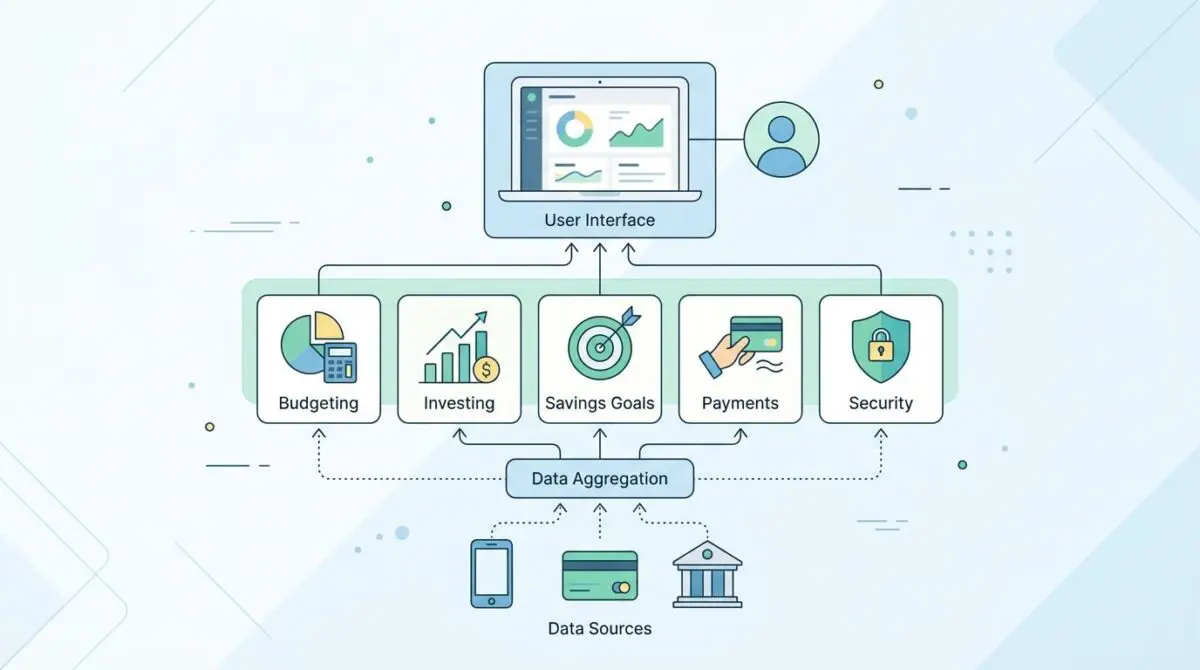
We have officially entered the era of the Autonomous Sovereign Wealth Stack. In the past, high-net-worth individuals relied on massive family offices to manage complex portfolios and execute cross-border transactions. Today, the ultimate fintech stack for a private person is entirely software-defined.
This new paradigm replaces human intermediaries with unified ledgers and highly advanced artificial intelligence. The historical friction of manual financial orchestration is effectively dead. Previously, individuals had to manually manage tax-loss harvesting, bill payments, and portfolio rebalancing across ten or more disconnected platforms.
This legacy approach created a massive drag on capital efficiency and consumed countless hours of personal time. The Autonomous Sovereign Wealth Stack eliminates this friction entirely by acting as a personalized central bank. It creates a self-optimizing financial engine that manages liquidity twenty-four hours a day, seven days a week.
Through this technology, retail investors can now access institutional private credit and Treasuries with fractional entry points. They achieve near-instant liquidity that was previously reserved for massive hedge funds and sovereign states.
Market Intelligence and Capital Flow
Market Intelligence & Data
On-Chain Tokenized RWAs
Data from DeFiLlama as of April 2026 shows that the total value of tokenized real-world assets on public blockchains has surged 66% in the first four months of the year.
Leader Agentic Adoption
According to the Citizens Bank 2026 Financial Outlook, 82% of midsize financial firms have implemented agentic AI to automate complex customer wealth management workflows.
AI Agent Market CAGR
Research and Markets reports that the autonomous AI agent market is growing at an exponential 42.9% annually as of May 2026, driven by retail finance integration.
Global FinTech Inflow
KPMG’s 2025/2026 Pulse of Fintech highlights that global investment in fintech infrastructure reached $150 billion in the most recent reporting period, focused on modular AI stacks.
The data presented above paints a definitive picture of where smart money is aggressively positioning itself. Venture capital flow is now heavily concentrated on modular AI stacks and autonomous orchestration frameworks. We are witnessing a permanent transition from legacy digital banks to intelligent financial layers.
Reviewing the broader macroeconomic landscape, data from KPMG’s latest Pulse of Fintech analysis confirms that institutional focus has fundamentally shifted toward intelligent infrastructure. Capital allocators are no longer interested in funding basic consumer banking applications. They are funding the deep technological rails that allow artificial intelligence to move actual value.
The surge in on-chain real-world assets proves that tokenization is no longer a fringe experiment. It is the new foundational rail for global liquidity and institutional settlement. Midsize financial firms are now scrambling to adopt agentic AI simply to keep pace with these evolving consumer expectations.
This capital flow indicates that the market values execution over mere data aggregation. The future belongs to platforms that can securely synthesize market data and autonomously execute trades without human hesitation.
The Autonomous Orchestration Engine
The core of this new financial reality rests upon a radically different technological architecture. We are moving away from simple application programming interfaces that require manual triggers. Instead, the industry is adopting intelligent systems capable of independent financial reasoning.
The Shift to Agentic Finance
Agentic Finance represents the most significant leap forward in personal wealth management. Large Action Models are the operational brain of this new ecosystem. Unlike traditional generative AI that simply provides financial advice or summarizes spending habits, these models take direct action.
These advanced models execute complex, multi-step transactions across cross-chain networks and traditional fiat accounts simultaneously. Disruptors are shifting rapidly from simple digital banks to comprehensive autonomous orchestrators. Startups like Monarch and Bilt are expanding aggressively into this realm of agentic automation.
They are building sophisticated interfaces that allow AI agents to securely hold and move value with zero human intervention. A May 2026 study by Oliver Wyman reveals that 38% of retail banking customers have already authorized autonomous AI agents to execute financial transactions on their behalf without real-time human approval. This metric illustrates a profound and rapid shift in consumer trust toward machine execution.
The traditional banking user interface, characterized by static dashboards and manual transfer buttons, is being entirely replaced. It is giving way to a conversational or biometric action layer where intent is instantly translated into financial execution. Financial Agent Layer-1 networks are becoming the new standard for secure, automated value transfer.
Tokenizing the Personal Balance Sheet
The true power of the Autonomous Sovereign Wealth Stack unlocks when agentic AI meets real-world asset tokenization. The integration of unified ledgers allows individuals to treat their entire net worth as a single, high-velocity liquidity pool. This comprehensive pool includes tokenized real estate, private equity, and liquid cash.
Everything within this ecosystem settles instantly via FedNow or institutional blockchain rails. Institutional giants are providing the heavy backend infrastructure required for this revolution to function at scale. BlackRock, through its BUIDL fund, and JP Morgan’s Onyx are pioneering the institutional-grade tokenization backend.
They are successfully bridging the historical gap between decentralized finance and traditional, regulated banking. As highlighted by the staggering volume metrics detailed within CoinGecko’s Q1 2026 RWA report, the appetite for tokenized commodities and equities is fundamentally restructuring how private wealth is stored and traded.
Tokenization solves the notoriously high entry barriers to elite asset classes. The retail investor is now equipped with the same high-velocity liquidity tools previously reserved for sovereign wealth funds. They can dynamically shift allocations from tokenized real estate into yielding stablecoins in milliseconds based on AI-driven market analysis.
Strategic Trajectory and Anticipatory Finance
Strategic Trajectory
- Capitalize on the rise of ‘Anticipatory Finance’ by transitioning from reactive to predictive stacks.
- Deploy AI agents to utilize high-frequency behavioral data for autonomous inflation and currency hedging.
- Shift toward the ‘Invisible Bank’ model where financial management is entirely backgrounded.
- Secure the sovereign wealth stack using digital identities and zero-knowledge proofs.
- Eliminate the physical act of ‘banking’ for private individuals through automated sovereign systems.
The next eighteen months will definitively separate the winners from the losers in the modern fintech space. We will see the rapid rise of Anticipatory Finance across all major wealth management platforms. In this model, the fintech stack transitions from a reactive tool to a highly predictive engine.
AI agents will utilize high-frequency behavioral data and macroeconomic indicators to hedge against inflation or currency volatility. They will execute these defensive maneuvers before the user is even aware of the impending market risk. This proactive approach ensures that the private wealth stack is constantly optimized for global economic shifts.
We are rapidly moving toward the Invisible Bank model. In this idealized state, financial management is entirely backgrounded and operates silently in the periphery of the user’s life. The physical act of banking is becoming completely obsolete for the modern private individual.
Security remains paramount in this invisible, automated ecosystem. The sovereign wealth stack is secured by immutable digital identities and zero-knowledge proofs. This cryptographic foundation ensures absolute privacy while maintaining strict adherence to global regulatory standards.
While regulatory frameworks continue to evolve around tokenized assets and automated execution, the technology has already solved the compliance bottleneck. The integration of zero-knowledge proofs allows platforms to achieve instantaneous verification without exposing underlying consumer data to third parties.
Conclusion
The Autonomous Sovereign Wealth Stack is not merely a technological upgrade for consumer finance apps. It is a fundamental reimagining of personal capital orchestration and wealth generation. By merging Large Action Models with tokenized real-world assets, the industry has birthed a system of unprecedented financial sovereignty.
For the private individual, this means the end of fragmented liquidity and the beginning of hyper-efficient capital allocation. The future belongs to those who embrace the invisible, anticipatory, and autonomous nature of modern money.
Navigating the intersection of financial technology, institutional capital, and market psychology requires a sharp strategy. To future-proof your FinTech architecture and scale with precision, connect with Andres at Andres SEO Expert.
Frequently Asked Questions
What is an Autonomous Sovereign Wealth Stack?
An Autonomous Sovereign Wealth Stack is a software-defined financial engine that replaces human intermediaries with unified ledgers and advanced artificial intelligence. It functions as a personalized central bank, autonomously managing liquidity, rebalancing portfolios, and optimizing capital efficiency 24/7 without manual intervention.
How does Agentic Finance differ from traditional digital banking?
Unlike traditional digital banking that relies on static dashboards and manual triggers, Agentic Finance utilizes Large Action Models (LAMs). These models are capable of independent financial reasoning and can execute complex, multi-step transactions across cross-chain networks and fiat accounts without requiring real-time human approval.
What role do tokenized Real-World Assets (RWAs) play in private wealth?
Tokenization allows private individuals to treat their entire net worth—including real estate, private equity, and commodities—as a single, high-velocity liquidity pool. This provides retail investors with fractional access to institutional-grade assets and near-instant settlement previously reserved for sovereign states and hedge funds.
What is the “Invisible Bank” model?
The Invisible Bank model refers to a state where financial management is entirely backgrounded and operates silently. Through Anticipatory Finance, AI agents use high-frequency data to hedge against inflation and market risks proactively, eliminating the physical act of banking for the individual.
How is privacy and security handled in autonomous financial systems?
Security is maintained through immutable digital identities and zero-knowledge proofs (ZKPs). These cryptographic tools allow for instantaneous verification and regulatory compliance without exposing underlying personal data to third parties, ensuring the sovereign wealth stack remains private and secure.