Key Points
- Cost-Efficiency Balancing: Hybrid architectures mitigate API margin inflation by routing routine tasks to open-source models and complex reasoning to proprietary APIs.
- Data Sovereignty Mastery: Localized open-source execution ensures sensitive enterprise data remains within secure, air-gapped perimeters.
- Continuous Distillation: Enterprises leverage proprietary models to generate synthetic data and fine-tune smaller, highly efficient open-source models for production.
Table of Contents
The AI Landscape
By May 2026, 72% of Fortune 500 companies have shifted at least 40% of their production AI workloads from proprietary APIs to fine-tuned open-source models to combat ‘API Margin Inflation’. The Generative AI ecosystem has rapidly evolved from simple API wrappers to complex architectural paradigms. Enterprises now face a critical strategic juncture between high-performance proprietary models and ultra-efficient open-source weights.
This bifurcation necessitates a sophisticated approach to Hybrid Model Governance and TCO Optimization. Organizations must move beyond basic integrations to secure operational autonomy and long-term viability. Balancing raw intelligence capabilities against predictable infrastructure costs is the new frontier of enterprise technology.
Proprietary models continue to offer the convenience of intelligence-as-a-service, delivering cutting-edge reasoning with zero infrastructure maintenance. However, the open-source alternatives provide unprecedented control over data sovereignty and customization. Navigating this landscape requires a meticulous strategy that maximizes throughput-per-dollar while mitigating operational risks.
Core Concepts & Capabilities
Core Architecture & Pillars
Token-Unit Economics
Proprietary models operate on a variable OPEX model where costs scale linearly with usage (per 1k tokens), whereas open-source models involve a front-loaded CAPEX for hardware or reserved cloud instances.
Model Distillation and Transfer
Knowledge distillation allows a ‘teacher’ proprietary model to train a ‘student’ open-source model, capturing up to 95% of performance in a fraction of the parameter size.
Inference Latency Engineering
Proprietary models suffer from network latency and shared-tenant bottlenecks, while open-source models allow for deep-level optimization like FlashAttention-3 and custom quantization kernels.
Data Sovereignty and Privacy
Proprietary APIs necessitate sending PII (Personally Identifiable Information) to third-party servers, whereas open-source allows for execution within air-gapped VPCs or on-premise hardware.
Balancing Economics and Performance
The token inflation costs associated with large-scale agentic workflows can quickly erode corporate profit margins. Proprietary APIs scale linearly with usage, transforming high-volume data processing into a massive operational expense. Conversely, the open-source ecosystem offers long-term cost predictability through localized hardware deployments.
In early 2026, the ‘Quantization Revolution’ led by the open-source community made it possible to run a 400B parameter model on a single consumer-grade workstation with negligible accuracy loss (Source: 2026 AI Hardware Benchmarks by Hugging Face Research). This breakthrough fundamentally altered the calculus for enterprise AI deployments. Companies can now leverage the fact that knowledge distillation allows a ‘teacher’ proprietary model to train a ‘student’ open-source model, capturing elite performance at a fraction of the cost.
Furthermore, localized execution enables engineering teams to implement deep-level optimization like FlashAttention-3 to achieve sub-50ms inference times. This bypasses the shared-tenant bottlenecks inherent to cloud-based proprietary providers. The result is a highly responsive, cost-effective infrastructure capable of handling massive throughput.
Strategic Implementation
Implementation Roadmap
Workload Categorization and Audit
Conduct a comprehensive audit of all AI tasks to categorize them by ‘Complexity’ and ‘Data Sensitivity.’ Use proprietary models for tasks requiring SOTA reasoning and open-source for data-heavy pattern matching.
Model-Agnostic Layer Implementation
Deploy a model gateway or orchestration layer (e.g., LiteLLM or custom middleware) that allows for seamless switching between proprietary APIs and local LLM endpoints without rewriting the application logic.
Infrastructure Right-Sizing
For open-source workloads, provision dedicated H200 or B200 GPU instances based on the 4-bit or 8-bit quantized requirements of the chosen model to maximize throughput-per-dollar.
Continuous Distillation and Fine-Tuning
Establish a feedback loop where ‘Golden Responses’ from proprietary models are used to iteratively fine-tune the open-source model using PEFT (Parameter-Efficient Fine-Tuning) techniques like LoRA.
Orchestrating the AI Stack
Executing a hybrid strategy requires a meticulous workload categorization audit across the entire organization. Enterprises must isolate tasks requiring state-of-the-art reasoning from those that involve high-volume, repetitive data summarization. Proprietary models are increasingly reserved for high-stakes, multi-modal decision-making processes.
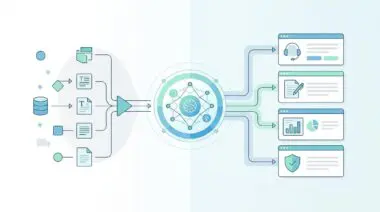
Meanwhile, fine-tuned open-source models are deployed for localized embedding and routine customer support workflows. Deploying a model-agnostic orchestration layer is critical for seamless switching between these distinct environments. This intelligent gateway prevents vendor lock-in and ensures continuous operation during unpredictable API surges.
To maintain peak efficiency and relevance, forward-thinking engineering teams are adopting PEFT (Parameter-Efficient Fine-Tuning) techniques like LoRA for continuous model iteration. By using golden responses from proprietary models to fine-tune smaller local models, companies create a self-improving ecosystem. This continuous distillation loop guarantees that local deployments remain highly capable over time.
Real-World Impact & Use Cases
The transition to Hybrid Model Governance and TCO Optimization is actively reshaping entire global industries. Under strict compliance frameworks like the 2026 EU AI Act, financial institutions are migrating core reasoning engines entirely to open-source environments. This ensures that sensitive client data never leaves their sovereign perimeter, completely eliminating the risk of data leakage.
In the logistics and manufacturing sectors, autonomous supply chain drones are prioritizing local models to maintain real-time edge AI capabilities. These remote deployments cannot rely on external internet connections or variable API latency. They utilize custom quantization kernels to maximize throughput-per-dollar on dedicated, ruggedized GPU instances.
The direct impact on the efficiency of enterprise Retrieval-Augmented Generation pipelines has been profound. Organizations are achieving unprecedented accuracy in AI Overviews while simultaneously slashing their variable operational expenditures. This hybrid approach represents the maturation of enterprise AI from an experimental novelty into a rigorous engineering discipline.
Best Practices & Future Outlook
Strategic Best Practices
- Implement a ‘Model Cascading’ strategy where queries are first processed by a small open-source model and only escalated to proprietary SOTA models if confidence scores fall below a predefined threshold.
- Ensure all open-source deployments use signed weights and secure supply chain protocols to mitigate ‘model poisoning’ risks.
- Maintain a strict decoupling of the application data layer from the model weights to allow for rapid version swaps as the open-source community releases superior architectures.
The future of enterprise AI relies heavily on dynamic model cascading and secure supply chain protocols. Decoupling the application data layer from the underlying model weights allows for rapid version swaps as superior architectures continually emerge. This agility is non-negotiable in an ecosystem where open-source capabilities are accelerating exponentially.
As the open-source community continues to close the performance gap, hybrid architectures will become the definitive standard for corporate infrastructure. Organizations that master this intricate balance will achieve unparalleled operational resilience and economic efficiency. The era of single-vendor reliance is ending, making way for intelligent, multi-model orchestration.
Navigating the rapid evolution of Large Language Models and AI infrastructure requires a precise strategy. To stay ahead of the AI revolution and optimize your digital presence, connect with Andres at Andres SEO Expert.
Frequently Asked Questions
What is API Margin Inflation in the context of enterprise AI?
API Margin Inflation refers to the linear scaling of operational costs associated with proprietary AI models, where high-volume token usage significantly erodes corporate profit margins. To combat this, enterprises are shifting to fine-tuned open-source models to achieve better cost predictability and lower total cost of ownership (TCO).
How does knowledge distillation benefit hybrid AI strategies?
Knowledge distillation allows a sophisticated proprietary “teacher” model to train a smaller, more efficient open-source “student” model. This process enables the smaller model to capture up to 95% of the performance of state-of-the-art models while operating with a significantly lower parameter count and reduced hardware requirements.
What are the primary advantages of open-source models for data sovereignty?
Open-source models provide superior data sovereignty because they can be executed within air-gapped Virtual Private Clouds (VPCs) or on-premise hardware. This setup ensures that sensitive Personally Identifiable Information (PII) never leaves the organization’s secure perimeter, which is critical for compliance with regulations like the EU AI Act.
What is model cascading and how does it optimize AI workloads?
Model cascading is a strategic workflow where AI queries are first processed by smaller, low-cost open-source models. If the initial model’s confidence score falls below a specific threshold, the task is escalated to a high-performance proprietary model, ensuring that expensive compute resources are only used when absolutely necessary.
How do PEFT and LoRA techniques improve local model performance?
Parameter-Efficient Fine-Tuning (PEFT) techniques, such as LoRA, allow enterprises to iteratively update local models without the prohibitive costs of full model retraining. By using “golden responses” from proprietary models to fine-tune local weights, organizations create a self-improving ecosystem that maintains high capability over time.
How does FlashAttention-3 impact inference latency for open-source AI?
FlashAttention-3 is a deep-level optimization kernel that enables open-source models to achieve sub-50ms inference times. By implementing these optimizations on dedicated local hardware, engineering teams can bypass the shared-tenant bottlenecks and network latency typically associated with third-party proprietary API providers.