Executive Summary
- Orchestrates complex data pipelines and multi-channel communication via centralized API management and event-driven triggers.
- Facilitates stateless automation by maintaining lead state and behavioral data across fragmented marketing and sales tech stacks.
- Enables programmatic SEO and AI content distribution through robust webhook integration and structured JSON payload handling.
What is Marketing Automation Platform?
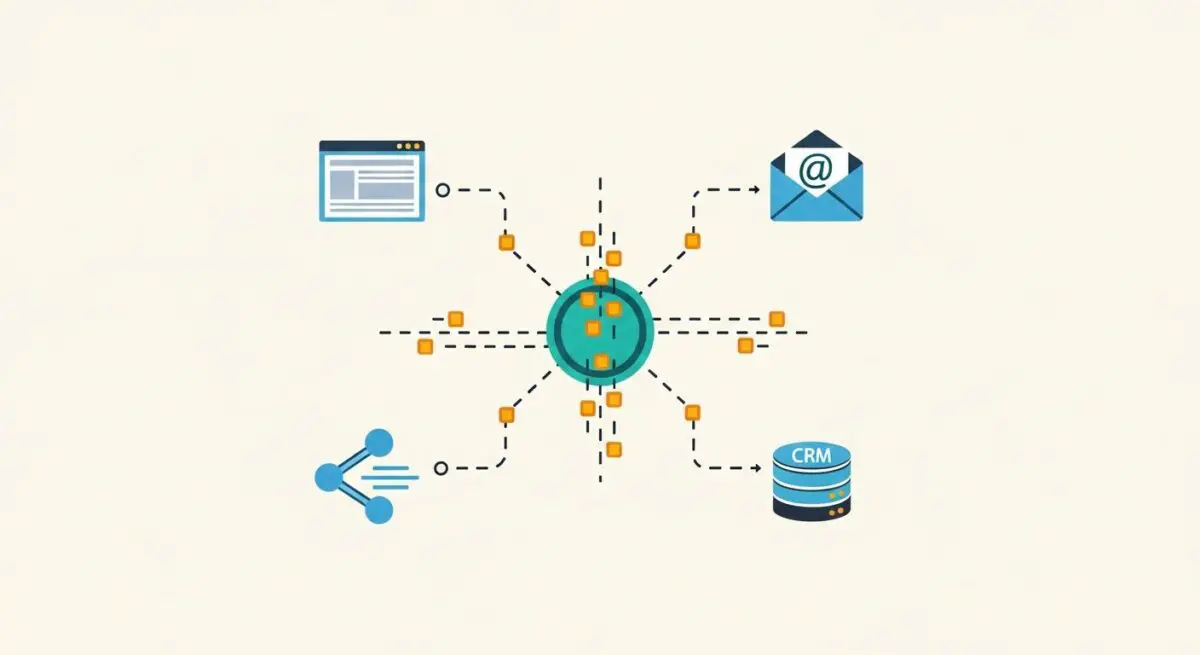
A Marketing Automation Platform (MAP) is a centralized software ecosystem designed to streamline, automate, and measure marketing tasks and workflows. At its core, a MAP functions as an orchestration layer that integrates customer relationship management (CRM) data with communication channels like email, SMS, and social media. In the context of modern AI automations, these platforms serve as the execution engine for data-driven triggers, utilizing complex logic to deliver personalized content at scale.
MAPs rely heavily on relational databases and event-driven architectures. They capture behavioral signals—such as page views, form submissions, or API calls—and process them through predefined rule sets or machine learning models. This allows for the programmatic management of the customer lifecycle, ensuring that data flows seamlessly between the marketing stack and the broader enterprise resource planning (ERP) systems through standardized protocols.
The Real-World Analogy
Imagine a highly advanced air traffic control tower. The planes represent different pieces of customer data and marketing messages. Without the tower, planes would fly haphazardly, potentially colliding or missing their destinations. The Marketing Automation Platform acts as the tower, using radar (tracking scripts) and radio communication (APIs) to ensure every “plane” lands at the right gate (the customer’s inbox or browser) at precisely the right time, based on a master flight plan (the automation workflow).
Why is Marketing Automation Platform Critical for Autonomous Workflows and AI Content Ops?
In the era of AI-driven content, a MAP is essential for managing stateless automation and high-volume API payloads. It provides the infrastructure necessary for programmatic SEO, where AI-generated content must be distributed across thousands of landing pages or email segments based on real-time data. By leveraging webhooks, a MAP can trigger external AI agents to generate personalized responses or update dynamic content blocks, ensuring that the automation remains responsive to user behavior without manual intervention. Furthermore, it handles the complexities of serverless architecture scaling, allowing brands to process millions of events without infrastructure degradation or manual oversight.
Best Practices & Implementation
- Implement Robust Webhook Error Handling: Ensure all outbound webhooks to AI agents include exponential backoff retry logic and logging to prevent data loss during API timeouts.
- Normalize Data at the Entry Point: Use middleware or edge functions to clean and format JSON payloads before they enter the MAP to maintain database integrity and prevent logic errors.
- Optimize for Rate Limits: Configure workflow delays and batch processing to respect the rate limits of downstream APIs and third-party LLM services.
- Leverage Dynamic Content Blocks: Use liquid logic or similar templating languages to inject AI-generated insights directly into communication templates for hyper-personalization.
Common Mistakes to Avoid
One frequent error is the creation of “automation loops,” where recursive triggers cause redundant API calls and exhaust resource quotas. Another mistake is failing to implement a unified data schema, leading to fragmented customer profiles that break personalization logic. Finally, many organizations neglect to set up monitoring for “silent failures” in background processes, where workflows appear active but fail to execute due to expired API tokens or schema mismatches.
Conclusion
A Marketing Automation Platform is the foundational infrastructure for scaling AI-driven operations and ensuring data-driven precision in autonomous workflows.