Executive Summary
- Algorithmic automation of the ad-buying process through Real-Time Bidding (RTB) and programmatic direct protocols.
- Seamless integration between Demand-Side Platforms (DSPs) and Supply-Side Platforms (SSPs) to optimize inventory yield and cost-per-acquisition.
- Advanced data attribution modeling utilizing first-party data and Customer Data Platforms (CDPs) to mitigate the impact of third-party cookie deprecation.
What is Programmatic Advertising?
Programmatic advertising refers to the automated, algorithmic purchase and sale of digital advertising inventory in real-time. Unlike traditional manual ad buying, which involves human negotiations, Request for Proposals (RFPs), and manual insertion orders, programmatic systems leverage sophisticated software to execute transactions in milliseconds. At its core, the programmatic ecosystem is powered by a complex MarTech stack consisting of Demand-Side Platforms (DSPs), Supply-Side Platforms (SSPs), Ad Exchanges, and Data Management Platforms (DMPs). These components work in tandem to ensure that the right ad is served to the right user at the optimal price point, based on a multitude of data signals including browsing behavior, geographic location, and device type.
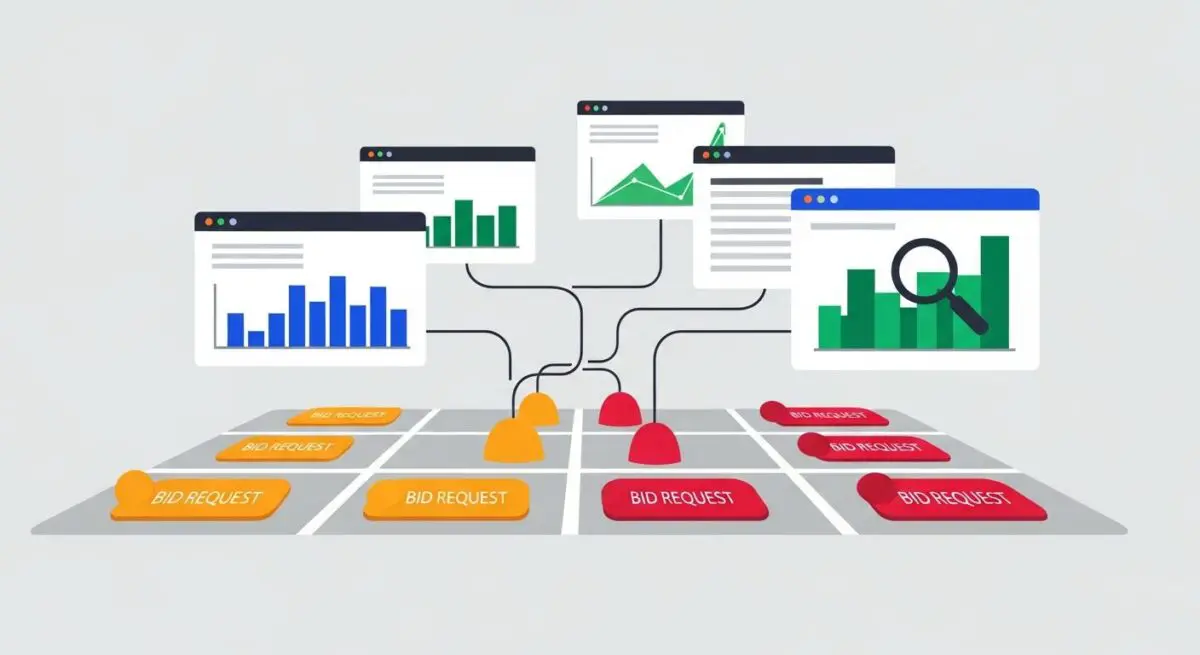
The technical backbone of programmatic advertising is Real-Time Bidding (RTB). When a user visits a website, the SSP triggers an auction by sending a bid request to the Ad Exchange. The exchange then broadcasts this request to multiple DSPs. Each DSP evaluates the user data against the advertiser’s predefined parameters and submits a bid. The highest bidder wins the auction, and the ad is rendered on the user’s screen—all within approximately 100 milliseconds. Beyond RTB, programmatic also encompasses Programmatic Direct and Private Marketplaces (PMPs), which allow for more controlled environments and guaranteed inventory for enterprise-level brands requiring higher brand safety and premium placements.
In the modern data landscape, programmatic advertising is increasingly intersecting with Artificial Intelligence (AI) and Machine Learning (ML). These technologies are used to predict bid prices, optimize creative assets through Dynamic Creative Optimization (DCO), and perform sophisticated fraud detection. As the industry moves toward a privacy-first framework, programmatic strategies are evolving to incorporate Privacy Sandbox APIs and contextual targeting, ensuring that marketing automation remains effective without relying on intrusive tracking mechanisms.
The Real-World Analogy
To understand programmatic advertising, consider the evolution of the global stock market. In the past, stock trading involved floor brokers shouting orders and manually recording transactions on paper—a slow, inefficient process prone to human error. Today, the stock market is dominated by high-frequency trading (HFT) algorithms. These systems analyze vast datasets and execute thousands of trades per second based on micro-fluctuations in price and volume. Programmatic advertising is essentially the high-frequency trading of the digital attention economy. The ad inventory is the stock, the DSP is the automated trading platform for the buyer, the SSP is the platform for the seller (the exchange), and the bid is the transaction price determined by the immediate market value of that specific user’s impression at that exact moment.
How Programmatic Advertising Impacts Marketing ROI & Data Attribution?
Programmatic advertising significantly enhances Marketing ROI by eliminating the inefficiencies of manual procurement and reducing wasted ad spend through granular targeting. By utilizing machine learning algorithms, programmatic platforms can shift budgets in real-time toward high-performing segments, effectively lowering the Customer Acquisition Cost (CAC). Furthermore, the ability to set strict frequency caps across multiple channels prevents ad fatigue and ensures that the budget is distributed across a wider unique audience, maximizing the reach-to-cost ratio.
From a data attribution perspective, programmatic advertising provides a wealth of log-level data that is critical for multi-touch attribution (MTA) models. Unlike walled gardens that often restrict data export, programmatic environments allow data scientists to analyze the entire path to conversion. This visibility enables marketers to understand the “halo effect”—how programmatic display or video impressions influence organic search behavior and direct traffic. By correlating programmatic spend with increases in branded search volume, organizations can better attribute value to top-of-funnel awareness campaigns that were previously difficult to quantify. This integration of programmatic data into the broader analytics engineering framework allows for more accurate Lifetime Value (LTV) modeling and strategic budget allocation.
Strategic Implementation & Best Practices
- Leverage First-Party Data Integration: Connect your Customer Data Platform (CDP) directly to your DSP to create highly accurate lookalike audiences and retargeting segments, reducing reliance on declining third-party cookie signals.
- Implement Supply Path Optimization (SPO): Audit your programmatic supply chain to remove unnecessary intermediaries. By consolidating spend with high-quality SSPs and direct paths, you reduce “ad tech tax” and improve transparency.
- Utilize Dynamic Creative Optimization (DCO): Deploy AI-driven creative that automatically adjusts elements like headlines, images, and calls-to-action based on real-time user data, significantly improving engagement rates and conversion probability.
- Prioritize Brand Safety and Suitability: Use advanced keyword exclusion lists, inclusion lists, and third-party verification tools (e.g., DoubleVerify or IAS) to ensure ads are never placed next to non-compliant or harmful content.
- Adopt a Hybrid Attribution Model: Combine programmatic log data with Marketing Mix Modeling (MMM) to account for both digital touchpoints and offline variables, providing a holistic view of marketing performance.
Common Pitfalls & Strategic Mistakes
One of the most frequent errors in programmatic advertising is the lack of transparency in the supply chain, leading to significant portions of the budget being lost to hidden fees or ad fraud. Enterprise brands often fail to implement rigorous monitoring, resulting in ads being served to bots rather than humans. Another common mistake is over-targeting, where hyper-segmentation leads to extremely small audience pools and high CPMs, ultimately stifling the scale necessary for significant ROI. Finally, many organizations treat programmatic as a silo, failing to align its messaging with SEO and content marketing strategies, which results in a fragmented customer experience and sub-optimal data attribution.
Conclusion
Programmatic advertising is a critical component of a scalable, data-driven marketing architecture, offering unparalleled efficiency through automation and real-time optimization. By integrating programmatic insights with broader SEO and analytics frameworks, brands can achieve a sophisticated, full-funnel approach that maximizes both immediate conversions and long-term brand equity.