Executive Summary
- Sender Score is a numerical reputation metric (0-100) assigned to outgoing mail server IP addresses by Validity, functioning as a primary indicator of email deliverability.
- The score is calculated via an algorithmic analysis of data from the Cooperative Reputation Network, factoring in spam trap hits, complaint rates, and volume consistency.
- High-tier Sender Scores (90+) are essential for bypassing ISP filters, directly impacting the efficiency of the MarTech stack and overall Customer Acquisition Cost (CAC).
What is Sender Score?
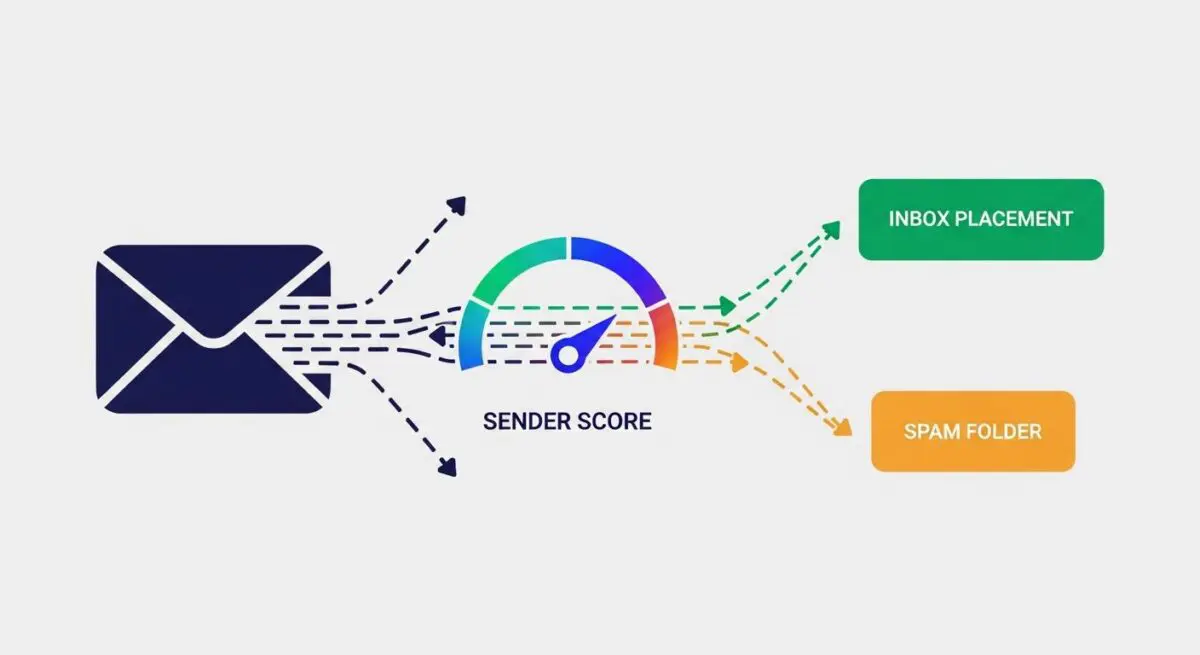
Sender Score is a proprietary reputation algorithm developed by Validity (formerly Return Path) that assigns a numerical value between 0 and 100 to an outgoing mail server’s IP address. This metric serves as a standardized benchmark for Internet Service Providers (ISPs) and Mail Transfer Agents (MTAs) to evaluate the trustworthiness of an email sender. In the modern MarTech stack, Sender Score operates as a critical diagnostic tool for performance marketing, providing a quantitative assessment of how likely an IP’s traffic is to be filtered, throttled, or rejected by receiving servers.
The calculation of a Sender Score is derived from the Cooperative Reputation Network, which aggregates data from over 60 million mailboxes. The algorithm analyzes various technical signals, including but not limited to, complaint rates, the frequency of hits on pristine and recycled spam traps, and the ratio of rejected messages due to invalid recipients (Unknown Users). Unlike domain-based reputation, which follows the brand across different infrastructures, Sender Score is strictly tied to the IP address, making it a vital metric for organizations managing their own mail servers or utilizing dedicated IPs through Email Service Providers (ESPs).
From a technical SEO and Data Analytics perspective, Sender Score is a foundational element of the communication infrastructure. While it does not directly influence search engine rankings, it is a primary driver of the ‘owned media’ channel’s efficacy. A degraded Sender Score leads to poor inbox placement, which in turn skews engagement data, disrupts attribution models, and creates data silos where user behavior cannot be accurately tracked across the customer journey due to delivery failure.
The Real-World Analogy
To understand Sender Score at a strategic level, consider it as a Credit Score for Digital Communication. Just as a financial credit score aggregates your history of payments, debts, and fiscal responsibility to determine your eligibility for a loan, a Sender Score aggregates your history of email transmissions to determine your eligibility for the recipient’s inbox. If a consumer has a low credit score, banks view them as a high-risk entity and may deny their application or impose high interest rates. Similarly, if an IP address has a low Sender Score, ISPs view the sender as a high-risk source of spam, leading them to either block the ‘transaction’ (the email) entirely or relegate it to the ‘subprime’ folder (the spam folder).
How Sender Score Impacts Marketing ROI & Data Attribution?
The impact of Sender Score on Marketing ROI is direct and quantifiable. In a high-performance marketing environment, the conversion funnel relies heavily on automated triggers, transactional updates, and lead nurturing sequences. If the Sender Score falls below the critical threshold—typically 70 to 80—ISPs like Gmail, Outlook, and Yahoo begin to apply aggressive filtering. This results in a ‘Deliverability Gap,’ where the Email Service Provider reports a 99% delivery rate (meaning the server accepted the mail), but the actual ‘Inbox Placement Rate’ (IPR) is significantly lower. This discrepancy inflates the Customer Acquisition Cost (CAC) because the resources spent on lead generation are wasted on prospects who never see the communication.
Furthermore, Sender Score integrity is paramount for accurate data attribution. Modern marketing relies on multi-touch attribution models to understand the path to conversion. If a critical ‘nurture’ email is diverted to the spam folder due to a poor reputation score, the data sequence is broken. The analyst may incorrectly conclude that the email channel is ineffective or that the user converted ‘organically,’ when in reality, the conversion was delayed or the attribution was misassigned due to a technical failure in the delivery infrastructure. Maintaining a high score ensures that the data flowing into the Analytics Engine reflects true user intent rather than infrastructure limitations.
Strategic Implementation & Best Practices
- Implement Advanced Authentication Protocols: Ensure that SPF (Sender Policy Framework), DKIM (DomainKeys Identified Mail), and DMARC (Domain-based Message Authentication, Reporting, and Conformance) are correctly configured. These protocols validate the identity of the sender, reducing the likelihood of spoofing and protecting the IP’s Sender Score from being tarnished by malicious actors.
- Maintain Rigorous List Hygiene: Utilize real-time email verification APIs to prune ‘Unknown Users’ and ‘Role-based’ addresses from your database. High bounce rates are a primary signal used by the Sender Score algorithm to identify poor sending practices, which can lead to rapid score degradation.
- Monitor Spam Trap Hits: Regularly audit your acquisition sources to ensure you are not inadvertently collecting ‘spam traps.’ These are email addresses specifically designed to catch irresponsible senders. A single hit on a pristine spam trap can cause a significant drop in Sender Score, signaling to ISPs that your list-building practices are non-compliant.
- Optimize Sending Volume and Cadence: Avoid erratic spikes in email volume, which are characteristic of botnets and spammers. Implement ‘IP Warming’ strategies for new infrastructures, gradually increasing volume to establish a predictable and trustworthy sending pattern that the Sender Score algorithm can positively profile.
Common Pitfalls & Strategic Mistakes
One of the most frequent errors in enterprise marketing is the failure to distinguish between Shared IP and Dedicated IP reputation. Organizations using shared IPs are often victims of ‘neighbor noise,’ where the poor sending habits of another company on the same IP degrade the Sender Score for everyone. Conversely, brands on dedicated IPs often fail to monitor their score until deliverability has already collapsed, leading to a reactive rather than proactive infrastructure management strategy.
Another strategic mistake is ignoring the ‘Unknown User’ rate. Many marketers focus solely on ‘Unsubscribe’ rates, but the Sender Score algorithm weighs ‘Unknown Users’ (hard bounces) much more heavily. Continuing to send to invalid addresses signals a lack of list maintenance, which is a major red flag for ISP filtering engines. In the era of AI-driven marketing, where algorithms prioritize user engagement, a low Sender Score acts as a technical barrier that no amount of creative optimization can overcome.
Conclusion
Sender Score is a vital technical KPI that bridges the gap between marketing operations and IT infrastructure. By maintaining a high reputation score through rigorous authentication and list hygiene, organizations can ensure maximum inbox placement, accurate data attribution, and a lower Customer Acquisition Cost.