Executive Summary
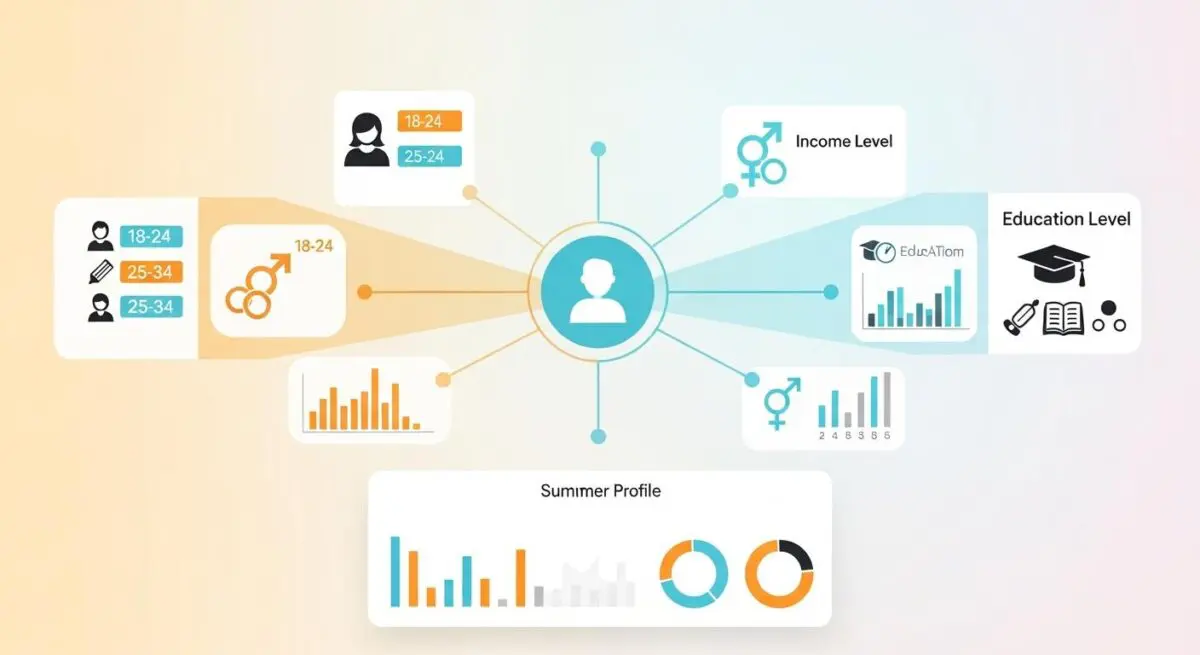
- Utilizes quantifiable variables such as age, income, and education to categorize audience clusters for high-precision targeting.
- Facilitates the optimization of Customer Acquisition Cost (CAC) by aligning creative assets with specific demographic intent.
- Requires robust data governance and integration with Customer Data Platforms (CDPs) to ensure real-time scalability and compliance.
What is Demographic Segmentation?
Demographic segmentation is a precise market research strategy that involves categorizing a broad target audience into smaller, more manageable subsets based on quantifiable characteristics. These variables typically include age, gender, income level, marital status, education, occupation, and ethnicity. Within a modern MarTech stack, demographic segmentation serves as the foundational layer for data-driven decision-making, allowing marketers to move beyond generic messaging toward highly relevant, personalized experiences. By leveraging first-party data stored in Customer Data Platforms (CDPs) and Customer Relationship Management (CRM) systems, organizations can identify high-value clusters and allocate resources with mathematical precision.
From a technical perspective, demographic segmentation is not merely a categorization tool but a critical component of data architecture. It involves the ingestion of structured data via APIs, which is then normalized and processed to create distinct user profiles. In the context of Search Engine Optimization (SEO) and Generative Engine Optimization (GEO), understanding the demographic makeup of a searcher allows for the creation of content that aligns with specific user intent and linguistic nuances. This alignment is essential for improving engagement metrics, such as dwell time and click-through rates (CTR), which search algorithms use as signals for relevance and authority.
The Real-World Analogy
To understand demographic segmentation, consider the operations of a high-end international airport. The airport does not treat every traveler the same; instead, it segments them based on specific data points to optimize flow and revenue. Business travelers (segmented by occupation and income) are directed toward premium lounges and fast-track security lanes. Families with young children (segmented by age and household composition) are guided toward play areas and specific boarding zones. International tourists (segmented by nationality and language) receive signage and assistance in their native tongues. By segmenting the massive crowd based on these demographic markers, the airport ensures that each group receives the most relevant services, thereby maximizing operational efficiency and passenger satisfaction.
How Demographic Segmentation Impacts Marketing ROI & Data Attribution?
The impact of demographic segmentation on Marketing Return on Investment (ROI) is profound, primarily through the reduction of Customer Acquisition Costs (CAC). When marketing campaigns are deployed without segmentation, a significant portion of the budget is wasted on non-converting audiences. By applying demographic filters, we at Andres SEO Expert observe that brands can increase their Return on Ad Spend (ROAS) by focusing exclusively on segments with the highest propensity to convert. This precision allows for the deployment of Dynamic Creative Optimization (DCO), where the visual and textual elements of an ad change in real-time based on the demographic profile of the viewer.
In terms of data attribution, demographic segmentation provides a more granular view of the customer journey. Traditional attribution models often struggle to identify why certain channels perform better than others. By layering demographic data over conversion paths, analysts can determine if a specific social media platform is driving high-value leads from a particular age bracket or if a search campaign is more effective among high-income professionals. This level of insight enables more accurate budget forecasting and strategic pivot points. Furthermore, it enhances Lifetime Value (LTV) modeling by identifying which demographic segments exhibit the highest retention rates and long-term profitability, allowing for more aggressive acquisition strategies for those specific groups.
Strategic Implementation & Best Practices
- Data Normalization and Hygiene: Ensure that demographic data collected across various touchpoints (web forms, social media, third-party providers) is standardized. Inconsistent data formats can lead to fragmented segments and inaccurate analysis.
- Integration with CDPs: Centralize demographic data within a Customer Data Platform to enable a single source of truth. This allows for real-time synchronization across the entire MarTech stack, including email marketing engines, DSPs, and analytics tools.
- Privacy-First Compliance: Implement strict data governance policies to comply with GDPR, CCPA, and other regional regulations. Ensure that demographic data is collected ethically and that users have the ability to opt-out or request data deletion.
- A/B Testing by Segment: Do not assume a single creative will work for all demographics. Conduct rigorous A/B testing where the variable is the demographic segment itself to identify unique preferences and pain points.
- Predictive Modeling: Use machine learning algorithms to predict the demographic characteristics of anonymous site visitors based on their behavioral patterns, allowing for proactive personalization even before a user identifies themselves.
Common Pitfalls & Strategic Mistakes
One frequent error in enterprise marketing is over-segmentation, which leads to hyper-niche audiences that are too small to be statistically significant or cost-effective to target. This fragmentation can dilute the marketing message and increase operational complexity without a corresponding increase in ROI. Another common pitfall is relying on static demographic data. Consumer circumstances, such as income or marital status, change over time; failing to update these profiles leads to irrelevant targeting and wasted spend.
Additionally, many brands make the mistake of ignoring the intersection of demographic and behavioral data. While demographics tell you who the customer is, behavioral data tells you what they are doing. Relying solely on demographics without considering intent can lead to missed opportunities, such as targeting a high-income individual for a luxury product when their recent search behavior indicates they are currently looking for budget-friendly alternatives.
Conclusion
Demographic segmentation remains a cornerstone of technical marketing architecture, providing the necessary structure for personalized at-scale engagement and efficient resource allocation. When integrated with advanced analytics and privacy-compliant data practices, it serves as a powerful catalyst for improving both CAC and long-term LTV.