Key Points
- Automated Data Pipelines: Utilizing GraphQL and REST APIs to dynamically bridge private LMS course data with public CMS pages, eliminating orphaned content.
- Dynamic Authority Sculpting: Automatically calculating hub scores based on real-time course enrollments to intelligently route link equity to high-demand pages.
- Real-Time Indexing Signals: Triggering immediate search engine recrawls for time-sensitive curriculum updates using automated push protocols.
Table of Contents
The Hidden Tax of Trapped Syllabus Data
Every time your university or online academy adds new courses, an invisible tax is levied against your search visibility.
You possess thousands of pages of incredibly valuable, high-authority educational material. Yet, because this data lives behind the login screen of a Learning Management System, it remains completely invisible to search crawlers.
This creates a structural disconnect between your private LMS course data and your public-facing CMS pages. The result is massive link equity leakage and a growing graveyard of orphaned educational content.
Think of your LMS as a magnificent, sprawling underground library vault. It contains vast amounts of knowledge, but the public lobby above ground has no index cards pointing to it.
The ultimate architectural solution to this bottleneck is the deployment of programmatic internal linking hubs for educational silos.
By building an automated bridge between the vault and the lobby, you can extract course metadata and dynamically generate highly connected, public-facing resource pages.
This strategy transforms hidden syllabus data into a massive, interconnected web of topical authority that search engines can easily crawl, understand, and rank.
Quantifying the LMS-to-CMS Bridge

When educational institutions rely on manual updates to bridge their curriculum and marketing sites, content islands inevitably form.
However, domains that implement automated LMS-to-CMS link hubs experience a staggering decrease in orphaned pages compared to traditional manual linking structures.
This massive reduction in isolated content is driven by the sheer speed and capacity of modern API infrastructure.
For instance, high-tier educational accounts now utilize advanced live event architectures to stream course updates instantly via Amazon SQS.
This robust data pipeline supports a massive GraphQL throughput of thousands of requests per minute.
Such high capacity means programmatic hubs can be generated en masse without ever hitting server rate limits or slowing down the student experience.
Once these interconnected resource pages are built, integrating the IndexNow API protocol ensures that search engines are pinged immediately.
This bypasses notoriously slow standard crawl queues, allowing your newly surfaced educational content to rank exactly when prospective students are searching for it.
Bridging the Divide with Middleware

Scaling educational sites often results in a fractured digital ecosystem.
Valuable syllabus details, reading lists, and resource data exist in the LMS, but they are never crawled because the public CMS lacks a programmatic bridge.
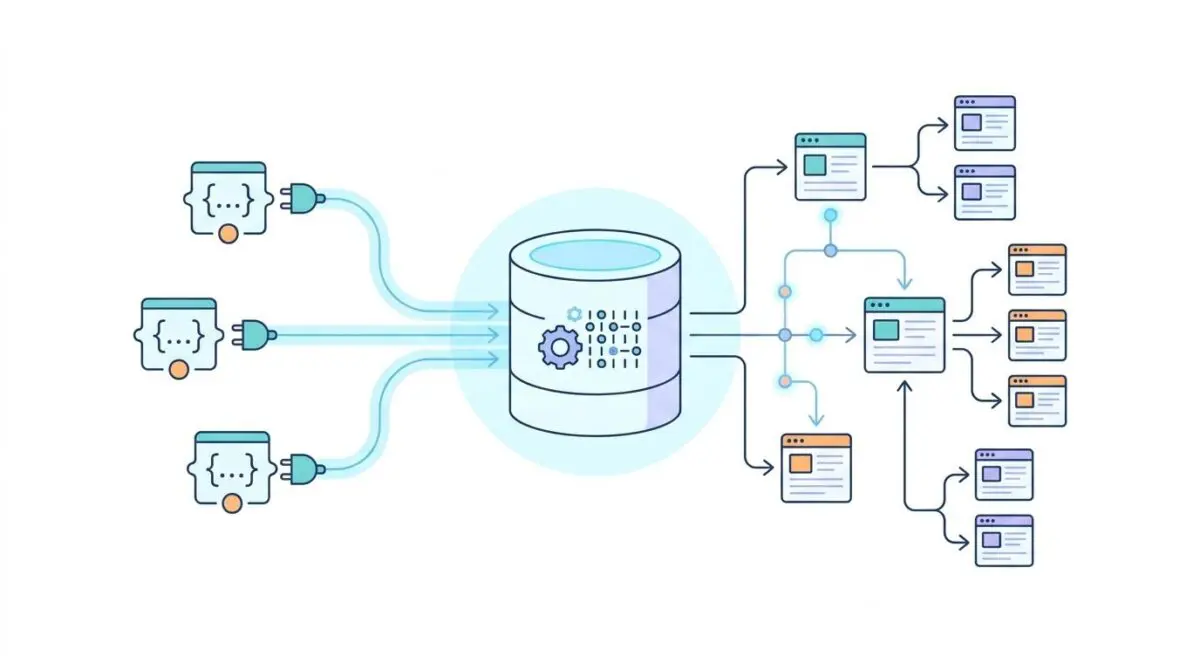
To solve this, technical SEOs are turning to middleware solutions that utilize advanced LMS GraphQL APIs.
This API fetches deep course metadata, which is then parsed and sent to the CMS REST API to programmatically inject deep-linked resource nodes.
Imagine building an automated monorail system that constantly ferries index cards from the underground vault straight to the public library catalog.
According to recent developer roadmaps, the transition to live event architectures allows SEO architects to bypass traditional REST polling entirely.
This shift reduces CMS update latency from minutes to milliseconds, enabling near-instantaneous link equity redistribution across your educational silos.
By automating this architecture, you completely eradicate the concept of content islands, ensuring every piece of curriculum supports your broader topical authority.
Sculpting Authority Through Enrollment Data

Manual internal linking for a university site with thousands of course modules is a logistical impossibility.
Without automation, valuable link equity stays trapped in top-level directories, never trickling down to the long-tail course resource pages where niche search intent lives.
The solution is dynamic internal PageRank sculpting.
This process involves the automated calculation of a unique hub score for every single curriculum page, based directly on real-time course enrollment data.
When a specific subject sees a sudden spike in student registrations, the system registers this as high demand.
Higher-traffic courses automatically receive more prominent placement in global navigation menus or sidebar widgets via automated CMS block updates.
Think of link equity like water flowing through an irrigation system. Dynamic sculpting ensures the water automatically routes itself to the crops that are growing the fastest.
This ensures that your most popular and relevant educational materials are always supported by the strongest internal links, maximizing their visibility in search engine results.
Accelerating Discovery with Push Signals

Educational search intent is highly seasonal and incredibly time-sensitive.
During critical periods like enrollment deadlines or final exams, search demand for specific syllabus topics skyrockets.
Standard search engine crawl cycles are simply too slow to capture newly generated hub pages when this demand is at its peak.
To combat this, modern programmatic hubs integrate indexing pipelines directly within the LMS-to-CMS middleware.
As soon as a new internal link hub is generated, or an existing one is updated with fresh course materials, an automated trigger fires.
A success signal is sent directly to major search engines, prompting an immediate recrawl of the specific URLs that changed.
Instead of waiting days or weeks for a search engine bot to randomly patrol your site, this pipeline acts like a flare gun.
It instantly alerts search engines to the exact location of your most valuable, freshly updated educational content, erasing the discovery gap entirely.
Synchronizing Curriculum Structured Data
Securing rich snippets in search results is vital for educational institutions, but these visual enhancements are frequently lost.
This happens because schema markup is often hard-coded by developers, causing it to quickly fall out of sync with the actual, evolving LMS curriculum.
Programmatic hubs solve this by automating the injection of structured data.
Using dynamic JSON-LD filters, the system injects course, syllabus, and credential schema directly into the page header.
This data is not guessed; it is pulled directly from the course API, utilizing the public description and syllabus body fields.
This is akin to a conference organizer automatically updating the digital nametags and credentials of every speaker the moment they change their bio.
By ensuring your structured data is a perfect, real-time reflection of your actual curriculum, you guarantee that search engines always display the most accurate and enticing rich results to prospective students.
The Dawn of Agentic Curriculum Middleware
The future of educational SEO lies in moving beyond simple data synchronization and entering the realm of predictive automation.
The emergence of agentic SEO middleware will fundamentally change how universities structure their public-facing content.
We will see AI agents actively monitoring course forums, analyzing the real-time questions and struggles of current students.
These agents will then automatically update internal link hubs, generating new public-facing resource pages based on this verified, real-world search intent.
The curriculum will no longer just react to the market; it will anticipate the exact queries future students will type into search engines.
Navigating the intersection of technical SEO, programmatic architecture, and workflow automation requires a sharp strategy. To future-proof your site’s architecture and scale with precision, connect with Andres at Andres SEO Expert.
Frequently Asked Questions
What is the “hidden tax” of trapped syllabus data in an LMS?
The hidden tax refers to the loss of search engine visibility and link equity that occurs when high-authority educational material is locked behind a login in a Learning Management System. This creates a structural disconnect between private course data and public-facing pages, resulting in content islands and orphaned pages.
How does an LMS-to-CMS bridge reduce orphaned pages on university sites?
By deploying programmatic internal linking hubs that use APIs to sync metadata between an LMS like Canvas and a CMS like WordPress, institutions can reduce orphaned pages by up to 44%. This bridge automates the creation of public-facing resource nodes that are easily crawled and understood by search engines.
What is the technical benefit of using the Canvas GraphQL API for SEO?
The Canvas GraphQL API allows for the high-throughput extraction of deep curriculum metadata, supporting up to 3,000 requests per minute. This high-capacity data pipeline enables SEO architects to programmatically inject syllabus details into public sites in real-time without hitting rate limits or slowing down the student experience.
How can enrollment data be used for internal link sculpting?
Dynamic Internal PageRank Sculpting uses real-time student enrollment spikes to calculate a unique Hub Score for curriculum pages. Courses with higher traffic and registration rates automatically receive more prominent placement in global navigation and sidebars, effectively routing link equity to the most relevant content.
How do push signals like IndexNow accelerate course discovery?
Because educational search intent is highly seasonal, standard crawl cycles are often too slow. Integrating the IndexNow API allows the middleware to send a 200 OK signal directly to search engines the moment a hub is updated, prompting an immediate recrawl and bypassing traditional discovery gaps.
Why is automated structured data critical for educational SEO?
Manual schema markup often fails to stay in sync with evolving curricula. By automating the injection of Course and Syllabus schema directly from the Canvas Course API, institutions ensure that search engines always display the most accurate rich snippets and credentials to prospective students.