



Executive Summary
- Strategic alignment of sales and marketing through high-precision account targeting and data synchronization.
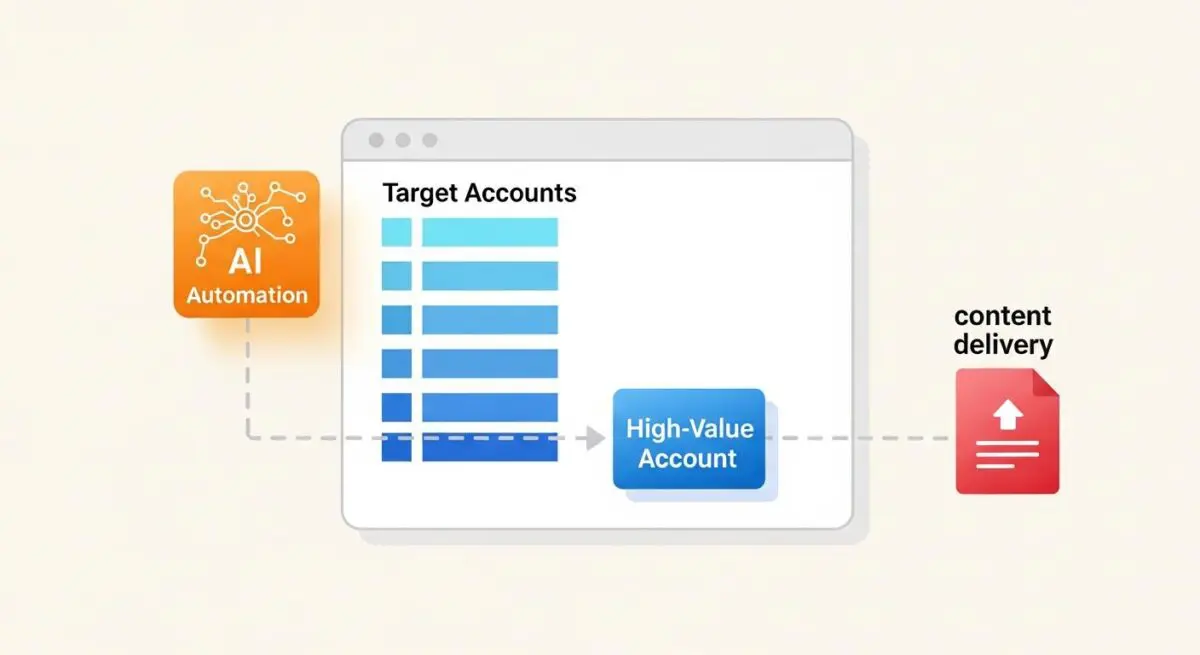
- Leveraging AI-driven predictive modeling to identify and prioritize high-value accounts within automated pipelines.
- Deployment of programmatic personalization via API-driven content delivery and dynamic landing page generation.
What is Account-Based Marketing?
Account-Based Marketing (ABM) is a strategic framework in B2B marketing where sales and marketing resources are deployed to target a specific set of high-value accounts. Unlike broad-reach demand generation, ABM treats individual accounts as discrete markets. In the landscape of AI automations, ABM is executed through sophisticated data pipelines that integrate CRM data, firmographic intelligence, and intent signals to trigger highly personalized outreach sequences.
Technically, ABM relies on the orchestration of various software layers, including Customer Data Platforms (CDPs) and Marketing Automation Platforms (MAPs). These systems use unique identifiers and API calls to ensure that content delivered to a stakeholder is contextually relevant to their specific organizational challenges. By utilizing machine learning models, organizations can predict which accounts are most likely to convert, allowing for the efficient allocation of computational and human resources.
The Real-World Analogy
Imagine you are an elite private chef hired to cater a high-stakes dinner. Instead of opening a buffet for a thousand random people (traditional marketing), you are tasked with preparing a bespoke seven-course meal for a single board of directors (ABM). You research every guest’s dietary restrictions, flavor preferences, and cultural backgrounds beforehand. Every ingredient is sourced specifically for this one event, and the service is timed perfectly to their conversation. In this scenario, the precision of the meal ensures a much higher satisfaction rate and a stronger relationship than a generic mass-produced buffet ever could.
Why is Account-Based Marketing Critical for Autonomous Workflows and AI Content Ops?
ABM is the primary driver for high-efficiency autonomous workflows because it reduces the noise within data pipelines. By narrowing the focus to a specific list of accounts, AI content operations can generate hyper-personalized assets—such as whitepapers, landing pages, and video scripts—using LLMs (Large Language Models) that are grounded in account-specific data. This programmatic SEO approach ensures that every generated page serves a high-intent purpose, rather than contributing to index bloat.
Furthermore, ABM enhances API payload efficiency. Instead of broadcasting generic data to thousands of endpoints, automation scripts can execute targeted webhooks that deliver specific value propositions to identified stakeholders. This precision is vital for serverless architectures where execution time and resource consumption directly impact operational costs. ABM allows for stateless automation to remain relevant by maintaining a persistent context of the target account’s journey across multiple touchpoints.
Best Practices & Implementation
- Unified Data Schema: Ensure that sales and marketing teams utilize a shared data schema within the CRM to prevent fragmentation of account intelligence.
- Dynamic Content Injection: Use API-driven variables to inject account-specific data (e.g., company name, industry pain points) into automated email templates and web components.
- Intent Signal Integration: Incorporate third-party intent data via webhooks to trigger automated workflows the moment a target account shows interest in specific keywords or topics.
- Lead-to-Account Mapping: Implement automated scripts to match incoming leads to existing target accounts, ensuring that individual contacts are routed into the correct ABM sequence.
Common Mistakes to Avoid
One frequent error is over-automation without a human-in-the-loop for high-stakes interactions, which can lead to uncanny or irrelevant AI-generated messaging. Another mistake is failing to clean and normalize firmographic data before it enters the automation pipeline, resulting in broken variables and failed API calls. Finally, many brands treat ABM as a purely marketing function, neglecting the necessary bidirectional data sync with sales teams that is required for a truly autonomous revenue engine.
Conclusion
Account-Based Marketing provides the strategic precision necessary to scale AI-driven content and automation workflows effectively. By focusing on high-value targets, organizations can optimize their technical infrastructure for maximum conversion and ROI.