


Executive Summary
- MACH ROI Multiplier: Enterprises adopting Microservices, API-first, Cloud-native, and Headless (MACH) frameworks report a 6x improvement in AI-driven ROI compared to monolithic competitors.
- Edge-to-Cloud Latency: Shifting real-time inference to the edge reduces latency to sub-5ms, enabling a 30-50% reduction in cloud egress costs while boosting production efficiency.
- Operational Precision: Market valuations have shifted toward Net Revenue Retention (NRR) above 100%, favoring modular stacks that allow for rapid, low-risk component replacement.
The Shift from Monoliths to Modularity
In the current landscape of 2026, the traditional enterprise architecture—once a fortress of stability—has become a liability. The rigid, monolithic systems that powered the last decade of growth are now struggling to keep pace with the volatile demands of generative search and autonomous agent orchestration. Digital transformation is no longer about simply moving workloads to the cloud; it is about re-engineering the organization to be as fluid as the market itself. This evolution is driven by the necessity of speed, where deployment cycles must be measured in days rather than quarters.
As we navigate the complexities of 2026, the move toward a composable approach has transitioned from a competitive advantage to a baseline requirement for survival. With traditional search traffic declining by 25% due to the rise of generative engines, businesses are forced to adopt architectures that can feed high-quality data into Retrieval-Augmented Generation (RAG) systems and vector databases. The goal is to ensure that a brand’s intellectual property is not just stored, but is discoverable and actionable by the AI agents that now mediate the relationship between companies and consumers.
Defining Composable Architecture for the Modern Enterprise
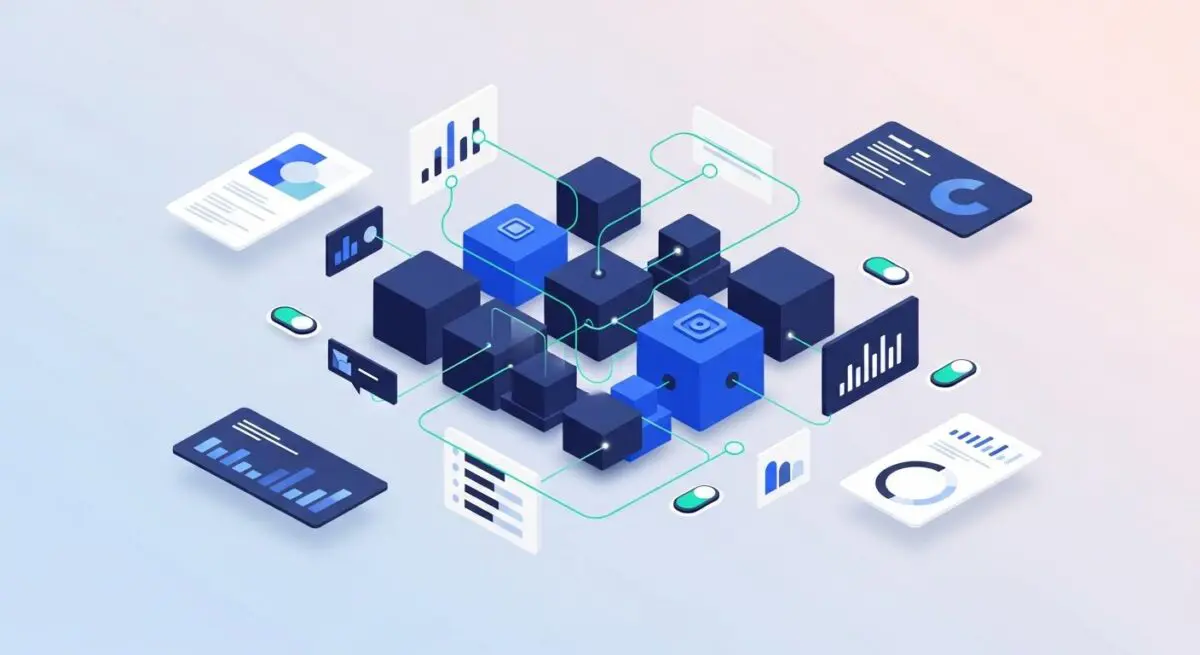
At its core, a composable architecture is a design philosophy where business capabilities are encapsulated as independent, interchangeable modules. Instead of a single, tightly coupled software suite, the enterprise is built from Packaged Business Capabilities (PBCs) that communicate via standardized APIs. This allows a company to swap out a payment processor, a search engine, or a logistics module without disrupting the entire ecosystem. It treats the tech stack as a living organism, capable of evolving its individual parts in response to specific pressures, such as shifting regulatory requirements or the emergence of superior AI models.
The Infrastructure of Agility: MACH and Edge Convergence
The technical foundation of this transformation is often referred to as the MACH architecture. By prioritizing Microservices and API-first design, organizations decouple the front-end user experience from the back-end logic. This headless approach has already demonstrated a significant impact on unit economics, with migrations showing an average 42% increase in conversion rates. The ability to push updates to a mobile app, a web portal, and an AI-driven voice interface simultaneously, using the same underlying data source, is the hallmark of a mature composable strategy.
Furthermore, the convergence of cloud and edge computing is redefining where intelligence resides. While the cloud remains the primary training ground for complex models, the execution—or inference—is increasingly moving to the edge. This shift is critical for industrial applications where latency exceeding 5ms can result in catastrophic failure or significant production waste. By adopting a “Train in Cloud, Execute at Edge” pattern, firms are utilizing Kubernetes as a universal control plane to manage stateful services across a distributed network, effectively reducing cloud spend by up to 50%.
Think of a traditional enterprise architecture like a medieval castle—imposing and secure, but impossible to move or expand without tearing down the walls. Composable architecture is more akin to a high-performance modular spacecraft. If the propulsion system needs an upgrade or the navigation sensor fails, you swap the specific module without grounding the entire mission. You aren’t married to the stone; you are empowered by the interface.
Economic Realities: ROI, Talent, and Financial Leakage
The transition to a composable model is not without its friction points. While the long-term operational costs can be 40-60% lower, the initial engineering hurdle is substantial. We are currently witnessing a sharp polarization in the talent market. There is a critical shortage of senior systems engineers capable of managing load-bearing AI architectures, while junior roles are being increasingly automated. This skills decay means that nearly a third of the technical workforce requires immediate reskilling to manage the complexities of multi-module stacks.
Financial management also requires a new lens. The shift to usage-based pricing and API-driven services has led to significant budget overruns for the unprepared. Many enterprises find themselves underestimating operational costs by 15% due to hidden egress fees and vendor-specific overhead. Moreover, the ease of generating code with AI has led to a surge in code bloat, where poorly architected modules create technical debt that threatens the stability of autonomous agent projects. Success in this era requires a disciplined approach to architectural judgment, ensuring that every new module adds more value than it costs in maintenance.
The Regulatory Catalyst and Sovereign AI
The regulatory environment is also acting as a forcing function for modularity. With the full enforcement of the EU AI Act, any composable module used in high-risk sectors like finance or healthcare must be fully auditable and traceable. This has sparked a move toward Sovereign AI, where data architectures are localized to comply with regional sovereignty laws. A composable framework allows an enterprise to swap a global AI module for a locally compliant one in specific jurisdictions, avoiding the risk of massive fines that can reach 7% of global turnover.
Andres’ Masterclass: The Big Picture
We have observed that the most successful digital transformations are those that treat technology as a capital allocation strategy rather than a cost center. In my experience, the true value of a composable architecture lies in its ability to protect a company’s most valuable asset: its optionality. When you are locked into a monolithic vendor, your roadmap is dictated by their innovation cycle. When you are composable, your roadmap is dictated by your own market insights. This shift from being a software consumer to a capability orchestrator is what separates the market leaders from the laggards.
I advise my clients to focus on Operational Precision as the primary metric for success. In an era where premium valuations are gated by Net Revenue Retention and high LTV:CAC ratios, the ability to rapidly iterate on customer-facing features is paramount. A modular stack allows you to isolate and optimize the specific touchpoints that drive retention without the risk of a full-system overhaul. We are moving toward a future where the most resilient companies will be those that can reconfigure their entire business logic in a weekend to meet a new market reality.
Architecting for an Autonomous Future
Navigating the intersection of generative search and operational efficiency requires more than just tools—it requires a roadmap. If you’re ready to evolve your strategy through specialized SEO, GEO, Adavanced Hosting Environments, or AI-driven automation, connect with Andres at Andres SEO Expert. Let’s build a future-proof foundation for your business together.