Executive Summary
- Architectural Convergence: The market is shifting toward Diffusion Transformers (DiT) to combine high-reasoning logic with superior multimodal output fidelity.
- The Agentic Pivot: Enterprise value has migrated from simple token generation to Action Reliability, where models are judged by their ability to execute complex, multi-step workflows.
- Infrastructure Constraints: Energy availability, rather than raw compute, has become the primary bottleneck for scaling generative ecosystems, favoring architectures with linear scaling like Mamba-3.
The Generative Architecture Landscape
The current technological landscape is defined by a transition from experimental AI to integrated agentic ecosystems. As we navigate the complexities of 2026, the strategic focus for founders and executives has shifted from basic model implementation to architectural optimization. Understanding the interplay between Transformers, Diffusion Models, and Generative Adversarial Networks (GANs) is no longer a technical luxury; it is a prerequisite for capital allocation and long-term scalability. The market has reached a frontier plateau where raw logic benchmarks are achieving parity, forcing a pivot toward operational reliability and specialized infrastructure.
Defining the Core Architectures
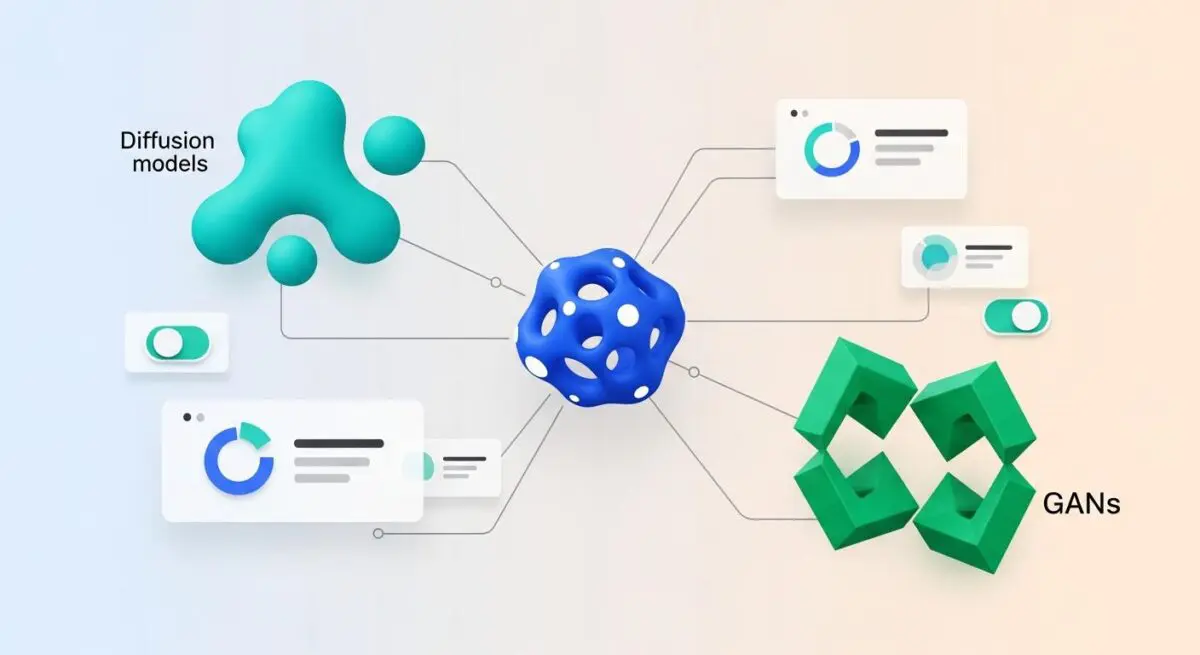
To lead in this environment, one must distinguish between the three pillars of generative technology. Transformers serve as the cognitive backbone, utilizing self-attention mechanisms to process and generate sequential data with deep contextual understanding. Diffusion Models have emerged as the gold standard for high-fidelity synthesis, particularly in visual and multimodal domains, by iteratively refining noise into structured data. GANs, while less dominant in broad creative tasks, remain the primary choice for low-latency, real-time applications where speed is the critical metric. Each architecture represents a different trade-off between reasoning depth, output quality, and computational efficiency.
The Strategic Shift Toward Action Reliability
The industry is moving beyond the era of the assistant and into the era of the agent. Market leaders are no longer evaluated solely on their ability to pass standardized logic tests but on their Action Reliability. This shift is driven by the commoditization of the bottom 80 percent of use cases by open-source models like Meta’s Llama series. Consequently, proprietary players are focusing on high-stakes reasoning and zero-day vulnerability detection. The goal is to move from a system that suggests an answer to a system that autonomously executes a solution within a secure, multi-agent environment.
Think of these architectures not as software, but as the specialized machinery of a modern factory. The Transformer is the central logic controller managing the workflow, the Diffusion Model is the high-precision 3D printer creating the final product, and the GAN is the rapid-fire quality inspector on the assembly line ensuring everything moves at the speed of light.
Infrastructure and the Energy Bottleneck
While the focus often remains on the models themselves, the underlying infrastructure is facing a significant friction point: power. Hyperscalers are currently navigating grid interconnection deadlines that stretch years into the future. Compute capacity is abundant, but the energy required to sustain massive data center expansions is not. This has led to a surge in interest for State-Space Models (SSMs) like Mamba-3, which offer linear scaling. These models provide significantly faster inference for long-context tasks while requiring a fraction of the VRAM, making them a strategic alternative to the quadratic complexity of traditional Transformers.
Economic Impact and the Execution Gap
Despite the rapid advancement of these technologies, an execution gap persists. Only a small fraction of enterprises have successfully moved beyond shadow AI into large-scale agentic production. The primary reason is that many current agentic solutions are merely static wrappers—API-driven logic rather than true autonomous reasoning systems. Success in this space is now measured by Cost-Per-Outcome (CPO). Enterprises that focus on building citation-ready, server-side rendered environments are seeing the highest returns, as they are better positioned to be indexed and utilized by generative search engines.
Andres’ Masterclass: The Big Picture
I have observed that the most successful organizations are those that prioritize model agnosticism and sovereign AI infrastructure. The era of vendor lock-in is ending as enterprises adopt model routing strategies to avoid dependency on a single provider. By leveraging a mix of proprietary high-reasoning models for critical tasks and commoditized open-source models for routine operations, businesses can optimize their unit economics while maintaining the flexibility to pivot as new architectures emerge. The real competitive moat is no longer the model you use, but the proprietary data and agentic orchestration layer you build around it.
We are seeing a massive deployment of capital into domestic data centers and bespoke foundational models, particularly from sovereign wealth funds. This indicates a global shift toward AI as a core utility. To maintain a competitive edge, leaders must focus on the integration of the Model Context Protocol (MCP) and peer-to-peer negotiation frameworks. The future belongs to those who can manage distributed agent states with minimal latency, turning technical complexity into a seamless operational advantage.
Navigating the Future of Generative Systems
The convergence of these architectures is creating a new standard for enterprise efficiency. As the regulatory environment tightens and energy constraints become more pronounced, the ability to select the right tool for the right task—whether it is a Transformer for logic, a Diffusion Model for creation, or a GAN for speed—will define the next generation of market leaders. The focus must remain on building robust, scalable systems that can adapt to the rapid pace of innovation without sacrificing reliability or security.
Navigating the intersection of generative search and operational efficiency requires more than just tools—it requires a roadmap. If you’re ready to evolve your strategy through specialized SEO, GEO, Adavanced Hosting Environments, or AI-driven automation, connect with Andres at Andres SEO Expert. Let’s build a future-proof foundation for your business together.”