




Executive Summary
- Interoperable Data Rails: The integration of FHIR clinical standards with RESTful Open Banking APIs has created a unified data layer for real-time health-wealth synchronization.
- Behavioral Unit Economics: Top-tier platforms are achieving LTV/CAC ratios of up to 12:1 by leveraging automated health-data-driven upsells and dynamic insurance pricing.
- Agentic Financial Security: The shift toward Post-Quantum Cryptography and behavioral biometric verification is mitigating the risks of AI-generated deepfakes in high-stakes financial transactions.
The Convergence of Biological and Financial Capital
The traditional silos separating personal health data and financial management are dissolving into a unified infrastructure known as the Health-Wealth stack. This evolution represents a fundamental shift in how value is generated and preserved, moving beyond static asset management into a dynamic, behavioral-driven ecosystem. Today, the market has transitioned from experimental pilots to a mature infrastructure-first model where health metrics directly influence financial outcomes, liquidity, and risk profiles.
For the strategic decision-maker, this convergence is not merely a lifestyle trend but a significant shift in capital allocation. Institutional leaders like Vitality Group and John Hancock have already integrated wellness-linked dynamic pricing into their retail stacks, while disruptors like Bilt Rewards have turned physical activity into a liquid asset class. The underlying thesis is simple: a healthier individual is a lower-risk, higher-value financial participant. By bridging these two domains, fintech platforms are unlocking new revenue streams and operational efficiencies that were previously inaccessible due to data fragmentation.
The Infrastructure Layer: FHIR and Open Banking Interoperability
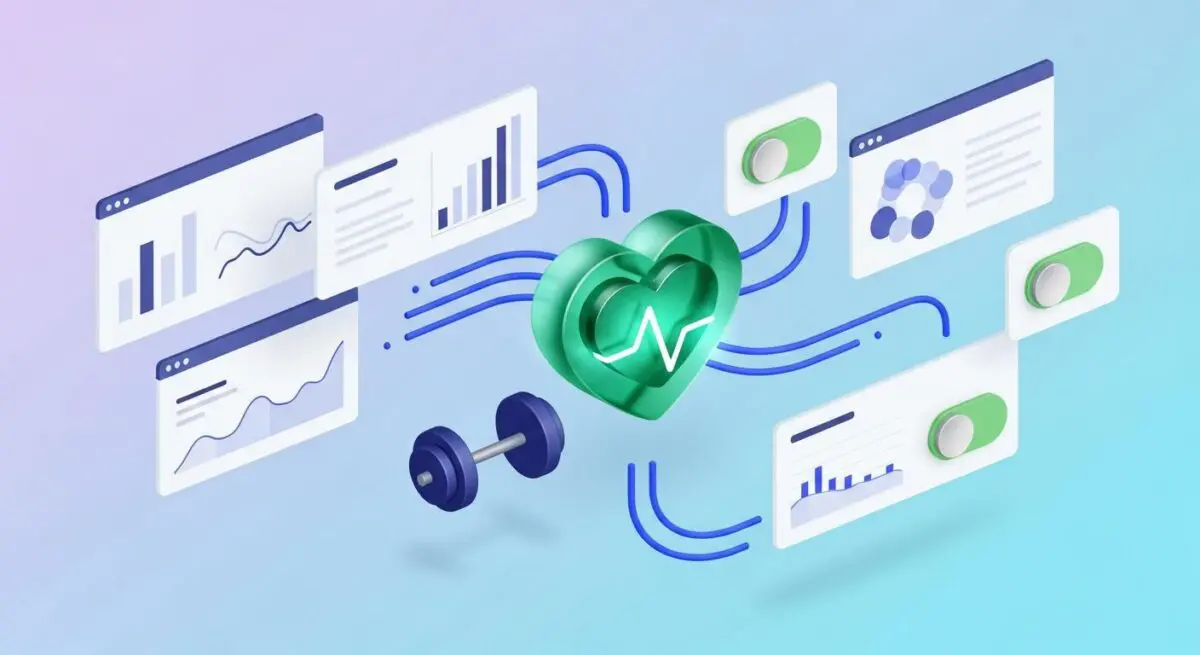
At the core of the health-wealth stack lies a sophisticated API-first architecture designed for real-time event-driven processing. The technical foundation relies on two primary standards: Fast Healthcare Interoperability Resources (FHIR) for clinical data and RESTful Open Banking APIs for financial data. This dual-layer approach allows for the seamless exchange of information between wearable devices, electronic health records, and brokerage accounts.
Middleware providers such as Thryve and dacadoo function as the invisible abstraction layer, aggregating data from hundreds of disparate wearables and clinical sources. This infrastructure enables what is now termed Agentic Finance, where AI agents autonomously execute financial strategies based on real-time life events. For instance, a significant health milestone could trigger an automated tax-loss harvesting sequence or an adjustment in life insurance premiums without manual intervention. The move from legacy batch processing to this real-time model has reduced the cost-to-serve by nearly 70% in back-office operations, allowing platforms to scale without a linear increase in overhead.
Defining the Behavioral Liquidity Model
To understand the strategic value of this stack, one must grasp the concept of Behavioral Liquidity. This refers to the conversion of positive health behaviors into tangible financial advantages, such as lower interest rates, higher savings yields, or reduced insurance premiums. In this model, health data is treated as a form of collateral that reduces the risk premium associated with the individual.
The unit economics of this model are compelling. While the standard Golden Ratio for fintech platforms is a 3:1 LTV/CAC, those successfully integrating health data are seeing ratios as high as 12:1. This is achieved through highly personalized, data-driven upsells and a significant reduction in churn. When a user’s financial health is inextricably linked to their physical well-being through a single platform, the switching costs become prohibitively high, creating a powerful market moat for early movers. Furthermore, insurers utilizing behavioral economics have documented a median 4% reduction in total claims costs, representing a massive ROI on wellness program expenditures.
The health-wealth stack operates much like a modern smart power grid. Just as a smart grid balances energy production and consumption in real-time to prevent waste and optimize flow, this financial architecture balances biological data and capital allocation. It ensures that the ‘energy’ generated by healthy behaviors is not lost but is instead converted into financial ‘voltage’ that powers the individual’s long-term wealth accumulation.
Security and the Post-Quantum Transition
As the health-wealth stack handles increasingly sensitive Protected Health Information (PHI) alongside financial artifacts, the security requirements have reached a critical threshold. The industry is currently migrating toward Post-Quantum Cryptography (PQC) to defend against the threat of Harvest Now, Decrypt Later (HNDL) attacks. This transition involves implementing hybrid encryption models that combine classical RSA/ECC with PQC to ensure long-term data integrity.
Moreover, the rise of AI-generated deepfakes has made traditional biometric verification a primary attack vector. In response, the stack has shifted toward orchestrated verification workflows. These systems, led by innovators like Sardine AI, analyze behavioral biometrics—such as typing rhythm and device interaction patterns—rather than relying on static images or voice prints. This multi-layered approach to security is essential for maintaining the data trust deficit, as 77% of users report a willingness to switch providers for better transparency and security of their personal information.
Governance and the Regulatory Moat
The regulatory landscape is also evolving to keep pace with these technical shifts. The enforcement of the EU AI Act has classified AI used in insurance underwriting and credit scoring as high-risk, necessitating rigorous explainability and auditability. While this increases the cost of compliance, it also creates a significant barrier to entry for smaller competitors, favoring incumbents who can afford the high-performance financial infrastructure required to meet these standards.
In the United States, the implementation of Dodd-Frank Section 1033 is mandating standardized data rights, effectively shifting the competitive landscape from data ownership to data utility. Platforms can no longer win simply by holding the most data; they must now win by providing the most sophisticated analysis and actionable insights. This commoditization of the underlying data layer places a premium on the orchestration layer—the part of the stack that actually turns data into financial ROI.
The Wealth Architecture: Strategic Synthesis
The convergence of health and wealth is not a peripheral fintech niche; it is the blueprint for the next generation of personalized financial services. We are seeing a fundamental re-engineering of the relationship between the individual and the institution, where value is no longer static but is continuously recalibrated based on behavioral inputs. The hidden signal here is the shift from reactive financial management to proactive, autonomous orchestration. Organizations that fail to integrate these biological data points into their risk and growth models will find themselves operating with a significant informational disadvantage, leading to mispriced risk and customer attrition.
From a capital allocation perspective, the priority must be on building or acquiring the middleware and orchestration layers that facilitate this data exchange. The real value lies not in the wearables or the bank accounts themselves, but in the intelligent layer that connects them. As the infrastructure matures, we expect to see a consolidation of platforms that can offer a truly holistic view of an individual’s ‘Total Capital’—both biological and financial. For the strategic investor, the focus should remain on platforms that demonstrate high operational ROI through AI-enabled claims adjudication and those that have successfully navigated the transition to post-quantum security standards.
Navigating the Future of Integrated Finance
The health-wealth stack represents the ultimate realization of data-driven finance. By aligning the incentives of the individual, the insurer, and the financial institution, this architecture creates a virtuous cycle of value creation. As the technical hurdles of interoperability and security are cleared, the focus will shift entirely to the strategic application of these insights to drive long-term wealth preservation and growth.
In a landscape defined by rapid technical shifts, strategy is the only sustainable defense. Whether you are architecting for the generative search era or optimizing for operational ROI, the right partnership defines your success. Connect with Andres at Andres SEO Expert to build a future-proof foundation for your enterprise.