



Executive Summary
- A technical Value Prop serves as the primary conversion catalyst within the heuristic formula for user decision-making, directly influencing the probability of conversion (C).
- Integration with Generative Engine Optimization (GEO) requires value propositions to be structured as high-density semantic entities that LLMs can easily parse and rank.
- Data-driven attribution models must account for the Value Prop as a constant variable that mitigates friction and anxiety across the multi-touch customer journey.
What is Value Prop?
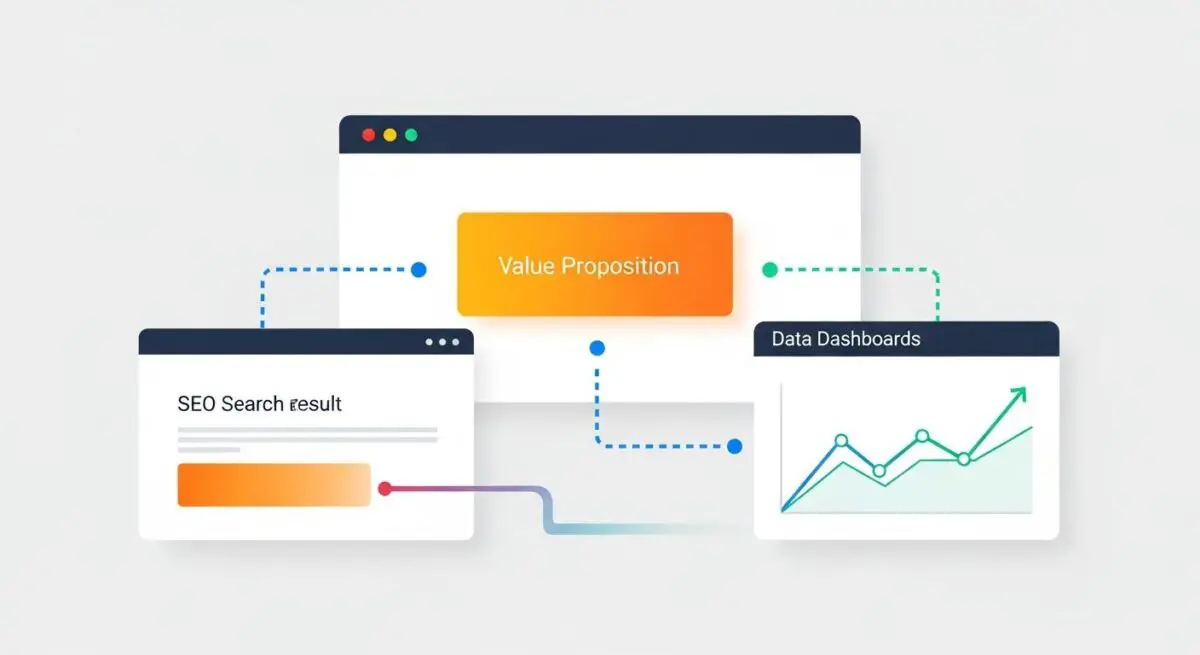
In the context of high-performance digital marketing and analytics engineering, a Value Prop (Value Proposition) is a technical statement of the functional, emotional, and economic benefits a brand promises to deliver to its target audience. It is not merely a marketing slogan or a creative tagline; rather, it is a strategic hypothesis that defines the intersection between a product’s unique capabilities and the specific pain points of a market segment. Within a modern MarTech stack, the value proposition acts as the foundational data layer that informs every aspect of the user experience (UX), from the initial search engine result page (SERP) interaction to the final conversion event.
From a technical standpoint, the Value Prop is the core component of the conversion heuristic formula: C = 4m + 3v + 2(i-f) – 2a, where ‘v’ represents the perceived value of the offer. In this model, the value proposition is the most significant positive variable that a marketer can control to overcome user friction (f) and anxiety (a). In the era of AI-driven search and Generative Engine Optimization (GEO), the value prop must be engineered for machine readability, ensuring that Large Language Models (LLMs) can accurately extract and synthesize the brand’s unique selling points when generating responses to complex user queries.
The Real-World Analogy
To understand a Value Prop in a technical sense, consider the architecture of an Application Programming Interface (API). An API provides a specific set of protocols and tools for building software applications, and its ‘value prop’ to a developer is the efficiency, reliability, and functionality it offers over writing custom code from scratch. If the API documentation (the communication of the value prop) is vague, the developer will experience high friction and likely choose a competing service. Just as a well-defined API endpoint provides a clear input-output expectation, a robust Value Prop provides a clear ‘input’ (the customer’s investment of time or money) and a guaranteed ‘output’ (the specific solution to their problem).
How Value Prop Impacts Marketing ROI & Data Attribution?
The technical clarity of a Value Prop has a direct, measurable impact on Marketing ROI by optimizing the Customer Acquisition Cost (CAC) to Lifetime Value (LTV) ratio. When a value proposition is precisely aligned with user intent, the Conversion Rate (CVR) increases across all channels, effectively lowering the cost per acquisition. In programmatic advertising and real-time bidding (RTB) environments, a strong value prop improves click-through rates (CTR) and quality scores, which in turn reduces the effective cost per mille (eCPM) and improves ad placement priority.
Regarding data attribution, the Value Prop plays a critical role in multi-touch attribution (MTA) models. Traditional last-click models often fail to recognize how a compelling value proposition introduced at the top of the funnel (TOFU) influences the user’s cognitive processing throughout the entire journey. By utilizing advanced econometric modeling and incrementality testing, data scientists can isolate the impact of different value proposition variations on long-term brand equity and repeat purchase behavior. Furthermore, in a privacy-centric marketing landscape (GDPR/CCPA), a transparent and ethics-focused value prop can actually improve data collection rates by providing users with a clear reason to opt-in to tracking and personalization.
Strategic Implementation & Best Practices
- Quantitative A/B Testing: Implement a rigorous testing framework using Bayesian or Frequentist statistical methods to validate which value proposition components yield the highest lift in conversion. Focus on testing the ‘clarity’ of the value over the ‘creativity’ of the copy.
- Semantic Entity Mapping: Structure your value proposition using Schema.org markup and JSON-LD to ensure that search engines and AI agents can identify the specific attributes, prices, and benefits associated with your offering.
- Friction-Anxiety Auditing: Conduct a technical audit of the conversion funnel to identify where the value prop is failing to mitigate user anxiety. Use heatmaps and session recordings to see if users are stalling at points where the value promise is not reinforced.
- Alignment with Search Intent: Map specific value propositions to different stages of the buyer’s journey (Informational, Navigational, Transactional). A technical user looking for documentation requires a different value prop than a procurement officer looking for enterprise pricing.
Common Pitfalls & Strategic Mistakes
One of the most frequent errors in enterprise marketing is the ‘Vague Value Trap,’ where brands use non-specific jargon like ‘innovative’ or ‘world-class’ instead of quantifiable data points. This lack of specificity leads to high bounce rates and poor lead quality, as the user cannot determine if the solution fits their technical requirements. Another mistake is the failure to localize or segment the value prop; a global enterprise requires a different value articulation than a mid-market firm, even if the core product remains the same.
Additionally, many organizations suffer from ‘Value Prop Decay,’ where the stated benefits of a product no longer align with the actual user experience or the competitive landscape. This misalignment creates a ‘trust deficit’ that can be seen in declining LTV and increasing churn rates. In the age of AI, failing to update your value prop for generative search results can lead to total invisibility in the next generation of search interfaces.
Conclusion
A technically sound Value Prop is the strategic linchpin of a modern marketing architecture, driving conversion through clarity and data-backed relevance. By treating the value proposition as a dynamic variable to be optimized through testing and semantic engineering, brands can achieve superior ROI and sustainable growth in an increasingly complex digital ecosystem.