Executive Summary
- SWOT analysis serves as a foundational diagnostic framework for mapping internal operational efficiencies against external market volatility in the MarTech ecosystem.
- Integration of SWOT with quantitative data attribution allows for the identification of high-CAC (Customer Acquisition Cost) weaknesses and high-LTV (Lifetime Value) opportunities.
- Modern SWOT implementations must account for Generative Engine Optimization (GEO) and AI-driven search shifts as critical external threats and opportunities.
What is Strengths, Weaknesses, Opportunities, and Threats (SWOT)?
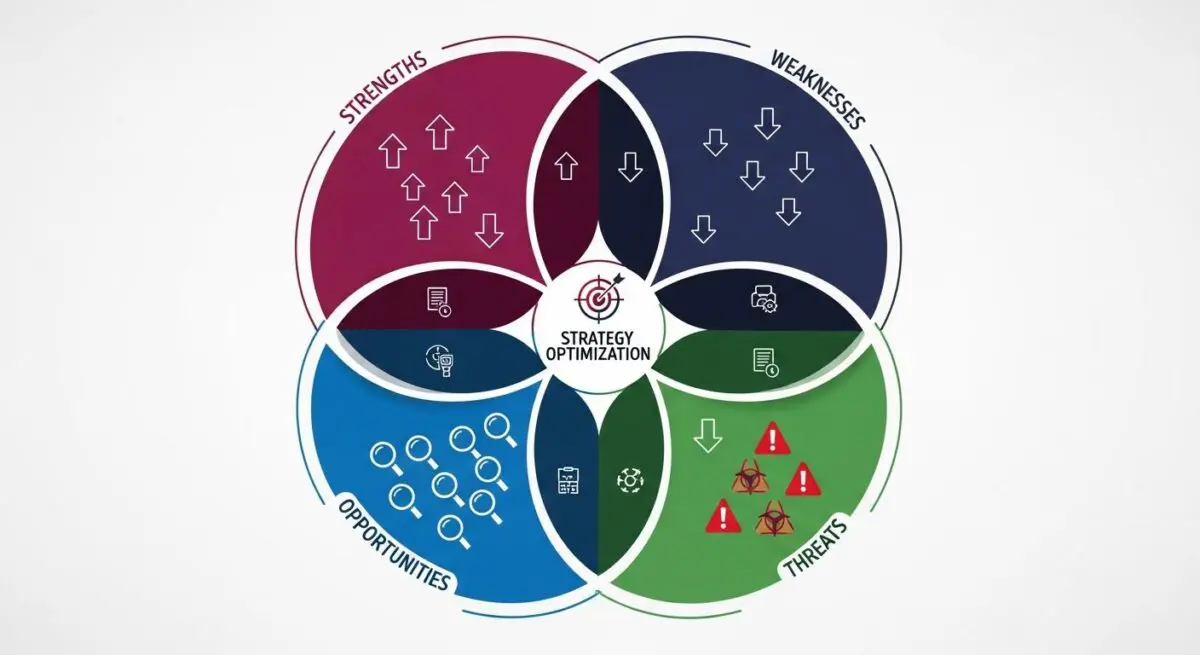
Strengths, Weaknesses, Opportunities, and Threats (SWOT) is a structured strategic planning framework used to evaluate the competitive positioning of an organization or a specific marketing initiative. In the context of a modern MarTech stack and data-driven SEO, SWOT analysis transcends simple brainstorming; it functions as a rigorous diagnostic tool. Internal factors—Strengths and Weaknesses—focus on the organization’s proprietary assets, such as data integrity, technical SEO infrastructure, and automation capabilities. External factors—Opportunities and Threats—analyze the broader market environment, including algorithmic shifts in search engines, competitor movements, and emerging technologies like Large Language Models (LLMs).
From a technical perspective, a SWOT analysis in digital marketing involves auditing the current state of data silos, API connectivity, and the scalability of the existing marketing architecture. It provides a multidimensional view of how internal technical debt (Weaknesses) might hinder the exploitation of new search trends (Opportunities). By aligning these four quadrants, marketing directors can develop a roadmap that prioritizes resource allocation toward initiatives with the highest probability of technical and financial success, ensuring that the marketing strategy is grounded in empirical reality rather than speculative growth targets.
The Real-World Analogy
Consider a high-performance racing team preparing for a Grand Prix. The Strengths are the car’s aerodynamic efficiency and the driver’s experience. The Weaknesses might be a high fuel consumption rate or a slightly slower pit crew compared to the field. These are internal variables the team can control. The Opportunities represent a sudden change in track temperature that favors their specific tire compound or a rival team’s mechanical failure. The Threats are the unpredictable weather conditions or a mid-season regulatory change by the racing commission. Just as the racing team must analyze these factors to decide when to pit and which tires to use, a marketing professional uses SWOT to decide which channels to fund and which technical vulnerabilities to patch before a major product launch.
How SWOT Impacts Marketing ROI & Data Attribution?
The application of a SWOT framework directly influences Marketing ROI by optimizing the efficiency of the capital-to-conversion pipeline. When a brand identifies a Strength in its first-party data collection, it can shift budget away from expensive third-party acquisition channels, thereby lowering the overall Customer Acquisition Cost (CAC). Conversely, recognizing a Weakness in mobile page load speeds (Core Web Vitals) allows for targeted technical intervention, preventing the waste of ad spend on high-bounce landing pages. This proactive identification of technical friction points ensures that every dollar invested is supported by a robust infrastructure.
In terms of data attribution, SWOT analysis helps in identifying ‘attribution blind spots.’ For instance, an Opportunity might exist in leveraging advanced multi-touch attribution (MTA) models to better understand the influence of top-of-funnel content. If the current attribution model is a Weakness (e.g., relying solely on last-click), the SWOT analysis highlights the risk of misallocating budget to underperforming channels. By addressing these threats to data integrity, organizations can achieve a more accurate reflection of their marketing performance, leading to more precise LTV (Lifetime Value) modeling and improved strategic decision-making at the enterprise level.
Strategic Implementation & Best Practices
- Conduct Cross-Functional Data Audits: Perform SWOT sessions involving SEO specialists, data engineers, and product managers to ensure internal strengths and weaknesses are identified from both a technical and a commercial perspective.
- Quantify Qualitative Factors: Assign weighted scores to each identified factor based on its potential impact on revenue or search visibility, transforming a subjective list into a prioritized technical roadmap.
- Integrate PESTLE Analysis: Supplement the ‘Threats’ and ‘Opportunities’ quadrants with a PESTLE (Political, Economic, Social, Technological, Legal, Environmental) scan to account for regulatory changes like GDPR/CCPA and AI ethics.
- Dynamic Iteration: Treat the SWOT analysis as a living document, updating it quarterly to reflect rapid shifts in the AI-Search (GEO) landscape and competitor API integrations.
- Map SWOT to OKRs: Directly link identified opportunities to Objectives and Key Results (OKRs) to ensure that strategic insights are translated into measurable technical execution.
Common Pitfalls & Strategic Mistakes
One of the most frequent errors in enterprise SWOT analysis is the ‘Confirmation Bias Trap,’ where teams only identify strengths that align with their current budget requests while ignoring glaring technical weaknesses in their data silos. Another common mistake is the lack of specificity; identifying ‘AI’ as an opportunity without defining how LLM-driven search impacts the specific niche leads to vague, unactionable strategies. Furthermore, many brands fail to distinguish between internal and external factors, often listing market trends as weaknesses, which dilutes the strategic focus on what the organization can actually control.
Conclusion
A technically rigorous SWOT analysis is essential for navigating the complexities of modern marketing architectures, providing the clarity needed to optimize ROI and mitigate the risks of algorithmic volatility. By systematically evaluating internal capabilities against external market dynamics, organizations can build a scalable, data-driven foundation for long-term growth.