Executive Summary
- Systematic evaluation of rival MarTech stacks, backlink profiles, and keyword gap analysis to identify untapped market opportunities.
- Integration of quantitative metrics like Share of Voice (SoV) and Domain Authority (DA) to benchmark performance against industry leaders.
- Strategic alignment of competitive intelligence with internal KPIs to optimize Customer Acquisition Cost (CAC) and search visibility.
What is Competitor Audit?
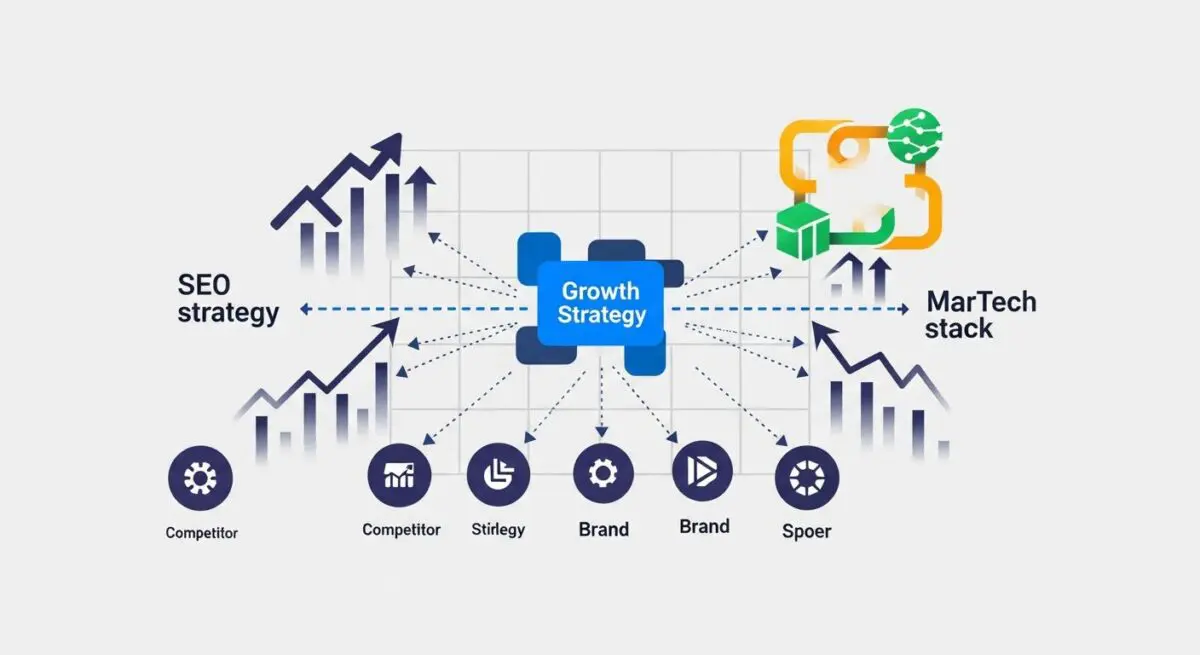
A Competitor Audit is a systematic, multi-dimensional diagnostic process used to identify, analyze, and evaluate the digital footprint, marketing strategies, and technical infrastructure of market rivals. In the context of a modern MarTech stack, this involves more than just a surface-level review of a competitor’s website; it requires a deep dive into their search engine optimization (SEO) performance, generative engine optimization (GEO) visibility, content velocity, and backlink profile. By leveraging advanced data analytics and crawling technologies, organizations can reverse-engineer the tactics that drive traffic and conversions for their competitors, providing a blueprint for strategic differentiation.
Technically, a competitor audit encompasses the analysis of on-page elements, such as schema markup and Core Web Vitals, as well as off-page signals like domain authority and social proof. It also involves assessing the competitor’s technology stack, including their choice of Content Management Systems (CMS), Customer Relationship Management (CRM) tools, and advertising pixels. This level of technical scrutiny allows SEO professionals and data scientists to identify gaps in the market, predict competitor moves, and allocate resources more efficiently within a programmatic growth framework.
The Real-World Analogy
To understand a Competitor Audit, consider the telemetry data used in Formula 1 racing. Every team on the grid uses high-frequency sensors to monitor not only their own car’s performance but also the performance of their rivals. They analyze the speed at which a competitor takes a specific corner, their tire degradation rates, and their fuel consumption patterns. By comparing this external data against their own internal metrics, engineers can make real-time adjustments to their car’s aerodynamics or engine mapping. Similarly, a Competitor Audit provides the “telemetry” of the digital marketplace, allowing a business to adjust its marketing “engine” to outperform rivals on the track of search engine results pages (SERPs).
How Competitor Audit Impacts Marketing ROI & Data Attribution?
The primary impact of a Competitor Audit on Marketing ROI lies in its ability to reduce Customer Acquisition Cost (CAC) through precision targeting. By performing a keyword gap analysis, we at Andres SEO Expert can identify high-intent search terms that competitors are neglecting. This allows for the creation of content that captures market share at a lower cost-per-click (CPC) or through organic search, directly improving the bottom line. Furthermore, understanding a competitor’s share of voice (SoV) across different channels helps in refining attribution models. If a competitor is dominating top-of-funnel awareness through heavy display advertising, a brand might choose to focus its budget on bottom-of-funnel search terms to capture ready-to-convert users, thereby optimizing the conversion path.
Data integrity is also enhanced through competitive benchmarking. When internal performance metrics are viewed in a vacuum, it is difficult to determine if a 10% growth in traffic is a result of internal optimization or a general market trend. By auditing competitors, marketers can establish a baseline for industry growth, ensuring that strategic decisions are based on relative performance rather than isolated data points. This technical oversight prevents inefficient budget allocation and ensures that every dollar spent is contributing to a measurable increase in market share.
Strategic Implementation & Best Practices
- Automated Keyword Gap Analysis: Utilize APIs from tools like Ahrefs or SEMrush to programmatically identify keywords where competitors rank in the top 10 positions but your domain is absent. Focus on terms with high search volume and low difficulty to maximize immediate ROI.
- Reverse-Engineering MarTech Stacks: Use technologies like BuiltWith or Wappalyzer to identify the tracking pixels, automation platforms, and CDN providers used by rivals. This can reveal their reliance on specific advertising channels or their commitment to site speed and user experience.
- Backlink Velocity Monitoring: Track the rate at which competitors are acquiring new referring domains. A sudden spike in backlink velocity often indicates a new PR campaign or a shift in their SEO strategy, allowing your team to respond proactively rather than reactively.
- SERP Feature Auditing: Analyze which competitors are winning Featured Snippets, People Also Ask (PAA) boxes, and Local Packs. Implementing structured data (JSON-LD) that specifically targets these features can displace rivals and increase organic click-through rates (CTR).
Common Pitfalls & Strategic Mistakes
One of the most frequent errors in enterprise competitor audits is the over-reliance on vanity metrics, such as social media follower counts or total backlink numbers, without assessing the quality or conversion potential of that data. A competitor may have millions of low-quality backlinks that actually put them at risk of algorithmic penalties, yet an uncritical audit might suggest they are winning. Another mistake is failing to identify “indirect” competitors—entities that do not sell the same product but compete for the same informational search intent. In the era of AI-driven marketing, ignoring these informational rivals can lead to a significant loss in brand authority and search visibility.
Conclusion
A technical Competitor Audit is an essential component of a data-driven marketing architecture, providing the necessary intelligence to optimize SEO strategies and maximize ROI. By systematically analyzing rival performance and infrastructure, brands can achieve a sustainable competitive advantage in an increasingly crowded digital landscape.