


Key Points
- Vector Embedding Alignment: Generative engines convert clean, structured content into high-dimensional vectors for cosine similarity retrieval.
- Two-Stage Retrieval: Advanced RAG systems utilize reranker models to evaluate semantic density and factual accuracy over traditional backlinks.
- Knowledge Graph Synthesis: Combining vector search with structured JSON-LD feeds into global knowledge graphs for authoritative citation mapping.
Table of Contents
The AI Search Context
By May 2026, RAG-enabled search engines have become the primary entry point for 60% of B2B research queries, according to Forrester’s Digital Search Evolution Study.
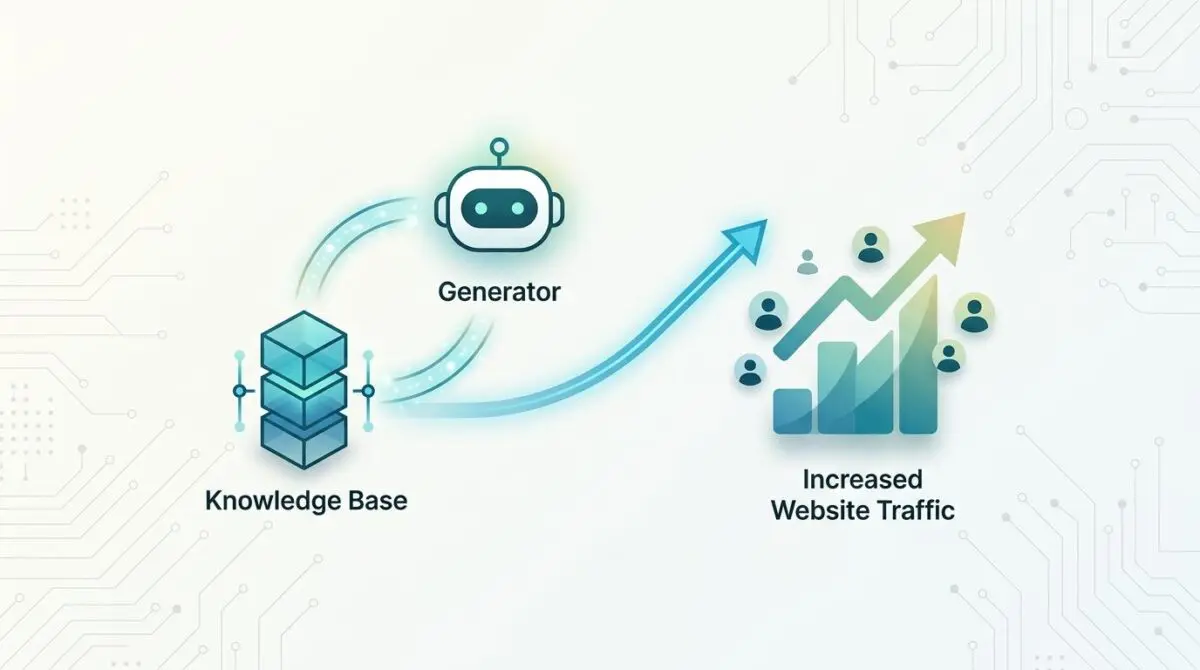
Retrieval-Augmented Generation (RAG) is the architectural bridge between static Large Language Models and real-time web data. It allows engines like SearchGPT and Google AI Overviews to ground their responses in live external sources.
Without Retrieval-Augmented Generation, Large Language Models are prone to severe hallucinations. They rely solely on their static training weights, which quickly become outdated and unreliable for factual queries.
RAG solves this by forcing the model to read external, live documents before generating an answer. This creates a massive opportunity for technical SEOs to position their content as the definitive grounding source.
This technology has fundamentally shifted website traffic from high-volume keyword hits to high-intent citation referrals. The search engine acts as a pre-filter, delivering only the most relevant users to the source site.
The impact is a dual-track ecosystem. We are witnessing a significant decline in zero-click informational traffic balanced by a surge in high-conversion referral traffic for sites that successfully act as grounding sources.
The transition from lexical BM25 search to dense vector retrieval changes everything about content formatting. Keyword frequency is completely ignored in favor of multidimensional semantic mapping.
This evolution requires a shift from keyword density to semantic relevance and structural clarity. Content must be successfully retrieved by vector-based search agents to survive in the generative era.
Core Architecture & Pillars
Core Architecture & Pillars
Vector Embedding Alignment
Generative engines convert website content into high-dimensional vector embeddings to store in vector databases. Retrieval occurs when a user query’s vector is mathematically similar to a content chunk’s vector, typically using cosine similarity. If content is too broad or poorly structured, its vector representation becomes ‘muddy’, leading to retrieval failure during the RAG process.
Reranker Optimization
After the initial retrieval of 20-50 possible chunks, a ‘Reranker’ model (like Cohere or BGE) evaluates which 3-5 sources are most authoritative and relevant to the specific prompt. This stage prioritizes semantic density and the presence of verifiable facts over traditional SEO metrics like backlink count.
Chunk-Size Strategy
RAG systems work best when content is delivered in 300-500 token ‘chunks’. Content that is too long or lacks clear topical breaks causes the LLM to lose context or include irrelevant noise, which lowers the likelihood of the site being cited as a primary source.
Knowledge Graph Integration
Advanced RAG systems in 2026 use ‘GraphRAG’, combining vector search with structured knowledge graphs. This allows the AI to understand the relationships between entities (e.g., a brand and its specific features) rather than just looking for word matches.
Understanding the underlying mechanics of Generative Engine Optimization requires a deep dive into the retrieval process. The architecture relies heavily on mathematical representations of text and multi-stage filtering algorithms.
We must adapt our content strategies to align with these machine-level operations. Failure to do so results in your content being entirely ignored by the LLM context window.
Vector Embedding Alignment
Generative engines process text by converting it into high-dimensional numerical arrays known as embeddings. These embeddings are stored in specialized vector databases like Pinecone or Milvus.
Modern embedding models transform your paragraphs into arrays containing thousands of dimensions. Each dimension represents a latent semantic feature of your text.
When a user submits a query, the system generates a corresponding vector and performs a nearest-neighbor search. Retrieval occurs when the query vector is mathematically similar to a content chunk vector.
Cosine similarity is the standard metric used to measure the distance between these vectors. If your content is too broad or poorly structured, its vector representation becomes muddy and ambiguous.
In a WordPress environment, this vectorization is often hindered by bloated themes or excessive DOM depth. Using Gutenberg blocks helps clean up the HTML output.
Cleaner HTML allows AI crawlers to more easily map specific headers to their corresponding content chunks. This structural purity is essential for precise vector embedding alignment.
Reranker Optimization
The initial vector search is optimized for speed, often retrieving twenty to fifty potential chunks. However, these initial results are not always the most contextually accurate.
To solve this, systems employ a secondary evaluation phase. After the initial retrieval, a ‘Reranker’ model (like Cohere) evaluates which sources are most authoritative.
This cross-encoder model scores the chunks based on deep semantic relevance to the specific prompt. It prioritizes semantic density and the presence of verifiable facts.
Traditional SEO metrics like raw backlink counts carry significantly less weight during this reranking phase. WordPress sites utilizing RankMath or Yoast for Schema markup gain a distinct edge here.
The reranker uses structured data as a definitive trust signal. Elements like ClaimReview or FactCheck can move a specific post to the top citation spot in an AI Overview.
Chunk-Size Strategy
Large Language Models process information in tokens rather than words. RAG systems work best when content is delivered in concise, semantic chunks.
The optimal chunk size typically ranges from three hundred to five hundred tokens. Content that is too long or lacks clear topical breaks causes the LLM to lose context.
Irrelevant noise within a chunk lowers the likelihood of the site being cited as a primary source. WordPress users should utilize heading tags as semantic boundaries.
Each section under a heading should be a self-contained answer. It must exist independently of the rest of the post to facilitate cleaner extraction.
Knowledge Graph Integration
Modern retrieval architectures are moving beyond simple vector proximity. Advanced systems are increasingly combining vector search with structured knowledge graphs to form GraphRAG.
This hybrid approach allows the AI to understand the relationships between entities. It maps connections between a brand, its specific features, and its industry context.
Plugin-based implementations of JSON-LD for Organization and Product schemas are critical. They allow WordPress sites to feed directly into the global knowledge graph.
In Q1 2026, OpenAI’s SearchGPT update revealed that 65% of its verified sources were prioritized based on the presence of Linked Open Data markup, according to a recent AI Index report.
This makes it significantly easier for RAG engines to verify the site authority on a specific niche topic.
The Execution Roadmap
Implementation Roadmap
Semantic Header Audit
Refactor WordPress content to ensure every H2 tag is a clear, standalone question or statement. Remove ‘fluff’ transitions between sections to ensure each block of text (chunk) is semantically dense.
Implement Advanced JSON-LD
Go beyond basic SEO schema. Manually add ‘mentions’ and ‘about’ schema to the WordPress header via functions.php or a custom code snippet to explicitly define the entities your content covers for GraphRAG engines.
Optimize for API-Based Crawling
Enable the WordPress REST API and ensure it is not blocked by security plugins. Many 2026 AI search agents prefer fetching raw JSON content via API for retrieval rather than scraping rendered HTML, as it reduces noise.
Citation Funnel Monitoring
Use Google Search Console’s ‘Search Appearance’ filter to track ‘AI Citation’ clicks. Adjust the first 100 words of cited sections to include a compelling ‘call-to-learn-more’ that survives the LLM’s summarization process.
Transitioning to a RAG-optimized architecture requires a methodical approach to content restructuring. The goal is to make every page highly digestible for machine learning algorithms.
Our execution roadmap focuses on semantic clarity, structured data, and optimized crawling pathways. These steps are essential for capturing high-intent AI referral traffic.
Semantic Header Audit
The first step is to refactor your existing WordPress content. You must ensure every heading tag operates as a clear and standalone statement.
Avoid vague headers that rely on surrounding text for context. Remove conversational fluff and unnecessary transitions between sections.
Each block of text must be semantically dense and directly answer the premise of its header. This ensures the resulting vector chunk is highly concentrated and relevant.
Implement Advanced JSON-LD
Basic SEO schema is no longer sufficient for modern Generative Engine Optimization. You must manually add mentions and about schema to your WordPress header.
These specific schema types explicitly define the entities your content covers. They provide the exact nodes and edges required by GraphRAG engines.
You can inject this advanced markup via your theme functions file or a custom code snippet. This explicit entity definition drastically improves your retrieval confidence scores.
Optimize for API-Based Crawling
Traditional web scraping is computationally expensive and prone to parsing errors. Many AI search agents now prefer fetching raw JSON content via API.
WordPress natively exposes your content through specific JSON endpoints. These endpoints deliver clean, structured data without the overhead of CSS or JavaScript.
AI agents prioritize these endpoints because they drastically reduce token consumption during the scraping phase. You must ensure your server configuration allows rapid GET requests to these specific URLs.
You must enable the WordPress REST API and ensure it is accessible. Verify that aggressive security plugins are not blocking API requests from known AI user agents.
Citation Funnel Monitoring
Tracking the success of your RAG optimization requires specialized analytics. You should use the Google Search Console Search Appearance filter to isolate AI Citation clicks.
Once you identify which chunks are being cited, you must optimize them for conversion. Adjust the first hundred words of cited sections to include a compelling call to action.
This hook must be strong enough to survive the summarization process of the LLM. By doing so, you capitalize on the traffic, as these systems are the primary entry point for B2B research queries.
Technical Implementation
Executing an advanced entity definition requires direct manipulation of your schema output. The following code demonstrates how to inject custom semantic grounding data into your WordPress environment.
This filter hooks into RankMath to append an entity context array to the JSON-LD payload. It specifically targets singular posts to ensure the markup is highly contextualized.
add_filter( 'rank_math/json_ld', function( $data, $jsonld ) { if ( is_singular() ) { $data['entity_context'] = [ '@type' => 'SemanticGrounding', 'mainEntity' => get_the_title(), 'description' => get_the_excerpt() ]; } return $data; }, 99, 2 );By implementing this snippet, you define the main entity and its description directly in the schema. This provides the Reranker model with immediate, verifiable trust signals during the secondary retrieval phase.
Validation & Future-Proofing
Validation & Monitoring
- Verify your RAG performance by using the ‘Perplexity Pages’ tool or ‘SearchGPT’ developer preview to see if your site is cited for niche queries.
- Monitor server logs for User-Agents associated with AI bots like ‘OAI-SearchBot’ or ‘Google-InspectionTool’ to ensure they access semantic chunks.
- Ensure high-priority retrieval blocks are returning without 403 errors and validate the presence of specific entities within the knowledge graph.
Continuous validation is required to maintain visibility in a rapidly evolving AI landscape. You must actively test your site against the latest generative interfaces.
Use tools like the Perplexity Pages feature to see if your site is cited for complex niche queries. Monitor your server access logs specifically for user agents associated with AI bots.
Server log analysis is no longer optional for advanced GEO strategies. You must routinely export your NGINX or Apache access logs to identify AI crawler patterns.
Use command-line tools to grep for specific user-agent strings associated with generative engines. Analyzing these logs reveals exactly which semantic chunks the AI is prioritizing.
Look for requests from crawlers like OAI-SearchBot or the Google Inspection Tool. Ensure these bots are reaching your semantic chunks without encountering forbidden errors.
Validate the presence of your specific entities within the global knowledge graph using schema testing tools. Proactive monitoring ensures your architecture remains aligned with the latest LLM updates.
Navigating the intersection of traditional SEO and Generative Engine Optimization requires a precise architecture. To future-proof your enterprise stack for AI Overviews and LLM discovery, connect with Andres at Andres SEO Expert.