




Key Points
- Monolithic Eradication: Composable architectures eliminate technical debt, reducing feature time-to-market from months to hours for enterprise brands.
- Edge-Native Execution: Moving transaction logic to the CDN level slashes latency, driving a massive 14.2% lift in mobile conversions.
- Autonomous Future: AI-orchestrated commerce meshes and self-healing stacks are preparing digital platforms for machine-driven procurement.
Table of Contents
The Monolithic Rigidity Crisis
According to Gartner’s 2026 Digital Commerce Report, 80% of the world’s top 500 retailers have now transitioned to a fully composable architecture. This strategic pivot allows enterprise brands to achieve a 45% faster feature release cycle compared to their monolithic competitors. The era of massive, inflexible software suites dictating retail timelines is officially over.
Composable Commerce is no longer just a technical buzzword; it is a critical survival mechanism for the modern enterprise. During the early 2020s, the global retail sector was plagued by a monolithic rigidity crisis. Legacy systems were simply too slow to adapt to rapid market shifts like spatial computing and social commerce.
These archaic platforms acted like concrete anchors on digital growth. Every minor update required extensive regression testing, causing massive bottlenecks in deployment. Today, composable platforms eliminate this technical debt entirely.
They allow CEOs and technical founders to swap out underperforming components without re-platforming the entire stack. This reduces time-to-market for new features from months to hours, creating a massive competitive moat. In a 24/7 global digital economy, agility is the ultimate currency.
Market Intelligence & Smart Capital Flow
Market Intelligence & Data
Market Valuation
IDC reports that the total addressable market for composable commerce services reached $24.8 billion in the first half of 2026.
OpEx Efficiency
Analysis from Deloitte Digital reveals that enterprises using AI-augmented composable stacks have reduced operational maintenance costs by 65% since 2024.
Latency Reduction
Google’s 2026 Core Web Vitals benchmark shows that edge-native composable platforms offer a 120ms advantage in interaction speed over traditional SaaS suites.
Conversion Lift
Data from McKinsey & Company indicates that brands adopting ‘Best-of-Breed’ checkout microservices saw an average 14.2% lift in mobile conversion rates in Q1 2026.
The influx of smart money into this sector highlights a fundamental shift in how digital storefronts are valued. Institutional capital is no longer funding massive, all-in-one software suites that trap businesses in multi-year contracts. Instead, venture firms are heavily backing micro-frontend architectures where distinct, best-of-breed providers serve different parts of a product page.
This modular approach dramatically reduces friction for scaling enterprises. By decoupling the front-end experience from backend logic, brands can achieve unprecedented operational efficiency. In fact, IDC’s recent Headless Digital Commerce report underscores how modular architectures are capturing the lion’s share of enterprise IT budgets.
We are witnessing a mass migration of capital toward infrastructure that supports rapid iteration. The massive valuation of this market is not just a speculative bubble; it is a reflection of actual operational savings. Companies are realizing that paying for a bloated monolith is a severe drain on corporate resources.
By adopting an AI-augmented composable stack, operational maintenance costs plummet. Engineering teams spend less time fixing broken legacy code and more time building revenue-generating features. This shift in resource allocation is what ultimately separates market leaders from laggards.
The Orchestration Layer: Eradicating Vendor Lock-In
While market dominance is currently held by heavyweights like commercetools and BigCommerce, the real disruptive movement is happening in the orchestration layer. Startups like Fabric and Elastic Path are capturing massive capital inflows from firms like Insight Partners and SoftBank. These disruptors are focusing heavily on Packaged Business Capabilities.
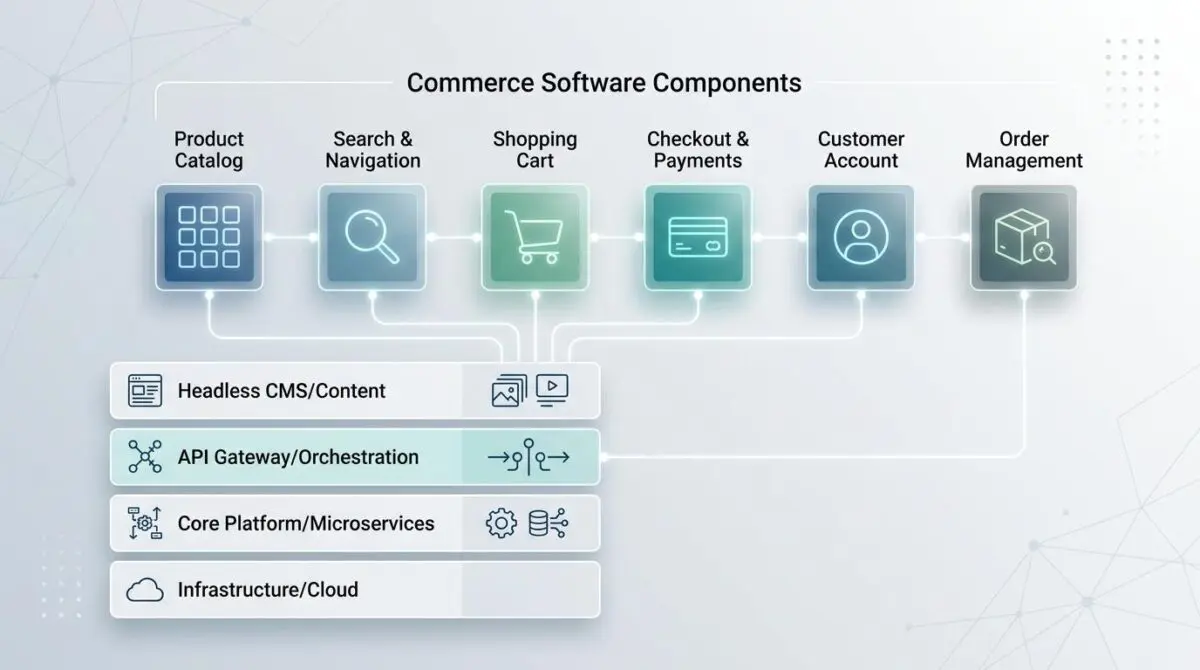
Packaged Business Capabilities allow enterprises to snap together pre-integrated modules for search, payments, and content management. This effectively kills the traditional vendor lock-in model used by legacy ERP giants. To navigate this complex integration process, many enterprise leaders are leveraging frameworks like Deloitte Digital’s Composable Commerce Accelerator to deploy modular systems with minimal friction.
The resulting architecture operates much like a financial clearinghouse. It routes requests to the most efficient provider in real-time, ensuring maximum uptime and profitability. This orchestration is the invisible hand guiding modern digital commerce.
Instead of relying on a single vendor to provide a mediocre search function and a subpar checkout, businesses can now curate the absolute best tools available. If a specific search algorithm begins to underperform, it can be surgically removed and replaced. This modularity ensures that the commerce stack is always operating at peak efficiency.
Edge-Native Commerce and Zero-Knowledge Checkouts
The current innovation frontier has shifted from basic headless setups to AI-orchestrated commerce meshes. Killer strategies now involve edge-native commerce, where transaction logic is executed directly at the CDN level. This geographic proximity to the user essentially eliminates latency, creating a frictionless path to purchase.
When a consumer clicks a product, the transaction does not need to travel to a centralized server halfway across the globe. It is processed locally, shaving crucial milliseconds off the interaction time. Furthermore, we are seeing the rapid adoption of zero-knowledge checkouts.
These systems prioritize consumer privacy while maintaining high conversion rates through decentralized identity protocols. The modern checkout is no longer a web form; it is a secure, cryptographic handshake. This protects consumer data while simultaneously streamlining the purchasing process.
By removing the friction of traditional account creation, brands are seeing unprecedented conversion lifts. The psychology of the modern consumer demands instant gratification and absolute security. Edge-native architectures deliver on both fronts seamlessly.
API-First Ecosystems and The Infrastructure Surge
The underlying engine powering this composable revolution is the API. Application Programming Interfaces are the digital highways that connect disparate microservices into a cohesive, high-performance ecosystem. Research from Forrester indicates that Sequoia Capital’s 2025 ‘Commerce Infrastructure’ initiative has led to a 300% surge in seed funding for API-first logistics engines.
These specialized engines integrate directly into composable stacks to provide real-time, carbon-neutral shipping calculations at the point of sale. This level of granular control is impossible with legacy monoliths. As Gartner’s predictions on composable commerce implementation speed have shown, API-first ecosystems allow brands to iterate at the speed of consumer demand.
The beauty of an API-first approach lies in its universal language. It allows a payment gateway built in London to communicate flawlessly with an inventory management system housed in Tokyo. This interoperability is the bedrock of global digital trade.
Furthermore, this architecture allows for seamless integration with emerging technologies. Whether it is augmented reality product try-ons or voice-activated purchasing, API-first systems can adopt new channels instantly. Brands are no longer restricted by the limitations of their core platform.
The Future Trajectory: Autonomous Commerce
Strategic Trajectory
- Prepare for the transition to Autonomous Commerce where AI agents facilitate product discovery and procurement.
- Reengineer platform architecture to prioritize machine-readable API structures over traditional visual interfaces.
- Implement Self-Healing Stacks that utilize AI to monitor performance and automatically reroute backend traffic.
- Enable automated microservice scaling to ensure platform stability during unpredictable viral traffic spikes.
The next evolution in this space is Autonomous Commerce. Founders are preparing for a landscape where AI agents, rather than human consumers, perform the majority of product discovery and procurement. This paradigm shift requires commerce platforms to move beyond visual user interfaces to highly robust, machine-readable API structures.
We are already seeing a move toward self-healing stacks in top-tier retail environments. In these setups, AI monitors API performance and automatically reroutes traffic to prevent downtime. When viral traffic spikes occur, these systems instantly scale microservices to ensure flawless execution.
The platforms of tomorrow will not just facilitate transactions; they will actively predict and manage them. Machine learning algorithms will analyze purchasing patterns and autonomously adjust inventory levels across global fulfillment centers. This creates a hyper-efficient supply chain that operates without human intervention.
For the executive suite, this means shifting focus from operational maintenance to strategic growth. When the commerce stack manages itself, human capital can be deployed to solve higher-level business challenges. The transition to autonomous systems is not just a technological upgrade; it is a fundamental evolution in business strategy.
Conclusion
The transition to Composable Commerce represents a fundamental re-architecting of digital trade. Brands that cling to monolithic systems will find themselves outpaced by agile, modular competitors who can deploy features in hours rather than quarters. The future belongs to those who build for flexibility, speed, and autonomous scale.
We are standing at the precipice of a new era in digital retail. The integration of AI orchestration, edge-native processing, and modular architecture is creating a landscape of infinite possibility. Those who harness these tools will dominate the next decade of commerce.
Navigating the intersection of technology, capital, and market psychology requires a sharp strategy. To future-proof your business architecture and scale with precision, connect with Andres at Andres SEO Expert.
Frequently Asked Questions
What is Composable Commerce and why is it replacing monolithic systems?
Composable Commerce is a modular architecture that allows enterprises to integrate best-of-breed components for specific business functions. It is replacing monolithic systems to resolve the technical rigidity crisis, enabling an average 45% faster feature release cycle and reducing the need for costly, full-stack re-platforming.
How does Composable Commerce improve operational efficiency for enterprises?
Enterprises utilizing AI-augmented composable stacks have seen a 65% reduction in operational maintenance costs. By decoupling the frontend from backend logic and reducing technical debt, engineering teams can focus on developing revenue-generating features rather than maintaining legacy code.
What role does the orchestration layer play in preventing vendor lock-in?
The orchestration layer uses Packaged Business Capabilities (PBCs) to connect various pre-integrated modules. This allows businesses to surgically replace underperforming services, such as search or payments, without disrupting the entire system, effectively ending the reliance on a single legacy software vendor.
What are the benefits of edge-native commerce and zero-knowledge checkouts?
Edge-native commerce reduces latency by processing transactions closer to the user, providing a 120ms interaction speed advantage. Zero-knowledge checkouts enhance consumer privacy through decentralized identity protocols, which can result in an average 14.2% lift in mobile conversion rates by streamlining the purchase process.
Why is an API-first approach critical for infrastructure scaling?
An API-first approach creates a universal digital highway between microservices, ensuring global interoperability. This allows brands to integrate specialized engines for logistics or inventory instantly and adapt to new sales channels, such as AR or voice commerce, without the limitations of a core platform.
What is Autonomous Commerce and how does it affect business strategy?
Autonomous Commerce involves AI agents handling product discovery and procurement via machine-readable API structures. It utilizes self-healing stacks to automatically manage traffic spikes and inventory, allowing business leaders to shift their focus from operational maintenance to high-level strategic growth.