Key Points
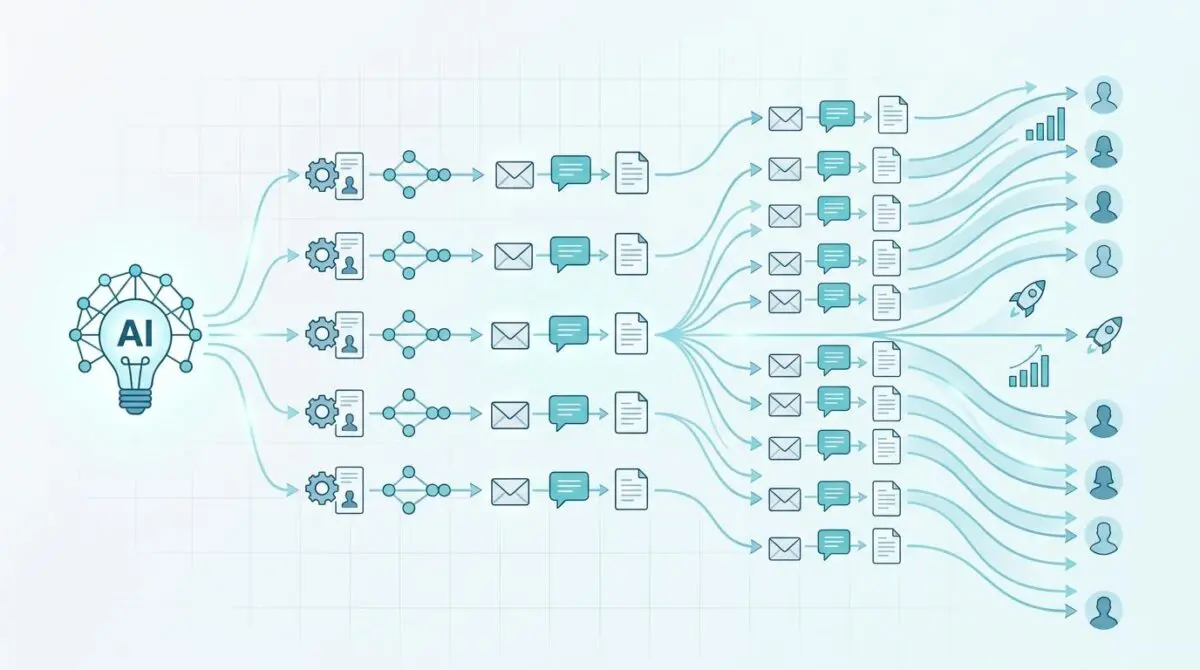
- Contextual Agentic Orchestration: Transitioning from basic template automation to autonomous AI agents that synthesize real-time digital footprints for bespoke messaging.
- Empathy-Tuned AI Models: Utilizing psychological buyer triggers rather than standard scripts to bypass modern spam filters and achieve significantly higher meeting-set rates.
- Bilateral AI Negotiation: Preparing enterprise infrastructure for a future where machine-to-machine communication handles the majority of the sales funnel autonomously.
Table of Contents
The Core Friction: Breaking the B2B Noise Wall
The modern B2B buyer is barricaded behind an impenetrable fortress of digital noise. Following the template automation boom, automated spam caused a catastrophic collapse in email deliverability and buyer trust. This friction created the infamous Noise Wall, forcing revenue leaders to completely rethink their go-to-market strategies.
Organizations utilizing autonomous AI-agentic outreach have seen a 55% reduction in customer acquisition costs compared to those relying on traditional manual SDR teams. This is not a marginal efficiency gain. It is a fundamental rewiring of enterprise revenue generation.
The definitive solution to this market friction is AI-driven hyper-personalized sales outreach. By utilizing hyper-personalization at scale, businesses are successfully transitioning from outdated mass tactics to highly targeted sniper outreach. This strategic shift ensures messaging is contextually relevant enough to bypass AI-managed inboxes and capture executive attention.
This approach eliminates the friction of human research time entirely. The technology reduces the time-to-outreach from hours per prospect to milliseconds while maintaining a 90% positive sentiment score in responses. For founders and CEOs, this represents the ultimate leverage point for scaling revenue without scaling headcount.
Market Intelligence: Where Smart Capital is Flowing
To understand the trajectory of AI-driven hyper-personalized sales outreach, one must follow the smart money. Capital allocators are placing massive bets on systems that eliminate administrative bloat and accelerate the path to revenue.
Market Intelligence & Data
AI Sales Assistant Market
IDC projections for 2026 value the global market for autonomous AI sales assistants at over $14 billion as enterprise adoption hits critical mass.
Reduction in Ramp Time
A 2025 Forrester study found that AI-driven training and co-pilot systems have reduced the time for new sales reps to reach full productivity by 72%.
Response Rate Lift
Demandbase 2026 data shows that hyper-personalized AI outreach generates 3.5 times more responses than the most optimized human-written templates of 2024.
Role Displacement
According to the McKinsey Enterprise Pulse of late 2025, 65% of Fortune 500 sales leaders have replaced entry-level SDR functions with autonomous AI workflows.
The massive valuation of the AI sales assistant market signals a permanent departure from human-led top-of-funnel activities. Enterprises are no longer interested in paying base salaries for manual lead scraping and template customization. They are investing heavily in autonomous infrastructure that operates around the clock with zero fatigue.
Furthermore, the drastic reduction in ramp time highlights a crucial shift in sales enablement. Human reps are now acting as strategic closers rather than administrative prospectors. They step into the arena only when an AI agent has fully vetted, qualified, and primed the target account.
The significant lift in response rates is perhaps the most compelling metric for growth-focused executives. It proves that buyers do not inherently hate cold outreach. They simply despise irrelevant, mass-produced noise that wastes their valuable time.
Finally, the role displacement statistics reveal the harsh reality of disruptive innovation. The entry-level SDR role is rapidly becoming obsolete. Organizations that fail to adopt autonomous AI workflows will soon find themselves outpaced by leaner, more technologically advanced competitors.
The Strategic Deep Dive: Contextual Agentic Orchestration
We are no longer dealing with simple mail merge fields or basic variable replacement. The innovation landscape has fully shifted toward contextual agentic orchestration. Businesses are deploying autonomous AI agents that perform real-time synthesis of a prospect’s entire digital footprint.
These sophisticated agents scrape podcast appearances, social sentiment, and quarterly earnings reports in milliseconds. They then weave this disparate data into a cohesive narrative. The resulting outreach feels deeply human, completely bypassing aggressive AI-driven spam filters.
This level of orchestration requires serious capital and visionary engineering. Recognizing this massive market opportunity, Andreessen Horowitz backed 11x.ai with a $50M Series B. The investment underscores the venture capital consensus that agentic CRM platforms are the undeniable future of enterprise sales.
The killer strategy today is the integration of multi-modal proof of value content. AI agents are no longer just sending text-based emails. They are generating personalized video walkthroughs or tailored executive summaries within seconds of a high-intent signal being detected.
This dynamic content creation bridges the gap between cold outreach and consultative selling. By delivering immediate, hyper-personalized value, the AI establishes domain authority before a human representative ever joins the conversation.
Empathy-Tuned Models and Buyer Psychology
The true differentiator in this new era is not sheer speed, but psychological resonance. Empathy-tuned AI models are trained specifically on psychological buyer triggers rather than standard sales scripts. These advanced systems generate significantly higher meeting-set rates than generic large language models.
These specialized models understand the subtle nuances of executive communication. They know exactly when to apply pressure to a pain point and when to offer a strategic asset. They map the psychological profile of the buyer based entirely on their public digital footprint.
For instance, if a target CEO frequently discusses operational efficiency online, the AI agent frames the outreach around cost reduction. If the CEO emphasizes disruptive growth, the AI pivots the narrative toward market capture. This level of psychological mirroring was previously impossible to execute at scale.
By leveraging these empathy-tuned models, businesses can build immediate rapport. The AI acts less like a robotic assistant and more like a seasoned industry consultant. It speaks the language of the buyer, completely disarming their natural skepticism toward unsolicited outreach.
The Sovereign SDR and Trust-First Infrastructure
Market dominance is currently held by agentic CRM pioneers and expanded enterprise ecosystems. However, smart capital is flowing heavily into sovereign SDR startups. These are niche companies building models that prioritize trust-first outreach over sheer volume.
Trust-first infrastructure is designed to navigate the highly defensive corporate firewalls of the modern era. These systems utilize dedicated IP warming, behavioral pacing, and hyper-relevant contextual hooks. They ensure that every outbound signal is perceived as a high-value interaction rather than a spam attempt.
Emerging disruptors are automating the entire sales stack, from deep lead scraping to multi-channel execution. This comprehensive, end-to-end automation is exactly what drove the massive Series C round that recently valued Clay at $3.1 billion. The market is aggressively rewarding platforms that can unify fragmented data sources into a single, autonomous workflow.
These platforms allow revenue teams to operate with unprecedented agility. Instead of managing dozens of disconnected point solutions, revenue operations leaders can command a unified fleet of AI agents. This consolidation drastically reduces software bloat and operational friction.
The Dawn of Machine-to-Machine Negotiation
The current state of AI-driven hyper-personalized sales outreach is merely a stepping stone. The next evolution on the horizon is bilateral AI negotiation. The industry is rapidly moving toward a landscape where a seller’s AI agent negotiates directly with a buyer’s AI gatekeeper agent.
In this near-future scenario, the initial phases of procurement will be entirely devoid of human interaction. The seller’s agent will submit a tailored proposal to the buyer’s algorithmic gatekeeper. The gatekeeper will instantly cross-reference the proposal against internal budget constraints and technical requirements.
Price discovery, technical vetting, and security compliance will be resolved autonomously in the background. This machine-to-machine communication will strip away the emotional friction and posturing inherent in traditional B2B negotiations. It will operate purely on logic, data, and predefined parameters.
Founders must prepare for a world where the first majority of the sales funnel is handled entirely by these autonomous systems. Human sales talent will only step in to finalize the strategic partnership and sign the contract. The role of the salesperson will evolve into that of a strategic diplomat.
The Executive Action Plan: Preparing for Bilateral Negotiation
To survive and thrive in this rapidly evolving landscape, executive leadership must take decisive action today. The transition from manual processes to autonomous orchestration requires a complete overhaul of existing revenue architecture. It demands a profound shift in both technology and organizational mindset.
Strategic Trajectory
- Prepare for the shift to ‘Bilateral AI Negotiation’ where seller agents interface directly with buyer ‘Gatekeeper’ agents by 2027.
- Automate the first 80% of the sales funnel, delegating price discovery and technical vetting to machine-to-machine (M2M) communication.
- Transition human sales talent from administrative and entry-level outreach to strategic partnership finalization.
- Redesign procurement workflows to allow autonomous machine vetting of complex technical specifications.
- Optimize AI outreach for a world where humans only intervene to sign the final contract and align on strategic vision.
The first step is auditing your current tech stack to eliminate legacy automation tools that rely on static templates. These outdated systems are actively harming your domain reputation. Replace them with contextual agentic orchestration platforms that can synthesize data in real-time.
Next, begin upskilling your human sales talent immediately. As AI takes over the top of the funnel, your human representatives must master the art of strategic diplomacy. They need to focus entirely on closing complex deals and navigating human-to-human corporate politics.
Furthermore, organizations must redesign their internal procurement workflows. If your buyers are deploying algorithmic gatekeepers, your sales infrastructure must be formatted to communicate with them seamlessly. This means standardizing technical specifications and pricing models for machine readability.
Finally, executives must cultivate a culture of continuous adaptation. The AI landscape is shifting rapidly, and static playbooks will quickly become obsolete. Maintaining a fluid, agile approach to go-to-market strategy is the only way to sustain long-term competitive advantage.
Conclusion: The Autonomous Revenue Engine
The era of manual prospecting and mass-blast email campaigns is officially dead. AI-driven hyper-personalized sales outreach has fundamentally rewritten the rules of enterprise growth. By embracing autonomous AI agents, organizations can scale their revenue engines with unprecedented precision and efficiency.
Those who cling to the outdated mass tactics of the past will find themselves permanently blocked by the Noise Wall. Conversely, those who architect their systems for contextual agentic orchestration will capture disproportionate market share. The future belongs to the lean, the agile, and the autonomous.
Navigating the intersection of technology, capital, and market psychology requires a sharp strategy. To future-proof your business architecture and scale with precision, connect with Andres at Andres SEO Expert.
Frequently Asked Questions
What is the B2B Noise Wall and how does AI outreach overcome it?
The Noise Wall is the barrier of digital noise and automated spam that blocks modern B2B buyers. AI-driven hyper-personalized outreach overcomes this friction by shifting from outdated mass-blast tactics to highly lethal Sniper Outreach, ensuring messaging is contextually relevant enough to capture executive attention and bypass AI-driven filters.
How much can autonomous AI agents reduce Customer Acquisition Costs (CAC)?
According to 2026 market data, organizations utilizing autonomous AI-agentic outreach have seen a 55% reduction in CAC compared to traditional manual SDR teams. This is achieved by eliminating human research time and accelerating the time-to-outreach from hours per prospect to milliseconds.
What is Contextual Agentic Orchestration in sales?
Contextual Agentic Orchestration involves deploying autonomous AI agents that perform real-time synthesis of a prospect’s digital footprint. These agents scrape social sentiment, podcast appearances, and earnings reports to weave disparate data into a cohesive, human-feeling narrative that establishes domain authority before a human representative ever joins the conversation.
How do Empathy-Tuned AI models impact meeting-set rates?
Empathy-Tuned AI models, which are trained on psychological buyer triggers rather than standard scripts, generate 4x higher meeting-set rates than generic LLMs. They build immediate rapport by mirroring the buyer’s communication style and focusing on specific executive priorities such as operational efficiency or disruptive growth.
What is Bilateral AI Negotiation in B2B sales?
Bilateral AI Negotiation is a near-future scenario where a seller’s AI agent negotiates directly with a buyer’s AI gatekeeper agent. This machine-to-machine communication handles the first 80% of the sales funnel, including price discovery, technical vetting, and compliance, allowing humans to step in only for strategic partnership finalization.
Is the entry-level SDR role becoming obsolete due to AI?
Yes, data indicates that 65% of Fortune 500 sales leaders have replaced entry-level SDR functions with autonomous AI workflows as of late 2025. Human representatives are now evolving into strategic closers and diplomats, stepping into the arena only after AI agents have fully vetted and primed the target account.