Key Points
- Autonomous Project Accounting: Decentralized infrastructure leveraging BIM and IoT sensors triggers instant smart contract payments upon digital milestone verification.
- Embedded Finance Integration: Vertical SaaS platforms are embedding credit lines and B2B payment engines to eliminate the Net-90 liquidity crisis and reduce material markups by 11%.
- Predictive Intelligence Layers: Domain-specific AI now parses complex construction data to generate highly accurate cash-flow forecasts and automate lien waiver compliance.
Table of Contents
The Financial Tech Friction and the Net-90 Crisis
According to recent industry intelligence, late payments in construction drive a massive 45 percent increase in material costs. Customers are often forced to pay an average 11 percent markup from suppliers simply to offset these liquidity risks.
This systemic bottleneck is widely known as the Net-90 liquidity crisis. Subcontractors essentially act as interest-free banks for developers. They float millions in capital while waiting for multi-stage approvals to clear.
This archaic administrative float creates massive operational drag across the built environment. Every delayed invoice compounds procurement risks and ultimately stalls on-site progress.
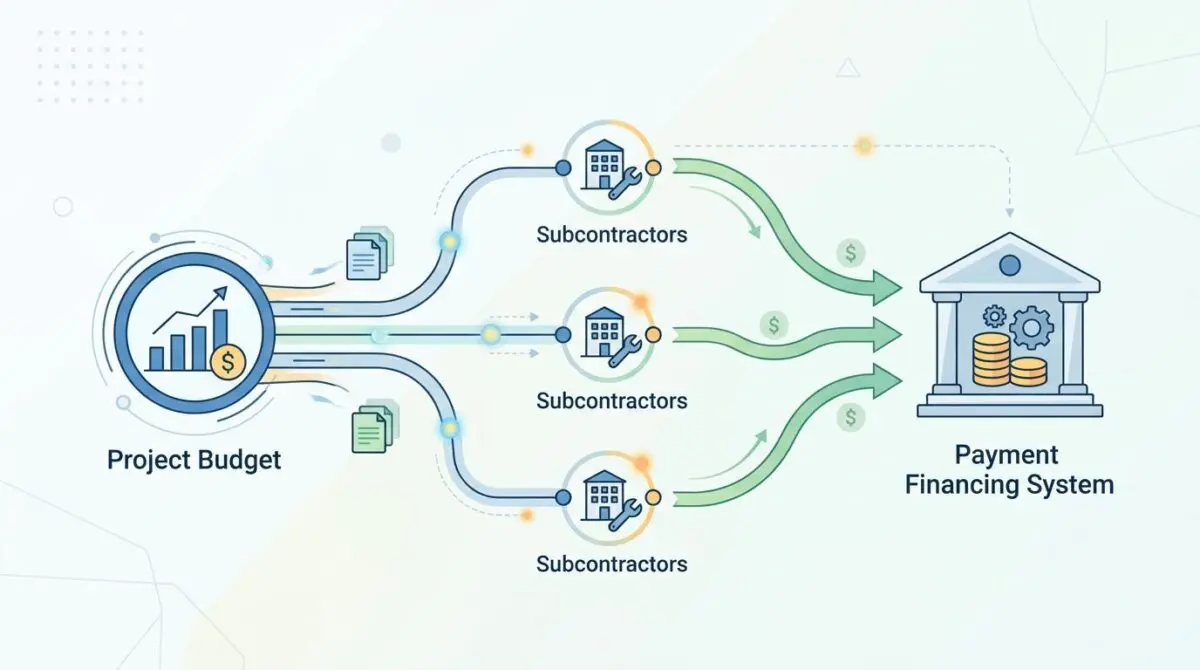
Enter Construction Vertical FinTech, a massive liquidity opportunity restructuring how capital moves across the industry. This is not merely a software upgrade. It represents a fundamental rewiring of how we manage project budgets, subcontractor payments, and financing.
By replacing legacy administrative float with real-time data layers, this ecosystem deploys capital with unprecedented velocity. Smart money recognizes that solving this friction unlocks billions in trapped liquidity.
Market Intelligence and Institutional Capital Flow
Institutional capital is rapidly flowing into vertical SaaS and embedded finance hybrids. Venture capital is concentrating heavily on infrastructure enablers that solve complex B2B payment friction.
Market Intelligence & Data
Global ConTech Valuation
The global construction technology market is projected to reach this value by late 2026 as firms digitize project workflows, according to Future Market Insights.
Embedded Finance Volume
Bain & Company research estimates that total US transaction value through embedded finance will exceed this threshold by the end of 2026.
Real-Time Payment Growth
The Federal Reserve reports that real-time payment (RTP) adoption grew by this margin in 2026, fueled by construction firms seeking faster subcontractor settlements.
FinTech Adoption Satisfaction
Over nine in ten companies report high satisfaction with their embedded finance capabilities as of February 2026, per data from Green Dot.
The data reveals a clear mandate for institutional investors and tech founders. As the global construction technology market is projected to reach $164.2 billion, legacy payment rails are quickly becoming obsolete.
Dominant industry players are aggressively acquiring niche fintechs to offer native payment rails directly within their dashboards. This creates a closed-loop financial ecosystem where project management and capital deployment are intrinsically linked.
Simultaneously, late-stage fintech funding has surged significantly in recent quarters. This capital is heavily focused on AI-driven trade finance and autonomous B2B payment engines.
Market disruptors are scaling rapidly by providing highly customized liquidity solutions. They are proving that embedded finance is the most efficient mechanism to stabilize supply chain volatility.
Autonomous Project Accounting and Decentralized Infrastructure
The industry is aggressively moving toward autonomous project accounting. Manual reconciliation, historically plagued by human error and administrative delays, is being systematically eradicated.
Cutting-edge platforms are integrating Building Information Modeling with IoT sensors to create a decentralized, single source of truth. This technological convergence allows physical on-site progress to be instantly translated into verifiable financial data.
These integrations trigger automated smart contract payments the moment a digital milestone is verified. The underlying ledger ensures absolute transparency and cryptographic security for all stakeholders involved.
Consequently, funds can now be released from escrow to subcontractors within minutes. This entirely bypasses the traditional multi-stage bank approval process that has stifled growth for decades.
Domain-Specific AI and Predictive Cash-Flow Modeling
Recent venture capital data reveals that AI-driven financial automation accounts for a massive share of fintech investments. This trend has shifted focus toward domain-specific AI that handles construction invoices and vendor compliance without human intervention.
These multimodal AI systems are revolutionary in their capacity to parse unstructured data. They effortlessly ingest complex construction drawings, vendor quotes, and historical pricing models.
By analyzing this vast data lake, the AI generates predictive cash-flow forecasts with remarkable accuracy. This allows developers to optimize capital allocation dynamically rather than relying on static quarterly projections.
Furthermore, these systems automatically manage complex lien waiver documentation. By digitizing and verifying compliance autonomously, platforms eliminate the administrative float that historically stalled capital deployment.
Embedded Finance and B2B Payment Engines
Specialized lenders are scaling rapidly by integrating flexible payment structures specifically tailored for building materials. This ensures that procurement is never halted due to temporary cash constraints.
By embedding credit lines directly into project management software, construction firms can reduce overall project costs significantly. This directly eliminates the average markup suppliers charge to cover the immense risk of late payments.
Analysts project that total US transaction value through embedded finance will exceed $7 trillion in the near future. This massive volume is heavily supported by the construction sector’s demand for instantaneous liquidity.
This liquidity is facilitated by API-integrated banking rails and real-time payment networks. Automated lien waiver tracking and digital pay-apps utilize these rails to reduce the average payment cycle from months to mere days.
The Strategic Action Plan for Con-FinTech Architecture
The coming years will be defined by the rapid rise of Project-as-a-Service models. Capital deployment will no longer be a rigid, upfront commitment, but a fluid, algorithmic process.
Funding will be inextricably tied to sustainability metrics and carbon-offset milestones. This requires a robust financial intelligence layer capable of real-time environmental and fiscal auditing.
Strategic Trajectory
- Adopt ‘Project-as-a-Service’ models to align funding with algorithmic sustainability and carbon-offset milestones.
- Integrate ‘Oracle-based’ payment triggers utilizing satellite imagery and on-site robotics for progress verification.
- Facilitate instant, touchless payments to eliminate manual verification delays and administrative friction.
- Transition executive oversight from manual spreadsheets to a unified financial ‘Intelligence Layer’.
- Implement predictive modeling to identify budget overruns and procurement risks months before on-site impact.
For chief executives, tech founders, and institutional investors, the mandate is incredibly clear. The era of managing static spreadsheets and siloed banking portals is officially over.
Executives must transition to overseeing a unified financial ecosystem that acts as a central nervous system for the project. This intelligence layer provides unprecedented visibility into supply chain health and subcontractor viability.
By implementing predictive modeling, leadership can identify budget overruns and procurement risks months before they materialize on-site. This proactive stance protects margins and ensures continuous capital velocity.
Future-Proofing the Built Environment
The integration of automated payment triggers is no longer a futuristic concept. Utilizing satellite imagery, drone telemetry, and on-site robotics to verify progress is quickly becoming the new industry baseline.
These technologies execute instant, touchless payments across the construction vertical. They remove human bias, accelerate project timelines, and guarantee that capital flows precisely when contractual obligations are met.
Firms that embrace this financial architecture will capture massive market share by attracting top-tier subcontractors who demand reliable liquidity. Those who cling to legacy payment practices will inevitably face insurmountable procurement friction.
Navigating the intersection of financial technology, institutional capital, and market psychology requires a sharp strategy. To future-proof your FinTech architecture and scale with precision, connect with Andres at Andres SEO Expert.
Frequently Asked Questions
What is the Net-90 liquidity crisis in construction?
The Net-90 crisis is a systemic liquidity bottleneck where subcontractors wait an average of 90 days for payment, effectively acting as interest-free lenders for developers. This delay causes a 45% increase in material costs and results in an average 11% supplier markup to offset financial risk.
How does Construction Vertical FinTech (Con-FinTech) address payment delays?
Con-FinTech replaces archaic administrative float with real-time data layers and native payment rails. By integrating capital deployment directly into project management dashboards, these platforms reduce payment cycles from 90 days to under 18 days using API-integrated banking like FedNow and the RTP network.
What role does AI play in construction financial automation?
Domain-specific AI systems ingest unstructured data such as construction drawings and vendor quotes to generate predictive cash-flow models with 95% accuracy. These systems autonomously manage vendor compliance and lien waiver documentation, eliminating the manual friction that historically stalled capital velocity.
How does embedded finance reduce total project costs?
By embedding credit lines and Buy Now, Pay Later (BNPL) structures directly into procurement software, construction firms can reduce project costs by up to 11%. This eliminates the insurance premiums and markups that suppliers typically charge to protect themselves against the risk of late payments.
What is autonomous project accounting?
Autonomous project accounting converges Building Information Modeling (BIM) with IoT sensors to create a decentralized source of truth. This allows physical on-site progress to trigger automated smart contract payments, releasing funds from escrow to subcontractors the moment digital milestones are verified.
What are the emerging trends in construction capital deployment?
The industry is shifting toward ‘Project-as-a-Service’ models where funding is tied to algorithmic sustainability metrics. Advanced architecture now utilizes ‘Oracle-based’ triggers—such as satellite imagery and drone telemetry—to execute touchless, instant payments based on verifiable site progress.