Key Points
- Real-world asset tokenization and Layer-2 blockchains have reduced the traditional luxury asset liquidation window from 180 days to approximately 1.5 seconds.
- Multi-modal AI valuation engines now power alternative asset platforms by analyzing real-time auction data and the sensory chemical profiles of fine wine.
- The future of wealth management relies on ‘Alts-in-a-Box’ API integrations to enable seamless fractional art and wine ownership within standard retirement accounts.
Table of Contents
The Financial Tech Friction
According to recent industry reports, ultra-high-net-worth individuals are projected to spend a record $2.7 trillion on art and collectibles this year. This staggering influx of capital highlights a fundamental shift in how affluent investors approach wealth preservation. The concept of smart money has moved beyond traditional equities, seeking refuge in tangible, culturally significant assets.
Fractionalized alternative asset platforms serve as the technological catalysts driving this massive market rotation. They transform historically illiquid, heavily gatekept luxury goods into high-velocity, tradable digital assets. For centuries, elite investments like blue-chip art and heritage vineyards required millions in upfront capital and exclusive auction house connections.
Legacy wealth management operated in isolated silos, keeping retail and mid-tier institutional investors locked out of high-yield luxury markets. The inherent friction of provenance tracking, physical storage logistics, and opaque pricing models created an insurmountable moat around these assets. Today, financial technology systematically dismantles this moat using cryptographic verification and fractional ledgers.
We are witnessing the dawn of a frictionless, decentralized market for alternative assets. By leveraging advanced tokenization protocols, FinTech platforms democratize access to the world’s most coveted luxury items. This technological disruption goes beyond mere access to engineer unprecedented liquidity in historically stagnant markets.
Market Intelligence and Capital Flow
Smart money is rapidly migrating toward digital infrastructure that supports real-world asset tokenization. Institutional giants and family offices are no longer satisfied with the volatility of traditional public markets. They demand the portfolio diversification and defensive resilience offered by tangible luxury assets.
This massive capital rotation is supported by undeniable market data and shifting advisor sentiment. Wealth managers increasingly adopt specialized financial technology to offer fractional ownership to their high-net-worth clients.
Market Intelligence & Data
Fractional Art Market
The global market size for fractional art ownership is projected to reach this value by mid-2026, according to Deep Market Insights.
Advisor Bullishness
An unprecedented 97% of wealth managers now view fine wine as a resilient defensive pillar for client portfolios, per the WineCap Wealth Report 2026.
On-Chain RWA AUM
Total value locked in on-chain real-world assets, including art and wine, reached nearly $34 billion in May 2026, as reported by Startup Fortune.
Wealth Management Adoption
According to Deloitte, 51% of global wealth managers now offer specialized art-related investment services, up from only 25% a decade ago.
Analyzing this data reveals that the sheer volume of on-chain real-world asset capital proves fractionalization is no longer a fringe FinTech experiment. It has matured into a core pillar of modern wealth management strategy. The technological infrastructure is finally robust enough to handle institutional-grade transaction volumes.
Pure-play innovators capture massive market share by democratizing access to these exclusive asset classes. For instance, Masterworks currently oversees an AUM of over $1 billion with a portfolio of numerous blue-chip artworks. This level of asset aggregation creates a powerful network effect, drawing even more liquidity into the platform’s secondary markets.
Meanwhile, global wealth managers are racing to integrate these platforms into their proprietary advisory services. Industry projections indicate the ultra-wealthy will spend a record $2.7 trillion on art and collectibles as these digital fractionalization tools become mainstream. This convergence of institutional capital and FinTech innovation is reshaping the global financial landscape.
Smart money currently flows heavily into RWA-as-a-Service providers that offer white-label fractionalization engines for private banks. This movement follows the undeniable success of massive institutional funds that have recently launched in the digital asset space. Financial institutions realize they must own the fractionalization infrastructure to remain competitive.
The FinTech Deep Dive
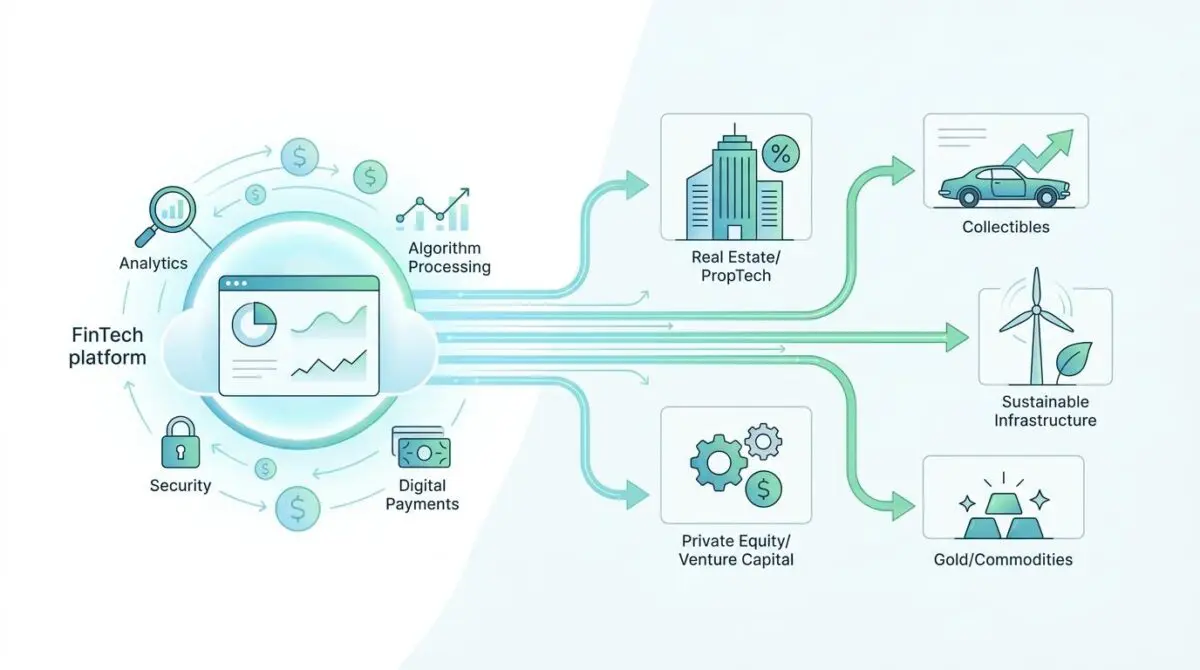
The true disruption in alternative asset investing lies in the underlying technological architecture powering these digital platforms. We have moved far beyond the era of manual appraisals, physical ledger books, and opaque auction houses. Today, the market is driven by algorithmic precision and decentralized networks.
The alternative asset sector now relies entirely on multi-modal AI valuation engines. These sophisticated algorithms analyze global auction data, real-time artist sentiment, and complex macroeconomic indicators to determine fair market value. They eliminate the subjective human bias that historically plagued the art and wine markets.
AI Valuation Engines and Digital Twins
Modern FinTech infrastructure is built fundamentally on real-world asset tokenization. Physical assets are securely anchored to decentralized ledgers via cryptographic digital twins. This creates an immutable, transparent record of ownership and provenance.
Specialized wine-tech platforms have seen massive capital inflows directly from family offices by leveraging this exact technology. These platforms utilize advanced sensory data and climate analytics to project the maturation value of rare vintages. The integration of this granular chemical data into decentralized ledgers ensures absolute authenticity for investors.
Recent market analysis reveals a seismic shift in composition, with institutional investors and family offices effectively replacing early retail speculators. This institutional takeover proves that the underlying technology has achieved enterprise-grade security and reliability.
These protocols allow for continuous secondary market trading on scalable Layer-2 blockchains. By operating on these high-throughput networks, platforms can execute micro-transactions with near-zero gas fees. This effectively turns static luxury goods into high-velocity liquid capital.
Overcoming Illiquidity with Tokenization
Fractionalized alternative asset platforms solve the two greatest barriers to entry in luxury investing: massive capital concentration and severe illiquidity. By tokenizing the asset, platforms can distribute ownership across thousands of individual wallets. This democratization of capital changes the fundamental mechanics of asset acquisition.
Historically, acquiring a heritage vineyard or a contemporary masterpiece required a rigid ten-year exit horizon. Investors were trapped in prolonged holding patterns, waiting for the right buyer to emerge in a highly inefficient secondary market. Capital was effectively locked away, unable to be redeployed into other yield-generating opportunities.
Today, FinTech fractionalization allows for accessible entry points and instant exits via integrated secondary exchanges. This technological leap reduces the traditional asset liquidation window from several months to mere seconds. Investors can now trade shares of fine art with the same fluidity as trading public equities.
While regulatory frameworks surrounding tokenized securities continue to evolve globally, the technology itself has already outpaced legacy compliance models. The primary focus for platform architects remains on scaling secure, decentralized liquidity pools while maintaining automated compliance checks at the smart contract level.
To understand the core components driving this ecosystem, we must look at the foundational tech stack:
- Real-World Asset Tokenization: The cryptographic process of anchoring physical luxury assets to decentralized blockchain ledgers.
- Digital Twins: Immutable digital representations of physical assets that guarantee provenance and enable rapid secondary market trading.
- Layer-2 Blockchains: Scalable network infrastructures that facilitate instant, low-cost asset transfers without congesting the mainnet.
The Strategic Action Plan
To capture the next massive wave of institutional capital, financial technology architects must look ahead to the next phase of infrastructure development. The upcoming years will be defined by seamless backend integration and hyper-personalization. Platforms that fail to adapt to these specialized investor demands will rapidly lose market share.
We anticipate a massive industry-wide shift toward comprehensive alternative asset integration. This technological bridge will allow fractional art and wine shares to be automatically rebalanced within standard retirement accounts. By utilizing specialized API layers, FinTech platforms can tap into the trillions of dollars currently sitting in traditional retirement portfolios.
Strategic Trajectory
- Facilitate ‘Alts-in-a-Box’ integration to enable seamless fractional art and wine ownership within standard retirement accounts.
- Deploy specialized API layers to automate the rebalancing of alternative asset shares within 401k and IRA portfolios.
- Transition to ‘Hyper-Personalized Indexes’ to provide bespoke investment vehicles beyond traditional platform-wide fund models.
- Implement AI agents to curate individualized luxury collectible portfolios tailored to investor ESG preferences.
- Align portfolio construction with specific risk-volatility appetites using advanced algorithmic curation for alternative assets.
Founders and institutional directors must prioritize the development of hyper-personalized indexes to stay competitive in a crowded market. Autonomous AI agents will soon curate individualized portfolios of luxury collectibles based on highly specific investor preferences. This level of customization was previously impossible under traditional wealth management models.
The integration of ethical preferences into luxury collectibles is a masterstroke in modern financial engineering. AI agents can dynamically filter portfolios to ensure that vineyards employ sustainable farming practices or that artists align with specific social impact criteria. This transforms a static alternative investment into a dynamic reflection of the investor’s core values.
This strategic pivot moves the industry away from rigid, platform-wide fund models that treat all investors the same. It empowers high-net-worth individuals with bespoke, algorithmic curation that aligns perfectly with their broader risk-volatility appetite. The future of alternative investing is entirely customized, automated, and hyper-liquid.
Conclusion
The financialization and fractionalization of alternative assets is no longer a speculative future concept. It is a present-day reality driven by relentless technological innovation and massive institutional capital inflows. The barrier between illiquid physical luxury and high-velocity digital capital has been permanently shattered.
Fractionalized alternative asset platforms have fundamentally altered the landscape of modern wealth generation. By fusing multi-modal AI valuation engines with scalable blockchain liquidity, these platforms offer unprecedented access to the world’s most coveted assets. Smart money has already made its move, anchoring its wealth in the immutable security of the blockchain.
Navigating the intersection of financial technology, institutional capital, and market psychology requires a sharp strategy. To future-proof your FinTech architecture and scale with precision, connect with Andres at Andres SEO Expert.
Frequently Asked Questions
What are fractionalized alternative asset platforms?
Fractionalized alternative asset platforms are specialized FinTech systems that transform illiquid luxury goods, such as blue-chip art and heritage vineyards, into tradable digital assets. By using blockchain technology, these platforms divide high-value physical items into smaller shares, democratizing access for institutional and retail investors alike.
How does RWA tokenization impact the liquidity of luxury investments?
Real-world asset (RWA) tokenization significantly increases liquidity by enabling 24/7 secondary market trading on Layer-2 blockchains. This technology reduces the traditional asset liquidation window from several months to approximately 1.5 seconds, allowing investors to exit positions with the same fluidity as trading public equities.
What role does AI play in valuing alternative assets like art and wine?
Modern platforms utilize multi-modal AI valuation engines that analyze global auction data, real-time artist sentiment, and macroeconomic indicators. These algorithms provide precise, fair market values and eliminate the subjective human bias historically associated with luxury asset appraisals.
What is the projected growth of the fractional art market by 2026?
According to market intelligence, the global fractional art market is projected to reach a value of $2.43 billion by mid-2026. This growth is supported by a broader trend of ultra-high-net-worth individuals projected to spend a record $2.7 trillion on collectibles as digital tools become mainstream.
Can fractionalized assets be integrated into traditional retirement accounts?
Yes, through ‘Alts-in-a-Box’ integration and specialized API layers, fractional shares of art and wine can be automatically rebalanced within standard 401k and IRA portfolios. This allows investors to treat alternative assets as core components of their long-term wealth management strategies.
What are Digital Twins in the context of alternative investments?
Digital Twins are immutable, cryptographic digital representations of physical assets securely anchored to a blockchain. They provide a transparent, unalterable record of provenance and authenticity, which is essential for institutional-grade security and rapid secondary market trading.