Executive Summary
- Quantifiable Trust Premium: High-security FinTechs utilizing biometric-only onboarding and ZK-KYC report an LTV/CAC ratio of 5.8x, significantly outperforming the industry average of 3.2x.
- Cryptographic Moats: The transition to Post-Quantum Cryptography (PQC) and the Regulated Liability Network (RLN) has shifted security from a cost center to a primary asset for institutional capital allocation.
- Operational Efficiency: Migration to API-first core banking integrated with real-time zero-knowledge proofs has reduced the latency cost of trust by 120ms, yielding millions in annual liquidity savings.
The Paradigm Shift to Resilience-Adjusted Returns
The financial technology landscape has undergone a fundamental transformation, moving away from the era of growth-at-all-costs toward a model defined by resilience-adjusted returns. In the current market landscape of 2026, the primary differentiator for market leaders is no longer just the user interface or the speed of the transaction, but the underlying integrity of the trust architecture. Institutional giants like BlackRock and J.P. Morgan have consolidated their dominance by establishing what is now known as the Institutional Trust Layer, utilizing the Regulated Liability Network for atomic settlement. This shift signals that security is no longer a back-office function; it is the core value proposition of modern financial marketing.
For founders and investors, the importance of trust and security in FinTech marketing has evolved from a compliance checkbox to a quantifiable economic driver. As capital flows toward platforms that can demonstrate verifiable resilience, the marketing narrative has shifted. We are seeing a move away from high-yield promises toward the promotion of sovereign identity and autonomous fraud prevention. This is not merely a branding exercise but a reflection of a deeper structural change in how digital value is exchanged and protected across global networks.
Defining Verifiable Finance: The Strategic Foundation
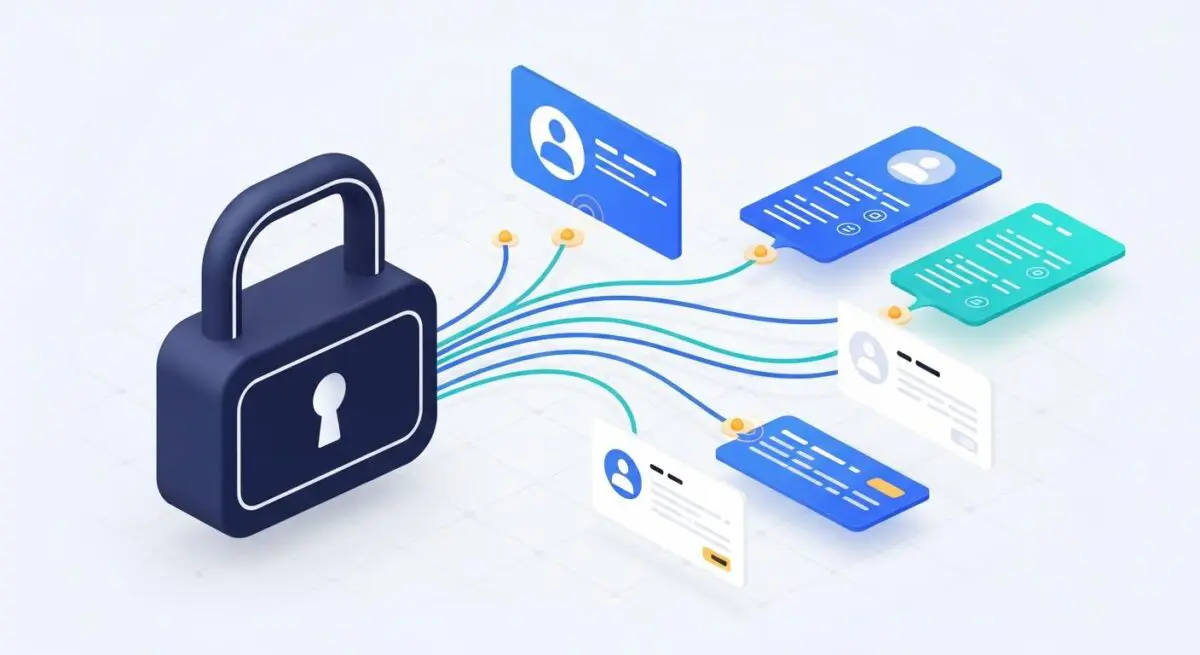
To understand the strategic implications of this shift, one must first grasp the concept of Verifiable Finance. This framework refers to a financial ecosystem where every transaction, identity, and asset movement is backed by cryptographic proof rather than just institutional promise. At its core, Verifiable Finance utilizes Zero-Knowledge Proofs (ZKP) to allow for the validation of data—such as identity or creditworthiness—without actually exposing the underlying sensitive information. This technology enables a paradox that was previously impossible: total transparency in compliance coupled with total privacy for the user. By integrating ZK-KYC protocols, firms can satisfy regulatory requirements while simultaneously reducing the surface area for data breaches, effectively turning privacy into a marketing asset.
The Unit Economics of Integrity: LTV/CAC and the Trust Premium
The impact of trust on the bottom line is now measurable through the Trust Premium, a metric that tracks the cost of capital and customer acquisition in relation to security benchmarks. Data indicates that platforms utilizing advanced security stacks, such as biometric-only onboarding and hardware-backed identity, see a 12% lower cost of capital compared to traditional neobanks. This efficiency is reflected in the unit economics of the industry’s top performers. High-security FinTechs report an LTV/CAC ratio of 5.8x, nearly double the industry average of 3.2x. This is driven by a significant reduction in customer churn, as users are less likely to migrate away from platforms they perceive as fundamentally secure.
Furthermore, the marketing of Zero-Fraud Guarantees has become a powerful tool for reducing acquisition costs. When a platform can demonstrate that its security stack—powered by specialized middleware from providers like Chainalysis or Privy—neutralizes threats like Authorized Push Payment fraud before they reach the network, the perceived risk for the consumer drops. This leads to higher conversion rates and a more loyal user base, proving that security is the most effective long-term marketing strategy available to modern financial institutions.
Infrastructure Moats: From PQC to the Unified Ledger
The technical moats of the future are being built at the infrastructure layer. We are witnessing a massive adoption of Post-Quantum Cryptography (PQC) in transit layers, specifically within TLS 1.4+ protocols. This move is a preemptive strike against the future threat of quantum computing, and it serves as a powerful signal to institutional investors that a firm is thinking in decades, not quarters. Stripe’s recent acquisition of specialized PQC startups is a prime example of this strategy, positioning the firm as a primary mover in the merchant-facing security stack.
- Unified Ledger Framework: The industry is transitioning toward a framework that integrates central bank digital currencies (CBDCs) and tokenized deposits into a single, interoperable layer.
- Autonomous Orchestration: AI-driven Trust Agents now reside at the edge of the network, pre-validating transaction intent on mobile devices to prevent fraud in real-time.
- ISO 20022 Migration: The shift from legacy Swift messages to ISO 20022 is nearly complete among Tier-1 banks, enabling rich metadata for real-time security auditing and enhanced transparency.
These infrastructure shifts have a direct impact on operational ROI. The migration to API-first core banking systems, such as Thought Machine or Mambu, integrated with real-time verification protocols, has reduced the latency cost of trust by an estimated 120ms per transaction. For mid-market players, this yields significant annual liquidity savings, as capital is no longer trapped in the friction of slow, manual verification processes.
Trust in financial infrastructure is not a static wall; it is the laminar flow in a high-pressure hydraulic system. If the seals—the cryptographic protocols and identity verifications—develop even a microscopic leak, the entire system loses the pressure required to move capital across borders. A FinTech platform without verifiable security is a pump trying to move water through a sieve; no matter how much marketing energy you pour in, the pressure never builds.
Navigating the Deepfake Gap and Regulatory Friction
Despite the technological advances, significant hurdles remain. The primary technical friction point is the Deepfake Gap, where advanced generative AI can bypass traditional biometric checks. This has forced a strategic return to hardware-backed identity solutions, such as YubiKey or Secure Enclave requirements. While this increases user friction, it is a necessary trade-off to maintain the integrity of the platform. Marketing this friction as a premium feature—rather than a hurdle—is the hallmark of a sophisticated FinTech strategy.
Regulatory mandates are also reshaping the marketing landscape. The evolution of PSD4 in the EU now mandates permissioned traceability, requiring firms to prove the security of their entire third-party vendor chain. Similarly, the EU AI Act classifies AI-driven fraud detection as high-risk, requiring firms to provide explainability audits for their algorithms. While these regulations increase the cost of compliance, they also create a significant moat for incumbents who have the resources to maintain robust auditing processes. The strategic response is to market this compliance as a form of cyber resilience, turning a regulatory burden into a signal of institutional strength.
Andres’ Masterclass: The Wealth Architecture
The convergence of cryptographic verification and institutional-grade infrastructure is creating a new hierarchy in the financial world. The hidden signal in the market is the shift from yield-based marketing to health-based marketing. Investors and consumers are no longer just looking for the highest return; they are looking for the most resilient ecosystem. This transition is forcing a reallocation of capital toward Verifiable Finance, where the security overhead is viewed as a primary asset rather than a cost center. Those who fail to recognize that trust is a technical product, not a marketing sentiment, will find themselves excluded from the high-trust silos where global liquidity is increasingly concentrated.
Our outlook for long-term market positioning is clear: the winners will be those who successfully bridge the gap between complex financial engineering and strategic clarity. Operational ROI will increasingly depend on the ability to automate trust through autonomous agent orchestration and ZK-proofs. For the strategic decision-maker, the mandate is to view every layer of the tech stack as a marketing opportunity. By building a foundation of verifiable security, firms can achieve a sustainable competitive advantage that no amount of traditional advertising can replicate.
Architecting the Future of Verifiable Value
In a landscape defined by rapid technical shifts, strategy is the only sustainable defense. Whether you are architecting for the generative search era or optimizing for operational ROI, the right partnership defines your success. Connect with Andres at Andres SEO Expert to build a future-proof foundation for your enterprise.