Executive Summary
- Network latency is the temporal delay in data transmission across a network, primarily governed by the speed of light, hardware processing, and routing efficiency.
- High latency directly inflates Time to First Byte (TTFB) and Largest Contentful Paint (LCP), creating a bottleneck for Core Web Vitals and user experience.
- Optimization strategies focus on reducing the physical distance between the server and the client through Content Delivery Networks (CDNs) and minimizing round-trip times (RTT).
What is Network Latency?
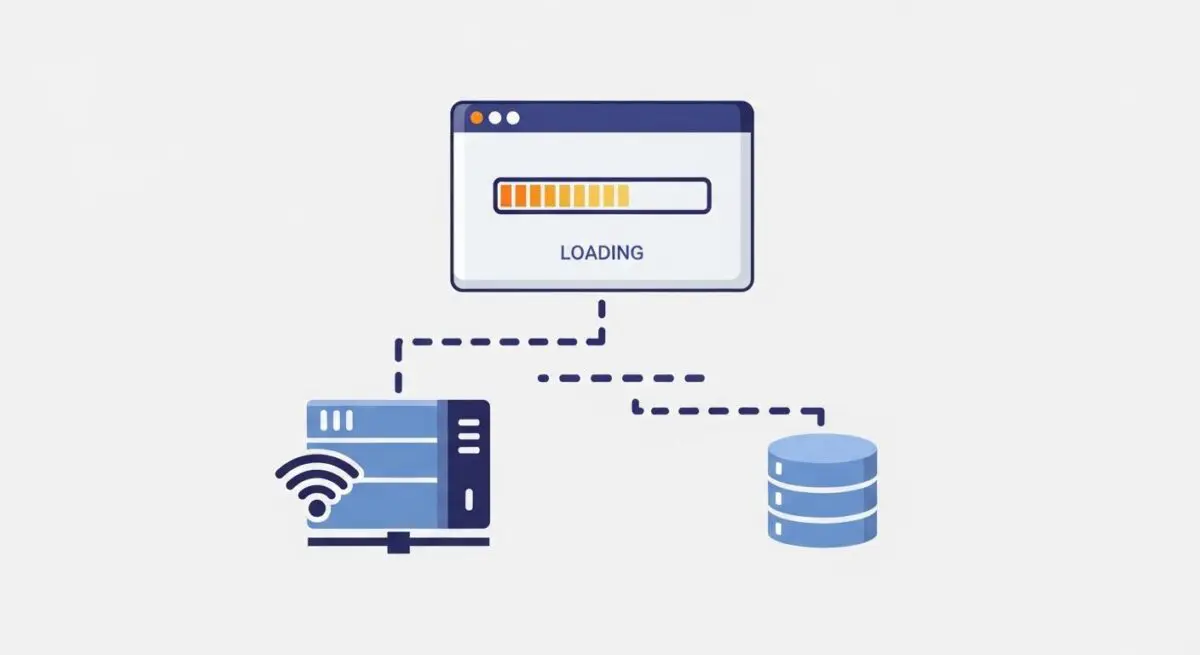
Network latency refers to the duration of time required for a data packet to travel from its source to its destination across a network. In the context of web performance, it is typically measured as Round-Trip Time (RTT), which accounts for the time a request takes to reach a server plus the time the subsequent response takes to return to the client. Latency is distinct from bandwidth; while bandwidth measures the volume of data that can be transmitted over time, latency measures the delay of that transmission.
Technically, network latency is the summation of four distinct components: propagation delay (the time for a signal to travel through a medium), transmission delay (the time to push bits onto the physical wire), queuing delay (time spent in router buffers during congestion), and processing delay (the time taken by routers or servers to handle packet headers). For high-performance websites, minimizing these delays is critical to achieving near-instantaneous interactivity.
The Real-World Analogy
Imagine you are at a restaurant. Network latency is not the time it takes for the chef to cook your meal; rather, it is the time it takes for the waiter to walk your order from the table to the kitchen, plus the time it takes for them to walk the finished plate back to you. Even if the chef is incredibly fast (high server processing speed), if the kitchen is located three blocks away, you will still experience a significant delay before you can eat. In this scenario, the distance the waiter travels represents the physical latency of the network.
Why is Network Latency Critical for Website Performance and Speed Engineering?
Latency is the primary constraint in modern web performance because, unlike bandwidth, it is limited by the laws of physics—specifically the speed of light in fiber optics. High latency compounds during the initial connection phases, such as DNS lookup, TCP handshakes, and TLS negotiation. For every resource requested, these round trips add up, significantly delaying the Time to First Byte (TTFB) and subsequently the Largest Contentful Paint (LCP).
In the era of AI-Search and Generative Engine Optimization (GEO), low latency is essential for ensuring that crawlers and LLM-based agents can ingest and index content rapidly without timing out. Furthermore, high latency negatively impacts the Interaction to Next Paint (INP) metric, as delayed server responses for dynamic data can make a user interface feel sluggish and unresponsive, regardless of the device’s local processing power.
Best Practices & Implementation
- Deploy a Content Delivery Network (CDN): Cache static and dynamic assets at the network edge to serve content from the PoP (Point of Presence) geographically closest to the user, reducing propagation delay.
- Implement HTTP/3 (QUIC): Utilize the UDP-based QUIC protocol to reduce the number of round trips required for connection establishment and to mitigate head-of-line blocking issues.
- Optimize DNS Resolution: Use premium DNS providers with global Anycast networks to minimize the initial lookup latency, which is often the first bottleneck in the loading sequence.
- Utilize Early Hints (103): Implement the 103 Early Hints status code to allow browsers to begin preloading critical resources while the server is still generating the main HTML response.
Common Mistakes to Avoid
One frequent error is over-optimizing file sizes (bandwidth) while ignoring the number of requests (latency). Even small files suffer if they require multiple round trips over a high-latency connection. Another mistake is hosting a global website on a single origin server without a geo-distributed edge strategy, forcing international users to endure high propagation delays that cannot be fixed by software optimization alone.
Conclusion
Network latency is a fundamental performance bottleneck that requires architectural solutions like edge computing and protocol optimization to minimize the physical and logical distance between data and the user.