Key Points
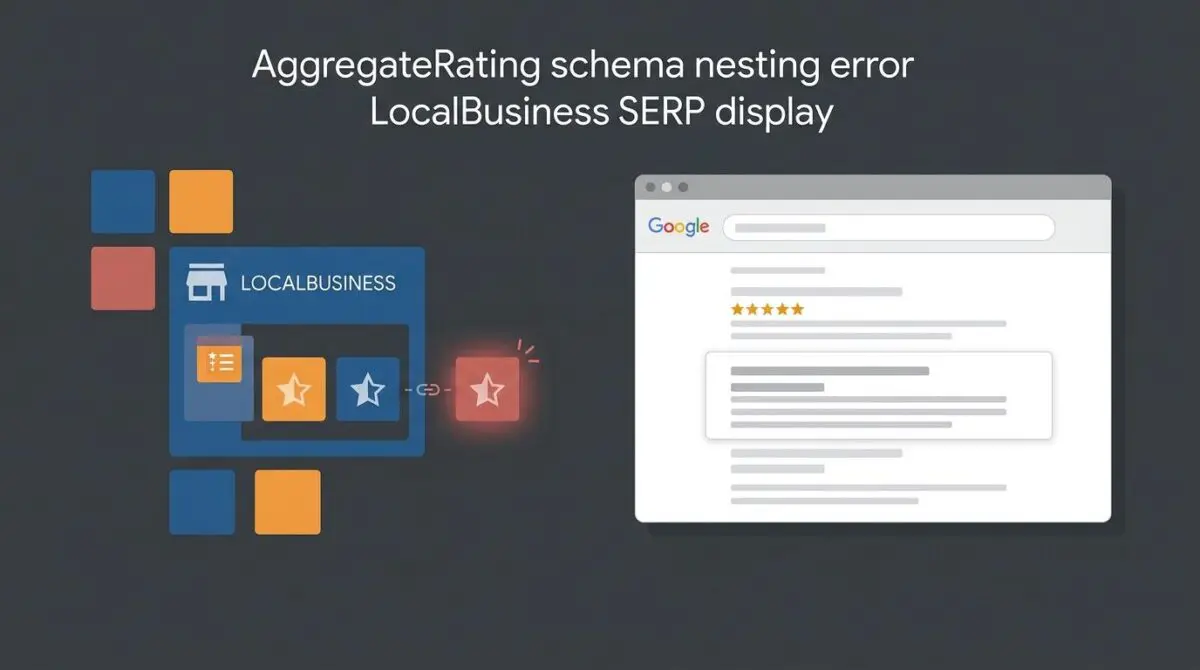
- Improperly nested aggregateRating creates entity ambiguity, preventing Googlebot-Render from attributing review stars to the LocalBusiness.
- Schema graph fragmentation often stems from disjointed JSON-LD blocks generated by conflicting WordPress plugins or syntax serialization errors.
- Restructuring the JSON-LD hierarchy to embed the rating directly within the LocalBusiness object resolves GSC itemReviewed errors and restores rich snippets.
Table of Contents
The Core Conflict: Schema Fragmentation
A technical study by Milestone Research reveals that websites correctly implementing Schema.org structured data see a 20% to 30% increase in Click-Through Rate (CTR) compared to those with missing or improperly nested rich result metadata. Despite this clear advantage, many enterprise architectures fail to capitalize on review snippets due to a critical structural flaw.
When review stars stop showing in SERPs, the culprit is frequently an improperly nested aggregateRating in LocalBusiness schema. This architectural failure occurs when the structured data hierarchy fails to establish a direct, valid relationship between a LocalBusiness entity and its numerical rating data.
Google’s rendering engine requires a specific tree structure where the rating property is an internal attribute of the parent entity. When this relationship is broken, it forces Googlebot-Render to parse fragmented DOM elements without generating a Search Result Feature. This effectively wastes crawl budget and decreases the efficiency of your indexing pipeline.
From a Generative Engine Optimization (GEO) perspective, incorrect nesting creates severe entity ambiguity. Large Language Models (LLMs) rely on precise schema graphs to attribute sentiment to specific nodes. When rating data is orphaned, generative engines fail to rank the business for high-intent queries.
Diagnostic Checkpoints and Root Causes
This error is fundamentally a desynchronization within your technology stack. It often manifests in Google Search Console as a Missing field ‘itemReviewed’ error or an invalid object type warning.
In raw server logs, you may observe a high frequency of Googlebot-Render hits on specific URLs that never yield rich features despite returning a 200 OK status code. The Rich Results Test tool might even show the schema as successful while simultaneously flagging the Review Snippet as non-eligible.
Diagnostic Checkpoints
Entity Disconnection (Top-Level Scope)
Standalone rating lacks required itemReviewed property connection.
Schema Type Mismatch
Rating object nested in unsupported text-only fields.
JSON-LD Syntax Serialization Error
Syntax errors break the LocalBusiness object hierarchy.
Self-Serving Review Policy Violation
Global review logic triggers self-serving policy suppression.
Plugin Conflicts and Entity Disconnection
At the WordPress or CMS layer, entity disconnection frequently occurs when a dedicated review plugin injects its own JSON-LD block separately from the primary SEO plugin. This creates two disconnected schema graphs instead of a unified node.
Without an itemReviewed property pointing back to the LocalBusiness ID, the search engine cannot determine what entity is actually being rated. This top-level scope error leaves the rating data completely orphaned in the DOM.
Schema Type Mismatches and Syntax Errors
Schema type mismatches happen when the rating object is nested inside unsupported text-only fields like a description or address. This is common when custom Advanced Custom Fields (ACF) templates are used to output schema manually.
Additionally, serialization errors like a trailing comma or premature closing brace will break the object hierarchy. Finally, Google explicitly ignores aggregateRating for LocalBusiness if the global review logic suggests the site is reviewing itself.
Engineering Resolution Roadmap
Resolving this schema fragmentation requires a systematic approach to restructuring your JSON-LD payloads. The goal is to consolidate disjointed scripts into a single, cohesive entity graph.
Engineering Resolution Roadmap
Identify Schema Graph Fragmentation
Open the target URL in the ‘Rich Results Test’ tool. Check if LocalBusiness and aggregateRating appear as two separate items or one unified item. If they are separate, you must unify the JSON-LD.
Restructure JSON-LD Hierarchy
Refactor the code to ensure aggregateRating is a key within the LocalBusiness object. Use the ‘@id’ property to create a canonical reference for the LocalBusiness if you cannot merge the scripts into a single block.
Purge Object and CDN Cache
Flush the WordPress Object Cache (Redis/Memcached) and clear the Edge Cache (Cloudflare/Akamai) to ensure the updated JSON-LD is served to Googlebot immediately.
Trigger GSC Validation
Navigate to the Google Search Console ‘Review Snippets’ report and click ‘Validate Fix’. This moves the error status to ‘Pending’ and prioritizes the affected URLs for re-crawling.
When restructuring the JSON-LD hierarchy, you must ensure that the aggregateRating is declared strictly as a key within the LocalBusiness object. If merging the scripts into a single block is impossible due to plugin constraints, you must utilize the @id property.
Using the @id property creates a canonical reference, allowing Googlebot to stitch the fragmented entities together during the rendering phase. Once the code is updated, aggressive caching at the Edge and Object layers must be purged to serve the fresh payload.
Resolution Execution: Restructuring JSON-LD
To execute this fix, you must modify the JSON-LD output in your theme functions or headless CMS payload. The following configuration demonstrates the correct nesting hierarchy.
Fixing via JSON-LD Refactoring
Ensure the aggregateRating object is housed directly inside the LocalBusiness declaration. Remove any standalone rating blocks from your source code to prevent conflicting signals.
{
  "@context": "https://schema.org",
  "@type": "LocalBusiness",
  "@id": "https://example.com/#business",
  "name": "Professional SEO Services",
  "address": {
    "@type": "PostalAddress",
    "streetAddress": "123 Server Lane"
  },
  "aggregateRating": {
    "@type": "AggregateRating",
    "ratingValue": "4.9",
    "reviewCount": "154"
  }
}
Validation Protocol and Edge Cases
Deploying the code is only the first phase; rigorous validation is required to ensure search engines process the updated hierarchy correctly. A technical study by Milestone Research confirms that strict validation of this metadata is what secures the competitive CTR advantages in modern SERPs.
Validation Protocol
- Inspect GSC ‘Evaluated Type’ for unified LocalBusiness data.
- Verify absence of noindex headers via curl -I.
- Ensure no dynamic script delays in Network tab.
In modern web architectures, edge cases frequently disrupt schema validation. For instance, in a Headless WordPress setup using React or Next.js, the schema might be correctly structured during Server-Side Rendering (SSR).
However, this pristine SSR schema can be overwritten by client-side hydration. If a secondary SEO component mounts after the initial load and pushes a flattened schema object to the dataLayer, Googlebot-Render will process the corrupted version.
Autonomous Monitoring and Prevention
Preventing schema regressions requires shifting from manual audits to automated pipeline validation. Engineering teams should implement a schema validation step directly in their CI/CD pipelines.
- Pipeline Validation: Integrate schema-dts into your deployment workflow to catch syntax errors before production.
- Log Monitoring: Track Googlebot-Render behavior autonomously to detect rendering bottlenecks.
Using libraries like schema-dts or headless browser scripts that query the Schema.org Validator API ensures no malformed JSON-LD reaches production. Furthermore, setting up server-side log alerts for 4xx and 5xx errors on your sitemap ensures Googlebot-Render maintains unhindered access.
At Andres SEO Expert, we advocate for advanced automation using platforms like Make.com to monitor entity integrity autonomously. By routing GSC API data through automated log analysis, enterprise teams can detect nesting anomalies before they impact SERP visibility.
Conclusion
Resolving an improperly nested aggregateRating is a critical step in maintaining a healthy, unambiguous entity graph. By enforcing strict JSON-LD hierarchies, you eliminate rendering bottlenecks and restore high-visibility review snippets to your search results.
Navigating the intersection of technical SEO, server architecture, and generative search requires a precise roadmap. If you need to future-proof your enterprise stack, resolve deep-level crawl anomalies, or implement AI-driven SEO automation, connect with Andres at Andres SEO Expert.
Frequently Asked Questions
Why are my review stars not showing in Google search results?
Review stars often disappear due to an improperly nested aggregateRating within the LocalBusiness schema. If the rating data is not directly contained within the business entity or linked via a canonical @id reference, Google’s rendering engine cannot associate the score with the business, resulting in the loss of rich snippets.
What is the ‘Missing field itemReviewed’ error in Google Search Console?
This error occurs when the aggregateRating or Review object lacks a clear connection to the specific entity being rated. In a technical SEO context, it signifies that the schema graph is fragmented, and the search engine cannot determine which LocalBusiness or product the rating belongs to.
How does improperly nested schema impact Generative Engine Optimization (GEO)?
For Large Language Models (LLMs) and AI-driven search, incorrect schema nesting creates entity ambiguity. If rating data is orphaned, generative engines may fail to attribute positive sentiment or authority to the business node, negatively affecting the business’s visibility for high-intent queries.
Can I use the @id property to fix schema fragmentation?
Yes, the @id property acts as a canonical reference that allows Googlebot to stitch together separate JSON-LD scripts. By using the same @id for both the LocalBusiness and the aggregateRating’s itemReviewed property, you create a unified entity graph even if the scripts are generated by different plugins.
Why does the Rich Results Test show success but I still have no review snippets?
The Rich Results Test may validate the syntax of individual schema blocks while the Review Snippet enhancement report flags the entity as ineligible. This usually happens because of Self-Serving Review policy violations or because the aggregateRating is nested inside an unsupported field, breaking the required structural hierarchy.
How do I resolve schema issues caused by client-side hydration?
In headless or React-based architectures, ensure that client-side hydration does not overwrite the clean Server-Side Rendered (SSR) schema with a flattened or corrupted version. You should synchronize your SEO components to maintain a consistent JSON-LD tree structure throughout the DOM lifecycle.