Executive Summary
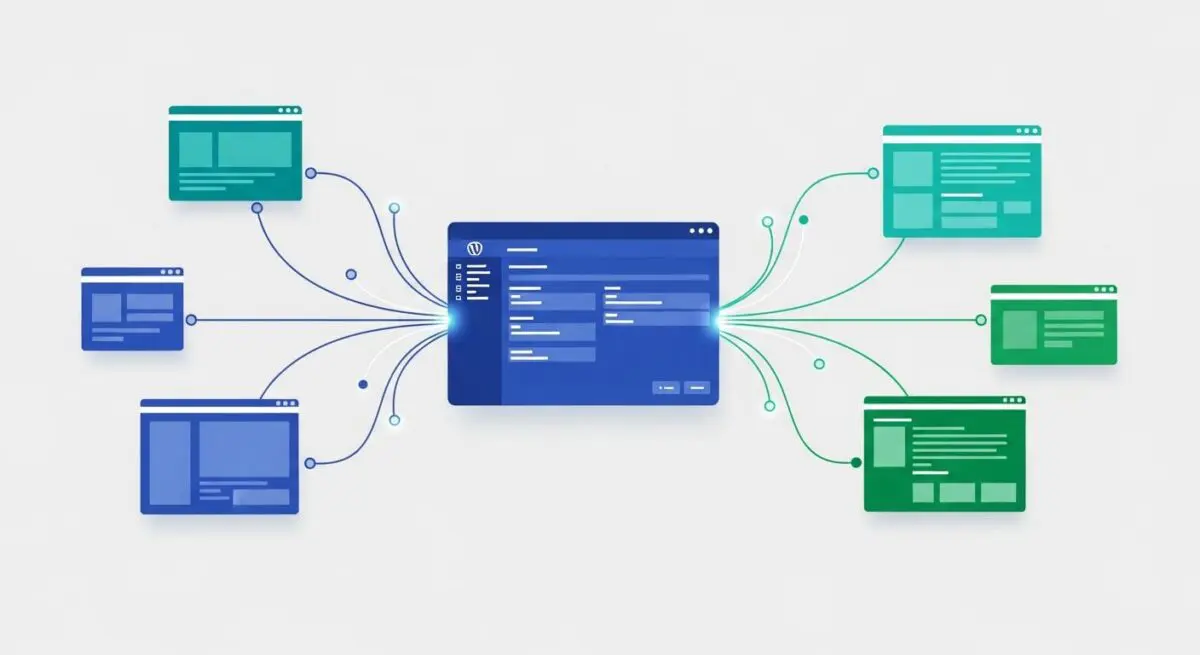
- Decoupled architecture isolates the content management system (CMS) from the presentation layer, communicating via the WordPress REST API or GraphQL.
- This approach enhances security by shielding the WordPress administrative backend from the public-facing frontend environment.
- It enables high-performance frontend delivery using modern JavaScript frameworks while maintaining the robust content editing capabilities of WordPress.
What is Decoupled Architecture?
Decoupled architecture, often referred to in the context of Headless WordPress, is a software design pattern where the content management backend (the ‘body’) is separated from the frontend presentation layer (the ‘head’). In a traditional WordPress setup, the CMS handles both data storage and the rendering of HTML via a theme engine. In a decoupled environment, WordPress functions strictly as a content repository and administrative interface, exposing data through structured endpoints such as the WordPress REST API or WPGraphQL.
This architectural shift allows developers to utilize modern frontend stacks—such as React, Next.js, or Vue.js—to consume the data and render it independently of the WordPress core. By removing the dependency on the standard WordPress theme hierarchy and template engine, engineers can achieve greater control over the user experience and the delivery mechanism, facilitating a more modular and scalable ecosystem for enterprise-level applications.
The Real-World Analogy
Imagine a high-end restaurant where the kitchen (the backend) is located in a completely different building from the dining room (the frontend). The chefs prepare the meals using specialized equipment and high-quality ingredients, but the customers never see the kitchen. Instead, a sophisticated delivery service (the API) transports the finished dishes to the dining room. This allows the kitchen to focus entirely on food production without being disrupted by the decor or seating arrangements of the dining room, while the dining room can be redesigned or moved to a different city without ever needing to change how the food is actually cooked.
How Decoupled Architecture Impacts Server Performance & Speed Engineering?
Decoupled architecture fundamentally alters the server-side resource allocation. In a monolithic setup, every page request triggers the full WordPress execution stack, including PHP processing, database queries, and theme rendering. In a decoupled environment, the frontend is often pre-rendered as static HTML or served via Server-Side Rendering (SSR) on a dedicated Node.js environment or an Edge Network. This significantly reduces the Time to First Byte (TTFB) because the public-facing site does not need to wait for WordPress to process complex logic for every visitor.
Furthermore, because the backend is isolated, the administrative server only handles API requests and content management tasks. This separation allows for granular scaling; the frontend can be scaled globally across a CDN, while the WordPress backend remains on a secure, private server. This reduces the attack surface and prevents frontend traffic spikes from impacting the stability of the content management interface, leading to superior Core Web Vitals and overall system resilience.
Best Practices & Implementation
- Implement WPGraphQL: Utilize GraphQL instead of the standard REST API to minimize over-fetching and under-fetching of data, ensuring that the frontend receives only the specific fields required for a given component.
- Leverage Static Site Generation (SSG): Use frameworks like Next.js or Gatsby to generate static assets at build time, drastically reducing server load and improving security.
- Secure API Endpoints: Implement JSON Web Tokens (JWT) or OAuth for authentication to ensure that sensitive data and administrative functions are not exposed to unauthorized users.
- Optimize Image Delivery: Use a dedicated media processing service or CDN to handle image transformations, as the decoupled frontend will not benefit from standard WordPress image size generation in the same way.
Common Mistakes to Avoid
One frequent error is neglecting Search Engine Optimization (SEO) requirements. Without proper Server-Side Rendering (SSR) or pre-rendering, search engine crawlers may struggle to index JavaScript-heavy frontend applications, leading to a loss in organic visibility. Another common mistake is over-engineering simple websites; decoupled architecture introduces significant complexity in deployment pipelines and state management, which may not be justifiable for small-scale blogs or brochure sites. Finally, failing to implement a robust preview system can frustrate content editors who lose the ‘Live Preview’ functionality inherent in traditional WordPress themes.
Conclusion
Decoupled architecture represents a sophisticated evolution in WordPress engineering, offering unparalleled flexibility, security, and performance for enterprise-grade deployments. By separating content from presentation, organizations can future-proof their digital assets and deliver high-speed, modern web experiences.