Executive Summary
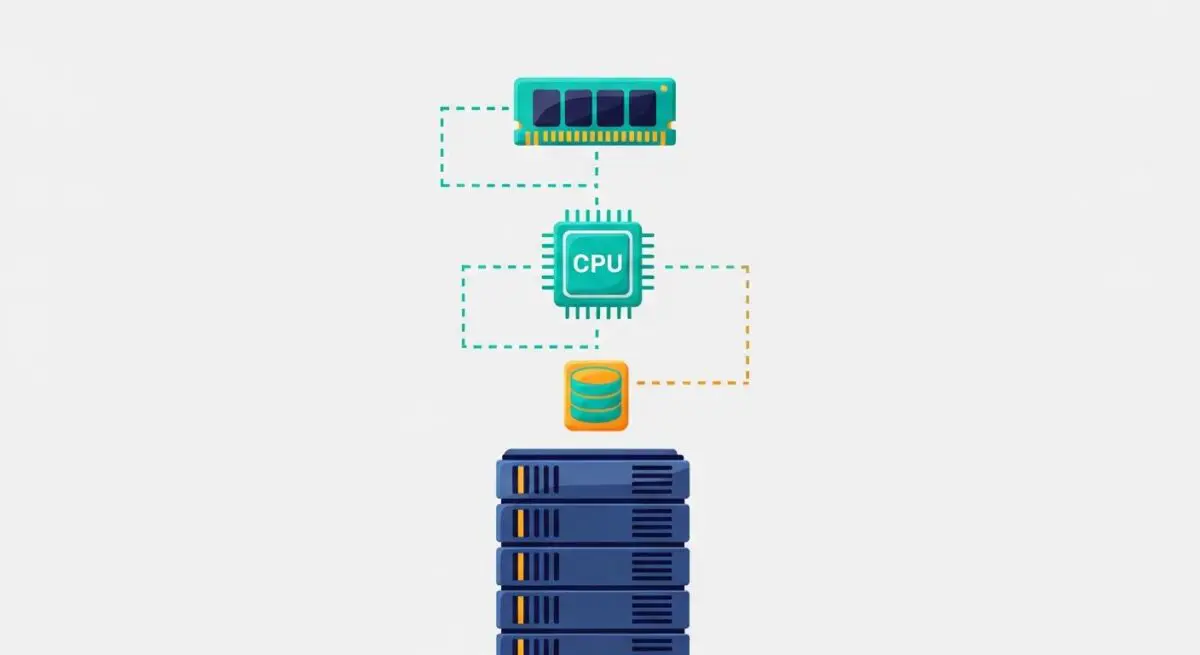
- Vertical scaling, or “scaling up,” involves increasing the hardware resources (CPU, RAM, Disk) of a single server instance to handle higher workloads.
- It is the primary method for improving WordPress performance in monolithic environments, directly impacting PHP execution times and database query speeds.
- While easier to implement than horizontal scaling, it is ultimately constrained by the physical hardware limits of the host machine.
What is Vertical Scaling?
Vertical scaling, often referred to as “scaling up,” is the process of adding more power to an existing server by increasing its hardware specifications. In the context of WordPress hosting, this typically involves upgrading a Virtual Private Server (VPS) or a Dedicated Server with additional CPU cores, increased RAM, or faster storage solutions like NVMe SSDs. Unlike horizontal scaling, which adds more machines to a pool, vertical scaling focuses on maximizing the capacity of a single node to process more concurrent requests and execute complex PHP scripts more efficiently.
For WordPress environments, vertical scaling is particularly effective because the CMS is traditionally monolithic. By providing more RAM, the server can allocate larger buffers for the MySQL database, reducing disk I/O. Increased CPU capacity allows for faster processing of the PHP-FPM pool, which is critical for dynamic page generation and handling high-traffic events without latency spikes. This approach is often the first line of defense for enterprise sites experiencing performance bottlenecks.
The Real-World Analogy
Imagine you own a delivery van that can carry 50 packages. As your business grows, you need to deliver 100 packages. Vertical scaling is the equivalent of trading in that van for a heavy-duty freight truck. You still have only one vehicle and one driver to manage, but that single vehicle now has a much larger engine and a significantly bigger cargo hold, allowing it to complete the job more efficiently without changing your operational workflow.
How Vertical Scaling Impacts Server Performance & Speed Engineering?
Vertical scaling directly influences the server’s ability to handle the “heavy lifting” required by the WordPress core, themes, and plugins. By increasing CPU frequency and core count, the server can execute PHP threads faster, which significantly lowers the Time to First Byte (TTFB). This is crucial for complex WooCommerce stores or membership sites where page caching is less effective due to personalized content.
Furthermore, increasing RAM allows for larger OpCache and Object Cache (like Redis or Memcached) allocations. This reduces the need for the server to re-compile PHP scripts or query the database repeatedly for the same data. From a database perspective, more memory enables larger InnoDB buffer pools, allowing the MySQL engine to keep more of the site’s data in memory rather than fetching it from the disk, which is a common bottleneck in WordPress architecture.
Best Practices & Implementation
- Monitor Resource Utilization: Use tools like New Relic or Netdata to identify whether the bottleneck is CPU-bound or memory-bound before performing an upgrade.
- Optimize PHP-FPM Settings: After scaling up, adjust the pm.max_children and pm.start_servers settings to ensure the software can actually utilize the newly available hardware.
- Database Tuning: Ensure the innodb_buffer_pool_size is recalculated to reflect the increased RAM, typically aiming for 60-80% of total available memory on dedicated database environments.
- Implement Object Caching: Use the additional RAM to deploy Redis, which offloads database pressure and speeds up metadata retrieval.
Common Mistakes to Avoid
The most frequent error is “throwing hardware at bad code.” If a WordPress site has poorly written queries or bloated plugins, vertical scaling will only provide a temporary fix; the underlying inefficiency will eventually consume the new resources. Another mistake is ignoring the “ceiling” of vertical scaling; there is a physical limit to how much a single server can grow, at which point horizontal scaling becomes mandatory for further growth.
Conclusion
Vertical scaling is a vital strategy for WordPress architects to ensure high performance and stability by strengthening the underlying server hardware. When combined with code optimization, it provides a robust foundation for enterprise-level web applications.