Executive Summary
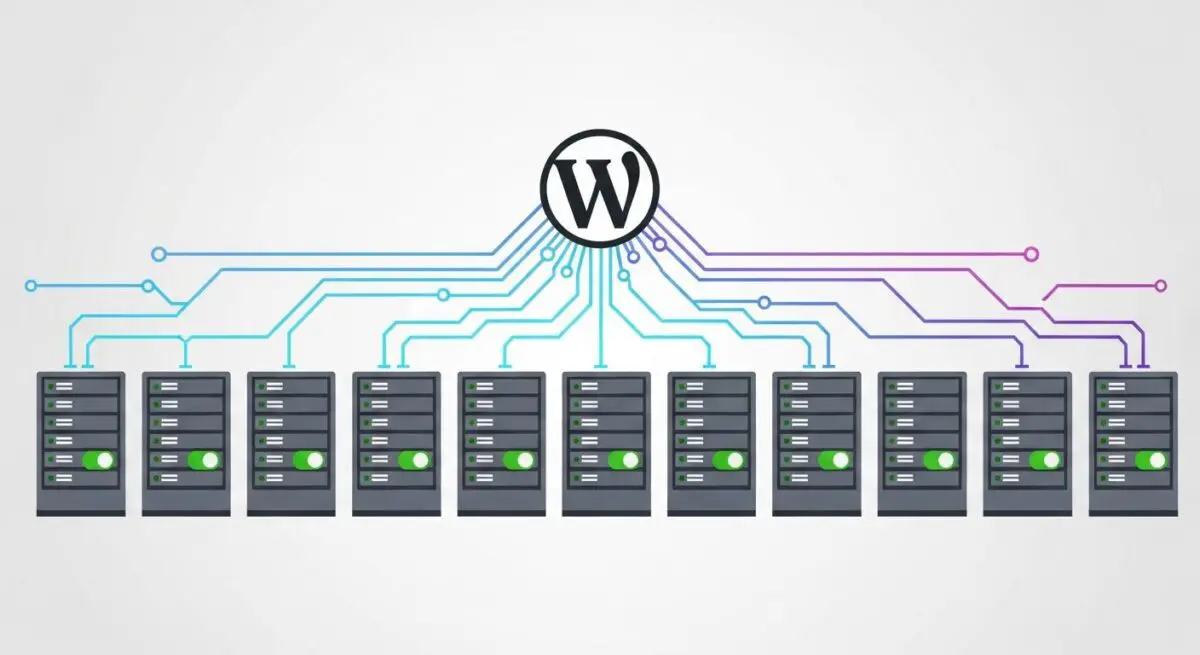
- Horizontal scaling involves adding more server nodes to a resource pool rather than increasing the capacity of a single machine, enabling elastic scalability.
- In WordPress architecture, this requires a stateless application layer where media, databases, and sessions are decoupled from the local file system.
- Load balancers act as the traffic orchestrator, distributing incoming requests across healthy web nodes to prevent single points of failure and optimize TTFB.
What is Horizontal Scaling?
Horizontal scaling, often referred to as ‘scaling out,’ is the architectural process of adding more hardware nodes to a resource pool—such as additional web servers—to handle increased traffic loads. Unlike vertical scaling, which upgrades the CPU or RAM of a single instance, horizontal scaling distributes the processing requirements across multiple machines. In a WordPress context, this typically involves deploying multiple identical PHP processing nodes behind a load balancer, ensuring that no single server becomes a bottleneck during traffic surges.
To achieve effective horizontal scaling, the WordPress environment must transition to a stateless architecture. This means that any individual web server can handle any incoming request because the persistent data—such as the MySQL database, the wp-content/uploads directory, and PHP session data—is stored in centralized, external locations. This decoupling is essential for maintaining consistency across the cluster and allowing nodes to be added or removed dynamically based on real-time demand without data loss.
The Real-World Analogy
Imagine a busy metropolitan grocery store. Vertical scaling is like hiring one ‘super-clerk’ who can scan items at lightning speed; however, no matter how fast they are, they can still only help one customer at a time, and if they take a break, the entire line stops. Horizontal scaling is like opening ten additional checkout lanes. Even if each clerk moves at a normal pace, the store can process ten times as many customers simultaneously. If one clerk needs to step away, the other nine lanes remain open, ensuring the store never stops functioning.
How Horizontal Scaling Impacts Server Performance & Speed Engineering?
Horizontal scaling fundamentally changes how WordPress handles concurrency and high-traffic events. By distributing the PHP execution load across multiple cores spread over different physical or virtual machines, the architecture prevents the ‘queueing’ of requests that leads to high Time to First Byte (TTFB). When one node reaches its PHP-FPM worker limit, the load balancer automatically routes the next request to a node with available capacity, maintaining consistent response times even under heavy load.
Furthermore, horizontal scaling enhances speed engineering through redundancy and fault tolerance. In a single-server setup, a hardware failure results in immediate downtime. In a horizontally scaled environment, health checks automatically detect a failing node and remove it from the rotation. This architecture also facilitates ‘blue-green’ deployments, where new code is rolled out to a separate cluster before switching traffic, ensuring that performance optimizations or core updates do not cause regressions or downtime for the end-user.
Best Practices & Implementation
- Externalize the Database: Move the WordPress database to a managed service like AWS RDS or Google Cloud SQL to ensure all web nodes query a single, authoritative data source.
- Implement Centralized Storage: Use an Amazon S3 bucket or a Network File System (NFS/EFS) for the
uploadsfolder so that images are accessible to all server nodes simultaneously. - Use a Load Balancer: Deploy a Layer 7 load balancer (like Nginx, HAProxy, or an AWS ALB) to manage SSL termination and distribute traffic based on server health and capacity.
- Centralize Object Caching: Utilize an external Redis or Memcached cluster for object caching to ensure that cache hits are consistent across all nodes in the pool.
Common Mistakes to Avoid
A frequent error is failing to synchronize the wp-config.php or plugin files across nodes, leading to ‘split-brain’ scenarios where different users see different versions of the site. Another common mistake is relying on local server storage for session handling; without a centralized session store like Redis, users will be randomly logged out as the load balancer moves them between different web nodes that do not share session data.
Conclusion
Horizontal scaling is the gold standard for enterprise WordPress hosting, providing the necessary infrastructure for high availability, fault tolerance, and elastic performance. By decoupling the application layer from data storage, agencies can ensure their sites remain performant regardless of traffic volume.