Executive Summary
- Decouples the WordPress backend from the frontend to eliminate server-side PHP execution and database queries during page loads.
- Significantly reduces Time to First Byte (TTFB) and enhances security by serving immutable flat files via a Content Delivery Network (CDN).
- Requires a robust CI/CD pipeline or specialized plugins to synchronize content updates between the CMS and the static deployment environment.
What is a Static Site Generator?
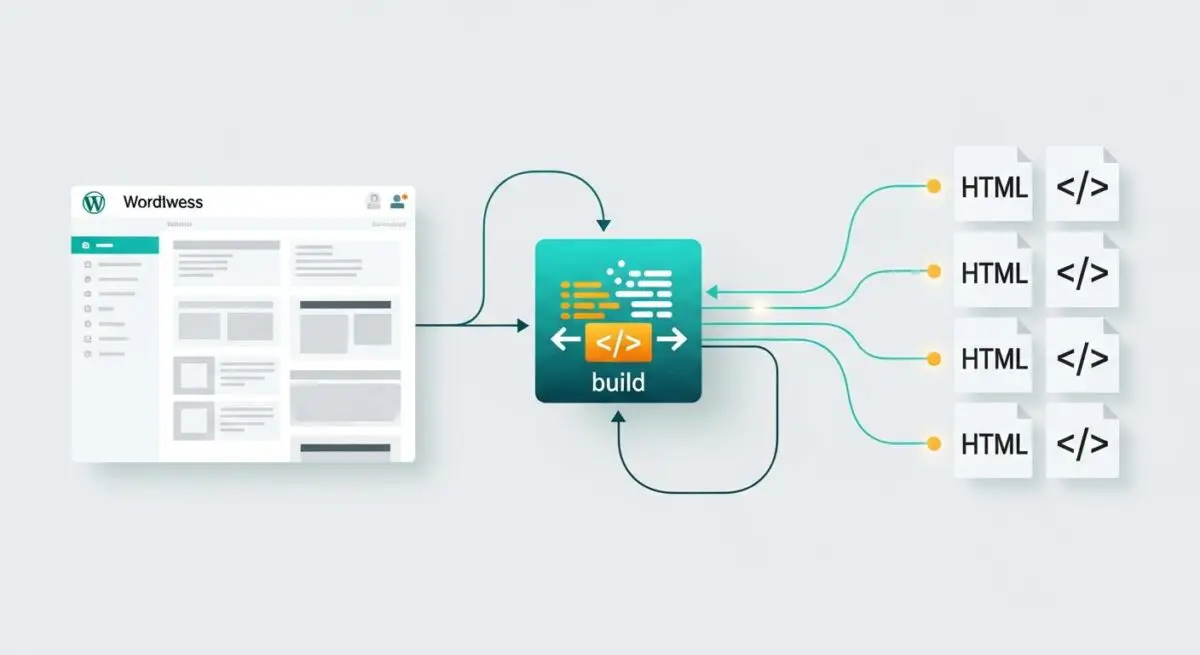
A Static Site Generator (SSG) is an architectural tool that transforms dynamic CMS content—such as WordPress posts, pages, and metadata stored in a MySQL database—into a collection of pre-rendered, flat HTML, CSS, and JavaScript files. In a traditional WordPress environment, the server must execute PHP scripts and query the database every time a user requests a page. An SSG shifts this processing upstream to the build phase, creating a finished product that requires zero server-side computation at the moment of delivery.
Within the enterprise WordPress ecosystem, SSGs are often used in Headless or Decoupled configurations. Developers use WordPress as the content management interface (the back-end) while the SSG (such as Gatsby, Hugo, or specialized WordPress plugins like WP2Static) generates the public-facing front-end. This architecture effectively separates the administrative environment from the production environment, providing a layer of abstraction that enhances both performance and security.
The Real-World Analogy
Imagine a high-end restaurant. A traditional WordPress site operates like a kitchen where every single dish is cooked from scratch only after a guest places an order; the guest must wait for the chef to chop vegetables, sear the meat, and plate the meal. A Static Site Generator is like a professional catering service that prepares the entire menu in advance. When the guests arrive, the meals are already plated and ready to be served immediately. There is no waiting for the kitchen to process the order because the work was completed before the doors even opened.
How Static Site Generator Impacts Server Performance & Speed Engineering?
The implementation of an SSG fundamentally alters the request-response cycle. By serving pre-rendered files, the server avoids the WordPress Bootstrap process, which typically involves loading the core files, active plugins, and theme files into memory. This results in a near-instantaneous Time to First Byte (TTFB), as the web server (Nginx or Apache) or a CDN edge node simply delivers a file from the disk or cache without any computational overhead.
Furthermore, SSGs optimize speed engineering by facilitating the deployment of assets to the Edge. Since the site consists of static files, it can be hosted entirely on a global Content Delivery Network (CDN). This minimizes physical latency by serving the site from the server geographically closest to the user. Additionally, because there is no active database or PHP engine on the public server, the attack surface for SQL injections and Cross-Site Scripting (XSS) is virtually eliminated, reducing the resource drain often caused by security firewalls and bot mitigation scripts.
Best Practices & Implementation
- Automate Deployment via Webhooks: Configure your WordPress environment to trigger a build process automatically whenever a post is published or updated, ensuring the static version remains synchronized with the CMS.
- Leverage Incremental Builds: For large-scale enterprise sites, utilize SSG frameworks that support incremental builds to avoid re-rendering the entire site for a single minor update, thereby reducing CI/CD resource consumption.
- Offload Dynamic Functionality: Replace native WordPress dynamic features (like search and comments) with API-driven services or serverless functions to maintain interactivity without sacrificing the static nature of the site.
- Optimize Image Processing: Integrate image optimization libraries within the build pipeline to generate WebP versions and responsive image sets automatically during the static generation phase.
Common Mistakes to Avoid
One frequent error is failing to account for dynamic content dependencies, such as contact forms or e-commerce carts, which stop functioning once the PHP environment is removed; these must be replaced with JavaScript-based API calls. Another mistake is neglecting the Build Time bottleneck; as a site grows to thousands of pages, the time required to generate the static files can become prohibitive if the architecture is not optimized for incremental updates. Finally, many brands fail to secure the source WordPress installation, leaving the administrative backend exposed even though the public site is static.
Conclusion
Static Site Generators represent the pinnacle of WordPress performance engineering by eliminating runtime processing and database dependency. For enterprise deployments, this architecture provides unparalleled speed, security, and scalability across global hosting infrastructures.