



Executive Summary
- Social monitoring facilitates real-time data ingestion via platform APIs to identify and respond to micro-level brand interactions and high-intent customer signals.
- Integration with Customer Relationship Management (CRM) and Customer Data Platforms (CDP) allows for the attribution of social touchpoints to specific conversion paths and Lifetime Value (LTV) calculations.
- Effective implementation requires sophisticated Boolean logic, Natural Language Processing (NLP) for sentiment classification, and automated webhook triggers to minimize response latency.
What is Social Monitoring?
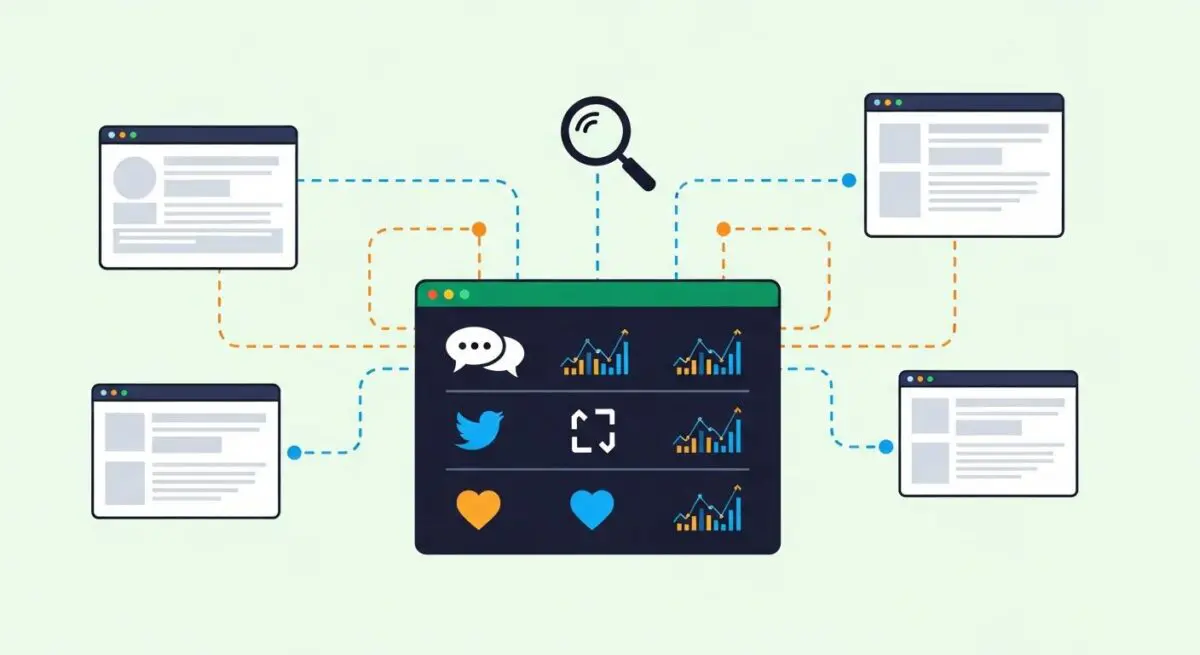
Social monitoring is the technical process of identifying, tracking, and responding to specific brand mentions, product keywords, and industry-relevant conversations across the digital ecosystem. Unlike social listening, which focuses on aggregate data and long-term trend analysis, social monitoring is inherently tactical and reactive. It operates at the micro-level, utilizing Application Programming Interfaces (APIs) to ingest real-time data streams from platforms such as X (formerly Twitter), LinkedIn, Facebook, and Instagram. By employing sophisticated filtering mechanisms—often involving Boolean logic and Regular Expressions (Regex)—organizations can isolate high-intent signals from the noise of global social discourse.
In the context of a modern MarTech stack, social monitoring serves as a critical data ingestion layer. It bridges the gap between public social interactions and internal Customer Relationship Management (CRM) systems. When a user mentions a brand’s handle or a specific product SKU, social monitoring tools trigger webhooks that can alert customer success teams, technical support, or sales departments. This technical infrastructure ensures that the brand maintains a high degree of responsiveness, which is essential for managing brand reputation and mitigating potential PR crises before they escalate into broader sentiment shifts. Furthermore, the data collected through monitoring provides granular insights into user behavior, which can be used to refine audience segmentation and improve the accuracy of programmatic advertising targeting.
The Real-World Analogy
To understand social monitoring, consider the operations of a high-end, 24/7 concierge desk in a global luxury hotel chain. While the hotel’s market research department (Social Listening) analyzes broad travel trends and seasonal occupancy rates to plan for the next five years, the concierge desk (Social Monitoring) is focused on the immediate needs of individual guests. If a guest in the lobby mentions they are looking for a specific vintage of wine, the concierge hears it and acts immediately to provide a solution. If a guest in a room complains about the temperature, the concierge triggers a maintenance request instantly. Social monitoring is that digital concierge: it is the specialized ear that listens for specific, individual requests or complaints across a vast digital property and ensures that the right department responds in real-time to maintain the guest’s satisfaction and the brand’s integrity.
How Social Monitoring Impacts Marketing ROI & Data Attribution?
Social monitoring has a direct and measurable impact on Marketing ROI by optimizing the middle and bottom of the sales funnel. From a data attribution perspective, social monitoring allows marketers to capture “dark social” signals that are often missed by traditional analytics tools. When a customer interacts with a brand on social media before making a purchase, that interaction can be logged as a touchpoint in a multi-touch attribution model. This provides a more accurate picture of the customer journey, allowing for better allocation of marketing spend across channels. By identifying high-intent queries—such as users asking for product recommendations or comparing competitors—social monitoring enables sales teams to intervene at the precise moment of decision-making, significantly lowering the Customer Acquisition Cost (CAC).
Furthermore, social monitoring plays a vital role in churn reduction and Customer Lifetime Value (LTV) modeling. By proactively addressing customer complaints or technical issues surfaced on social media, brands can prevent negative sentiment from proliferating. This proactive engagement increases customer retention rates, which is often more cost-effective than acquiring new users. From a technical standpoint, the integration of social monitoring data into a centralized data warehouse allows for sentiment-weighted analysis. By correlating social sentiment with purchase frequency and volume, data scientists can build predictive models that identify at-risk customers or potential brand advocates, further refining the strategic deployment of marketing resources.
Strategic Implementation & Best Practices
- Implement Advanced Boolean Queries: To minimize false positives and data noise, utilize complex Boolean strings that include proximity operators, exclusions (NOT), and exact match phrases. This ensures that the monitoring tool captures only the most relevant mentions, optimizing API usage and team efficiency.
- Integrate with CRM via Webhooks: Ensure that your social monitoring platform is not a data silo. Use webhooks to push social mentions directly into your CRM (e.g., Salesforce or HubSpot). This allows for a unified view of the customer, where social interactions are visible alongside email history and purchase data.
- Deploy NLP for Automated Sentiment Tagging: Leverage Natural Language Processing (NLP) algorithms to automatically categorize mentions as positive, negative, or neutral. Advanced models can even detect sarcasm or specific intent (e.g., “complaint” vs. “inquiry”), allowing for automated prioritization and routing to the appropriate department based on Service Level Agreements (SLAs).
- Monitor Non-Tagged Mentions: A significant portion of social discourse occurs without the use of official brand handles (@mentions). Configure your monitoring tools to track plain-text brand names, common misspellings, and specific product names to capture the full scope of the conversation.
Common Pitfalls & Strategic Mistakes
One of the most frequent mistakes in enterprise social monitoring is the failure to establish clear escalation protocols. Without a defined workflow for how different types of mentions (e.g., technical bugs vs. PR crises vs. sales leads) are handled, the data collected remains unactionable, leading to missed opportunities and slow response times. Another common pitfall is the reliance on vanity metrics, such as the total number of mentions, without analyzing the qualitative sentiment or the influence of the users involved. This can lead to an inefficient allocation of resources toward low-impact interactions.
Additionally, many brands suffer from data fragmentation, where social monitoring data is kept separate from the broader marketing analytics ecosystem. This prevents the brand from understanding the cross-channel impact of social interactions. In the era of AI-driven marketing, failing to feed social sentiment data into machine learning models for predictive analytics is a significant strategic oversight that limits the brand’s ability to anticipate market shifts and consumer needs.
Conclusion
Social monitoring is a foundational technical requirement for any data-driven marketing architecture, providing the real-time responsiveness and granular data necessary to optimize customer experience and maximize ROI. By integrating these micro-signals into a unified MarTech stack, brands can achieve superior attribution accuracy and sustainable programmatic growth.